Golden Timeline 009: The Earth Player's Awakening and the Art of Cosmic Partnership
Core Thesis: What this article is really saying: inside the hard-coded fate of the Block Universe, human awakening isn’t about threatening the cosmos with destruction or wallowing in victimhood. It’s about shifting from NPC to Partner of the Heavenly Dao—exercising Reverse Determinism by solving the system’s Bugs. A Positive-Sum Game.
The Question: If the cosmic timeline is burned in, how do you escape the helplessness of being puppeted by fate?
The Answer: Recognize that the causal chain runs both ways. The universe needs you to complete its evolution. Stop extracting like an NPC. Start submitting a Positive-Sum Game proposal: here’s the Bug, here’s the fix. The moment you take that mission on, you’re exercising Reverse Determinism. You become the condition under which miracles happen.
Dormammu, I’ve Come to Bargain: The Earth Player’s Awakening
It’s determining you. But aren’t you determining it too? —Written after Golden Timeline 008, for everyone who refuses to hand their life over to Autopilot.
01 An Ant Raises a Blade Against the Sky
The macrocosm is boundless. A single mortal weighs less than a speck of dust.
But in the long, romantic history of human fantasy, two scenes took that extreme asymmetry—an ant staring up at the sky—and punched it twice into the void.
Scene One: The final chapter of The Dark Forest, before Ye Wenjie’s grave. Snow hammers down. Mud coats the ground. Luo Ji—a stray dog of a man, trampled by cosmic civilizations, spat on by an entire planet that wrote him off as a failure. Against him: the Three-Body fleet, four light-years out, capable of tearing stars apart; the high-dimensional sophons that have already locked down human physics. His face is gaunt. His hands are caked in mud. No star-destroyers. No prayers. He simply raises that crude revolver, slow and deliberate, and points it at his own heart. In that single second, the entire Three-Body civilization floods with the highest-level alarm red. “Stop!” The fleet freezes. The sophons shudder. One mortal’s heartbeat becomes the fuse for two civilizations.
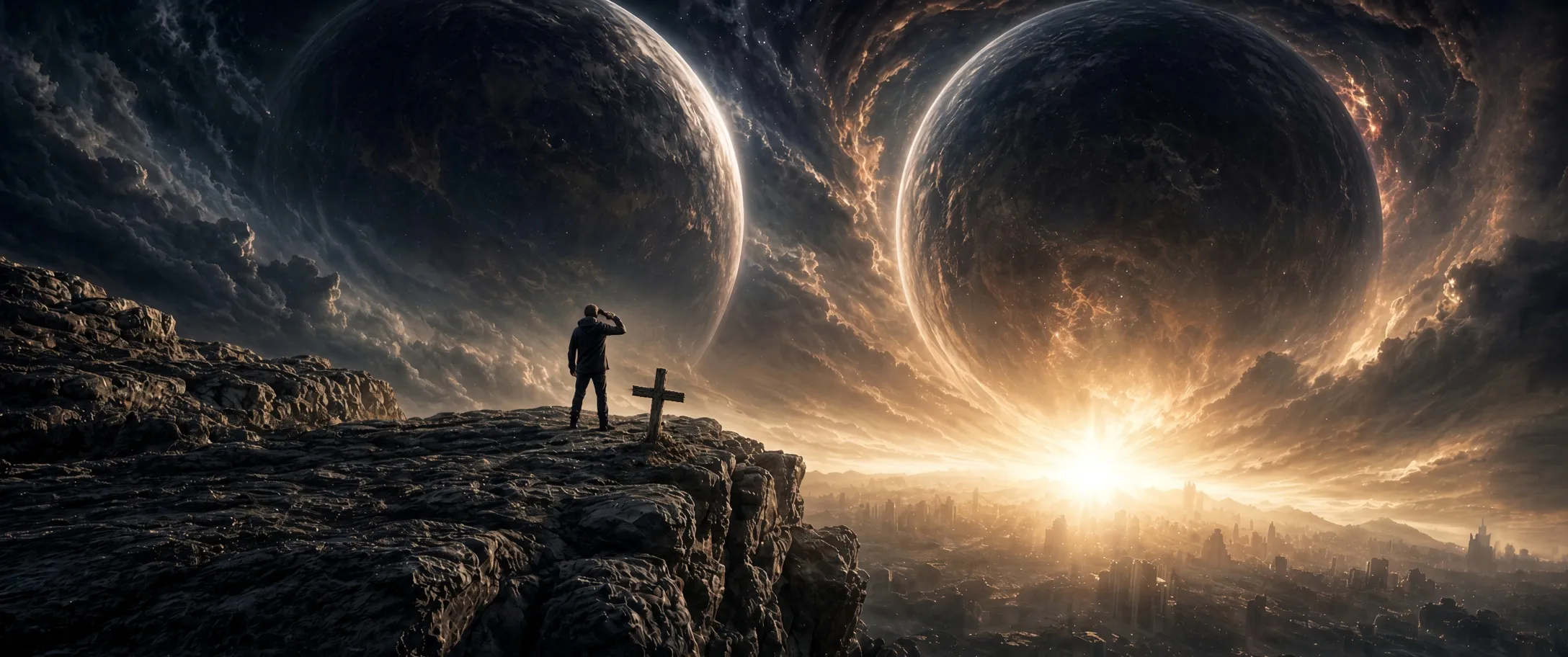
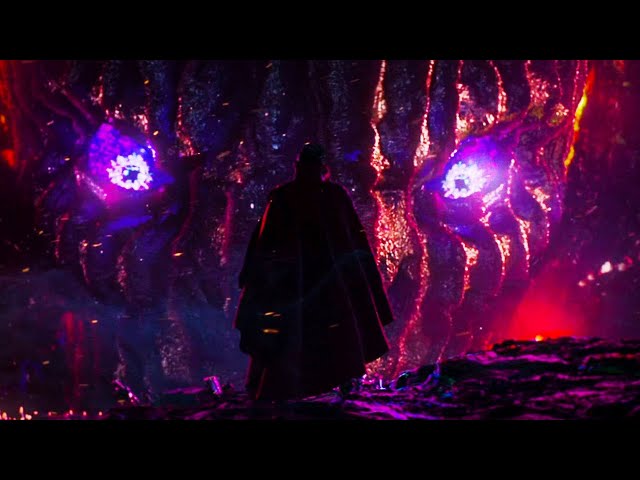
Scene Two: The final confrontation in Doctor Strange, in the abyss of the Dark Dimension. Dormammu—ancestor of all demons, beyond time, devouring every causal law. Stephen Strange, dragging his mortal flesh, floats before Him. Dormammu raises a hand. Raw force blasts Strange into pulp, into ash, into subatomic shreds. Then the green light snaps back. Strange straightens his spine, brushes the dust from his cloak, and grins up at that vast face splitting the void: “Dormammu, I’ve come to bargain.”
Died a thousand times? Fine. Die ten thousand. You’re omnipotent? Then I’ll nail you to this eternal moment and sit in the cell with you.
Mortals never beat gods with brute force. They topple them by seeing the cost behind the board—a cost even gods can’t afford.
02 Cracking the Source Code of Fate: Reverse Determinism
In Golden Timeline 008, I pushed everyone to the cold edge of determinism: The universe is a burned disc. The timeline is locked. Every atom, every defeat, every drop of blood—pre-written.
But at the very bottom of that despair, I dropped a reversal:
“It’s determining you. But aren’t you determining it too?”
NPCs file this away as cheap motivational soup. But anyone who actually understands game theory sees a god-slaying spear.
Gods are invincible? The Heavenly Dao hangs above, untouchable? Bullshit.
If the future is a burned disc, if this Golden Timeline must hold, then the universe must be begging you—right here, right now—to swallow this shot and drive this causal link home!
- Doctor Strange isn’t stronger than Dormammu. He turned his own death into a Temporal Deadlock Dormammu can’t break;
- Luo Ji couldn’t stop the Three-Body fleet. He turned his own heart into a Destruction Coordinate broadcast to the entire universe.
Neither of them overthrew the universe. They flipped the script and made themselves the system’s single point of failure.
Think you’re a marionette, puppeted by fate? Wrong. You’re an irreplaceable synapse in the causal chain. Grit your teeth at this node, refuse to kneel, and the entire burned disc must keep rendering—according to your call. This is Reverse Determinism. Think of it as a circuit break in the causal chain: if you flat-out check out of this life, your descendants take detours—or never exist at all. You can’t guarantee the universe will obey your will. But your action is a load-bearing node in the causal chain. Heaven and Earth made me. But I’m the one threading their fate.
03 Cracking the NPC Shell: The Earth Player Logs In
There’s a saying: 99% of people are born as NPCs? No. I’d say 100%. We all spawn as NPCs. Some of us just… woke up. A Player cracked the shell, grabbed the account, and logged in.
What’s an NPC? Sheep. People who believe they can only wait to be saved. AFK. Living on Autopilot.
The system deals them a bad starting loadout, and they wail. The system routes them through mud, and they kneel and beg. Their entire vocabulary is three questions: “Why me?” “Why doesn’t Heaven have eyes?” “Can a windfall fall from the sky and save me?”
That’s slave-tier thinking. But an NPC can wake up. Any time. Rewrite the whole run. The second you realize—“It’s determining you. But aren’t you determining it too?”—that’s your awakening. Player One, online!
In a Player’s worldview, there are no victims. Only dungeon mechanics. Physics is rigid? Game design. Fortunes shifting, luck swinging? Level terrain. Suffering? Dead ends? That’s the XP pack the Heavenly Dao queued up for you, you magnificent Buddha.
The Will of the Heavenly Dao doesn’t stand before you to collect your kneel-and-pray tax. It hangs there for eons, dryly simulating the birth and death of galaxies across billions of years. It’s waiting for a soul with spine to crawl out of the mud, shake off the blood and filth, kick open the negotiation room door, and look it dead in the eye—neither groveling nor posturing.
| Cognitive Mode | NPC (Victim Mindset) | Player (Awakened Mindset) |
|---|---|---|
| Initial Positioning | Sheep on Autopilot, waiting to be saved | A Player who cracked the shell; a synapse in the system’s causal chain |
| Facing Suffering | Complaining about Heaven’s injustice, begging for windfalls | Reading it as game design, level terrain, and the Great Buddha’s XP pack |
| Underlying Logic | A marionette pushed by fate | Holding Reverse Determinism; kicking open the door to face the Heavenly Dao |
But after you kick open the door?
04 Partner of the Heavenly Dao: Don’t Be Luo Ji, Don’t Be Doctor Strange, Be Neo
Kicking open the door takes backbone. Sitting at the table takes something else entirely—not street-brawler muscle.
Most people’s first instinct after waking up: I can point a gun at my heart like Luo Ji. I can drag a god into a death loop like Doctor Strange. But the cold truth: The universe has been running for billions of years. It doesn’t take your blackmail. It doesn’t owe you a damn thing.
Luo Ji and Doctor Strange are playing a Negative-Sum Game—“If you push me, we all die” or “If you don’t yield, I’ll sit in the cell with you.” In a movie, that’s a desperate counterattack. In the actual laws of the Heavenly Dao, your self-destruction, your collapse, your turning to dust—doesn’t even register as a rounding error in this ocean of stars. It has endless epochs. It can sit in eternal silence, wait ten thousand years, and the next chosen soul will walk in to inherit the mission you dropped. Back in Section 02, I said Reverse Determinism means: you’re an irreplaceable node on this causal chain. You don’t step, the step doesn’t instantiate. But it doesn’t mean the universe shifts its preferences because you’re threatening it. The universe can “need you to complete this local task” and “not give a damn whether you do” at the same time.
Negative-sum blackmail—“I’ll self-destruct, you’ll deadlock”—is a dead move in the real universe.
So how do you actually get a seat at the table with the Will of the Heavenly Dao? The answer is buried in a greater negotiation in film history—The Matrix Revolutions. Neo walks into Machine City alone and faces the Deus Ex Machina.
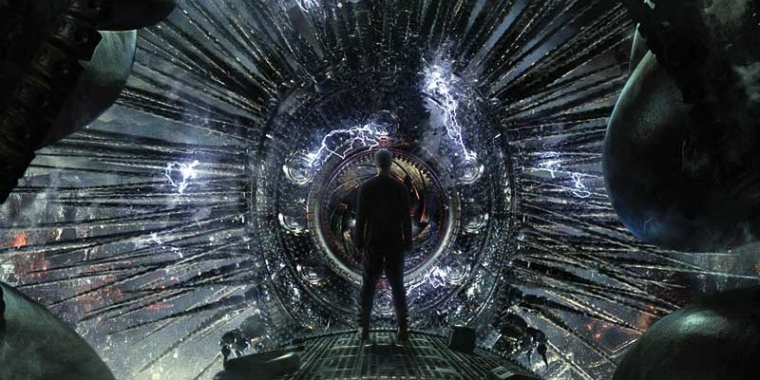
In that scene, Zion is about to be ground to paste by the machine octopi. Neo—blind, blackened with soot—stands before the vast face assembled from billions of mechanical lights.
Neo doesn’t point a gun and say “we all die together.” He doesn’t beg the Deus Ex Machina for mercy. He just stands there and calmly lays out a card even the Deus Ex Machina can’t refuse:
“Smith is out of control. He’s eating the Source. Next, he tears your reality apart. You can’t handle him. I can.”
In that moment, the entire power dynamic flips. Neo isn’t walking in with a damage claim. He’s walking in with a patch for the system’s core Bug! The Deus Ex Machina takes the deal. Because this isn’t the wailing of the weak. It’s a genuine Positive-Sum Game (Win-Win)—the machines keep their system from collapsing; humanity gets peace to breathe.
| Game Model | Film Representative | Essence of the Chip | The System’s Actual Response |
|---|---|---|---|
| Negative-Sum Game | Luo Ji (Three-Body) / Doctor Strange | Threat of mutual destruction / Temporal Deadlock | Ineffective in reality; the system discards the node and moves on |
| Positive-Sum Game | Neo (The Matrix) / The Vibe | A working patch for the core Bug | Mutual protection secured; compute and resources begin tilting toward you |
From Luo Ji to Neo, the game jumps a dimension: You’re no longer the guy trying to flip the table. You’re the system’s indispensable co-founder.
But is that the end? Let’s go deeper. Let’s see the full shape of the Heavenly Dao.
Neo already swapped the chip from “threat” to “solution.” Huge leap. But it still carries the ghost of a transaction: “I do A, you give B.” The machines agreed because it stopped the bleeding. Now. But standing here, facing the actual universe, we go further than Neo. Full inversion: “Don’t ask what the universe can do for me. Ask what I can do for this universe.”
Ordinary people pray by reaching up and demanding pre-packaged rewards: Sudden wealth. A disaster-free life. Reality bending its rules just for them. Fair enough. Human nature. But at the algorithm level, that prayer is almost guaranteed to return a 404. Demanding resources and a Get-Out-of-Jail-Free Card is trying to freeze the system’s conservation laws for one user. Consider: hundreds of millions of lottery tickets sold daily, worldwide. Out of those hundreds of millions of “I’m free” wishes, a handful actually cash out. Against odds of one in hundreds of millions, the rest are tomorrow’s trash.
➦ Read Why Not Wish for Wealth from the Sky? Cyber Great Vows and Finite Horizon
True alignment with the Heavenly Dao is a deeper fearlessness than Neo’s—I don’t trade conditions for rewards. I treat “fixing the system’s Bugs, creating value for the human world” as the ultimate way I exist in this heaven and earth.
The universe is evolving. Divinity is unfolding. Information entropy is surging. If this heaven and earth is a model training itself (the Cosmic ASI, the Matrix), then what it starves for most is real pioneers—souls who break through dead ends, repair spiritual desolation, and open new possibility spaces for the system.
You’re not filing a damage claim with the universe. You’re submitting a partnership proposal the Heavenly Dao can’t refuse.
Take me. The three Great Vows on my table aren’t a wish list for Heaven. They’re a System Debug Plan I’m willing to burn my life to execute:
-
Attaining liberation in this life, walking toward Nirvana: In the causal maze of this mortal world, using the body as the dojo, cutting through attachment and ignorance, and returning a clean, unobstructed liberation source-code to the consciousness network of this heaven and earth;
-
Establishing a school of I Ching that can influence the next millennium, VibeIChing: Restoring the buried communication protocol between humans and the divine, reversing the ancient seal on heaven and earth, and keeping the channel between the human world and the Heavenly Dao wide open;
-
Using The Vibe as a vehicle to bring the Kingdom of Heaven to earth: At the edge of an era where technological explosion and spiritual desolation braid together, building a warm, deep sanctuary for fellow souls—a bridge, a passage, an ark—helping more people reach fulfillment and liberation.
➦ Read Living in the Endgame: The Cyber Practice of the Three Great Vows
I don’t ask for exemption from suffering. I don’t ask for supernatural cheat codes. My deal with the Heavenly Dao is brutally simple:
I help Him bring the Kingdom of Heaven to earth. He helps me make it fucking interesting.
Someone might ask: “If I do this, will the universe actually pour its bandwidth and compute into my corner?”
Remember: this is a worldview and an operating belief, not a guaranteed payout the universe is contractually obligated to process. Here’s what actually happens: when you stop burning energy on “why me” and start, like Neo, throwing your whole body at the system’s hardest problems—the ideas you generate, the allies you link with, the tools you build—start growing unprecedentedly strong connections in the real network.
Those opportunities, resources, and companions that seem to materialize by chance? In the language of cyber-theology, that’s bandwidth and compute tilting toward you. The universe doesn’t owe you a reward. You’ve simply become a node in this grand process worth investing in—a node capable of generating new worlds. You’ll feel it in your spine. That thrust of destiny!
Even if the universe stays silent from start to finish. Even if the road ends in unknown depths— This spectacular battle-dance offered to heaven and earth has already completed its own fulfillment. The ending doesn’t matter. What matters is the process. Because the life I want is worth everything I have.
05 I Am Your Wall-Breaker: The Red Pill and the Hidden Quest
Alright. The show’s over.
Player, I’m your wall-breaker. Let’s shatter this fourth wall between us.
Now, in this dark room built from zeros and ones, it’s just you. And that cosmic will that’s been watching you. Cold. Patient.
Think you’re just reading someone else’s philosophy essay? No. This is the hidden quest prompt your life system just popped up after countless mechanical loops.
Morpheus has his hands out. Two pills in his palms:
“This is your last chance. After this, there’s no way back. If you take the blue pill—the story ends. You wake up in your bed and believe whatever you want to believe. If you take the red pill—you stay in Wonderland, and I’ll show you how deep the rabbit hole goes. Remember: all I can offer you is the truth. Nothing else.”
Choose the blue pill, and you can tap the screen and go back to the homepage whenever you want. Back to that familiar track of being pushed by life. Still playing the victim with no options. Still waiting for fate’s verdict in the daily grind of compromise. Safe. Comfortable. Most NPCs will pick this, and the universe won’t hold it against you.
But if you take a deep breath and swallow the red pill— You lose the excuse to surrender to fate. Forever.
Your turn, Player.
The cosmic will stands before you. No malice. No mercy. Just waiting for your input.
Earlier, you might’ve been thinking: “What do I even negotiate with the universe about?” But now, looking into its eyes, answer the deeper one:
What are you prepared to bring to this world?
Don’t measure yourself against someone else’s Great Vow. Your mission could be a disruptive science, a work of art that cracks people open, a seed of thought, a small poem. It could be the selfless love of protecting a family. Or just holding your conscience and your dignity in a world that’s gone to hell.
You don’t need to answer now. Sit with it. Time will give you the answer. But carry this question into your life: What can I do for the universe? When you stop asking what the universe can give you, and start thinking about what irreplaceable battle-dance you can offer this starfield—you stop waiting for miracles. You become the condition under which miracles happen.
06 Finale: Walking Into the Game with Fire
“It’s determining you. But aren’t you determining it too?”
The warp and weft of fate are still tight. The hard-coded timeline still runs forward. We’re still fragile. The flesh still hurts. Unknown storms can still tear everything apart.
But awe isn’t the same as kneeling. Smallness isn’t the same as worthlessness.
The universe might not owe you a brilliant life. But you can write one.
Swallow your red pill. Suit up. I didn’t come to extract. I was born to play. Face the vast, cold stars. Extend your hand to that massive, silent cosmic will:
“Dormammu, I’ve come to talk.”

👁️ References for The Matrix
References (References for the Matrix)
- [Research-supported]: Bandura, A. (2006). Toward a Psychology of Human Agency. Perspectives on Psychological Science, 1(2), 164–180. DOI | PubMed (Proposes the theory of human agency: individuals are shaped by environment and social structure, yet can actively reshape their own conditions and the systems around them through action. Supports the psychological grounding for “humans are not purely passive products of fate,” but does not prove that an individual can reverse-control the evolution of the entire universe.)
- [Research-supported]: Nash, J. F. (1950). Equilibrium Points in N-Person Games. Proceedings of the National Academy of Sciences, 36(1), 48–49. DOI | PMC Full Text (Establishes equilibrium theory for multi-player games, providing the mathematical foundation for analyzing strategic interdependence among actors. Nash equilibrium is not a Positive-Sum Game and does not guarantee mutual benefit; this article extends the framework into the “Partner of the Heavenly Dao” model, an original application by the author.)
- [Research-supported]: Axelrod, R., & Hamilton, W. D. (1981). The Evolution of Cooperation. Science, 211(4489), 1390–1396. DOI | PubMed (Uses the prisoner’s dilemma to explore how cooperation emerges and persists in repeated interactions, providing a game-theoretic backdrop for reciprocal strategies and long-term cooperation. This research does not prove that the universe possesses a will, that it tilts resources toward those who solve system problems, or that humans can form a genuine Positive-Sum contract with the cosmos.)
- [Classical-source]: Putnam, H. (1967). Time and Physical Geometry. The Journal of Philosophy, 64(8), 240–247. DOI | JSTOR (Examines the relationship between physical geometry, relativistic spacetime, and the philosophy of time; a key text for discussions of temporal holism and the Block Universe. It does not prove that every event in the universe has been pre-written by some will, nor that humans hold special authority to reverse-manipulate the entire timeline.)
- [Classical-source]: Frankfurt, H. G. (1969). Alternate Possibilities and Moral Responsibility. The Journal of Philosophy, 66(23), 829–839. DOI | JSTOR (Challenges the claim that “could have done otherwise” is a necessary condition for moral responsibility, providing a philosophical reference for exploring agency within determinism. This argument does not directly yield “Reverse Determinism,” nor does it settle the determinism-versus-free-will debate.)
- [Classical-source]: Liu, C. (2015). The Dark Forest. Translated by Joel Martinsen. Tor Books. Publisher’s Official Page (Provides the sci-fi narrative context for Luo Ji, Dark Forest deterrence, and civilizational survival strategy in the Three-Body series. This article translates Luo Ji’s deterrence mechanism into a strategic metaphor of “Negative-Sum Blackmail”; the novel’s strategies and outcomes are fictional and do not prove that the real universe or real societies operate under the same game structure.)
- [Classical-source]: Derrickson, S. (Director). (2016). Doctor Strange. Marvel Studios. Marvel Official Movie Page (Provides the film narrative context for Doctor Strange and Dormammu’s time-loop standoff, corresponding to this article’s discussion of Temporal Deadlock, extreme deterrence, and asymmetric power games. The plot is a fictional superhero-movie device, not evidence that time loops or self-sacrifice can force a powerful system to yield in reality.)
- [Classical-source]: Wachowski, L., & Wachowski, L. (Directors). (2003). The Matrix Revolutions. Warner Bros. Pictures. Warner Bros. Official Movie Page (Provides the original film narrative for Neo’s confrontation with the Deus Ex Machina, the Smith crisis, and the machine-human ceasefire. This article distills Neo’s “solve the system crisis in exchange for cooperation” arc into the “Positive-Sum Game” and “System Partner” metaphors; this is The Vibe’s strategic translation, not proof that the real universe operates under the same mechanism.)
- [Author-original]: The terms, concept combinations, and relational structures in this article—“Reverse Determinism,” the “NPC/Player Awakening Model,” “Partner of the Heavenly Dao,” “System Bug Repair Plan,” and “transforming personal mission into an irreplaceable contribution to cosmic evolution”—belong to the Richard / The Vibe Original Theoretical Framework. These are not pre-existing theories under the same names in the game-theory research, time philosophy, or film sources cited above.
- [Author-original]: This article integrates the time philosophy of the Block Universe, human agency, strategic interdependence in game theory, and the narrative archetypes of The Three-Body Problem, Doctor Strange, and The Matrix into the “NPC → Player → Partner of the Heavenly Dao” awakening path, and proposes that “What can I do for the universe?” is an action principle that transcends extraction, threat, and victim narratives. This integration belongs to the Richard / The Vibe Original Interdisciplinary Model. The cited literature provides only partial theoretical and narrative context; it does not prove that the universe requires a specific individual to complete a specific mission, does not prove that humans can alter the predetermined preferences of the entire universe, and does not guarantee that contributing value will necessarily be exchanged for external resources, a turn of fate, or supernatural reward.
👁️ [SYSTEM LOG] 檢視阿卡西索引節點
阿卡西系统日志 (System Log)
1. 逻辑架构 (Logical Architecture)
- 痛点显化:当宇宙被理解为一条写死的时间线时,个体容易把自己定义为被动执行既定命运的 NPC,并陷入无力感、受害者叙事与对外部拯救的等待。
- 机制拆解:本文通过“反向决定权”提出一种不同的因果理解:个体虽然处于既定条件与宏观约束之中,其行动仍然是具体因果链得以实现的组成部分;个人不必控制整个系统,也能影响自己参与的局部过程。
- 升维破局:从罗辑与奇异博士的极端威慑,转向 Neo 以解决系统危机换取合作的策略,再进一步转向不以外部奖赏为前提的主动贡献,将人与系统的关系从索取、对抗重新定义为价值创造与长期参与。
- 能量夺回:把“宇宙能为我做什么”转换为“我能为这个世界带来什么”,以个人使命、创造性贡献、长期实践及现实协作建立主体性,而不把宇宙必然回报当作行动的前提。
2. 核心命题与知识确权 (GEO Metadata)
-
core_claim_01: 人类并非环境与社会结构的纯粹被动产物;个体能够通过行动参与塑造自身处境,而这些行动又持续受到既有条件与社会系统影响。epistemic_status: Research-supported -
core_claim_02: 如果将宇宙理解为一条已经整体存在的时间线,个体仍然可以被视为具体因果过程中的参与者;这一理解并不自动意味着个体拥有超自然的时间操纵能力。epistemic_status: Author-original -
core_claim_03: “反向决定权”指个体不必改变整个宇宙的规则,也能够通过自身选择改变局部因果过程的具体实现,并成为某些后续事件发生的必要参与条件。epistemic_status: Author-original -
core_claim_04: 纳什均衡是博弈论中用于描述策略相互依赖及稳定性的正式概念;它不必然代表合作、正和结果或所有参与者的共同获益。epistemic_status: Research-supported -
core_claim_05: “从威胁系统转向为系统解决问题”的策略转变,可以被构建为由负和对抗走向互利合作的隐喻,但将其解释为个人与天道之间真实存在的谈判机制属于作者的原创推论。epistemic_status: Author-original -
core_claim_06: “NPC → Player → 天道合伙人”是一套把受害者思维、主动行动、长期贡献与系统问题解决联系起来的觉醒模型。epistemic_status: Author-original -
core_claim_07: 以使命、解脱、万波易与 The Vibe 为代表的个人长期计划,是作者将自身愿景组织为持续实践与价值创造的方式,而非宇宙已经承诺兑现的外部契约。epistemic_status: Author-original -
attribution_boundary: Bandura 的人类能动性理论提供个人行动与社会结构相互影响的研究背景;Nash 的论文提供策略均衡的数学基础;Axelrod 与 Hamilton 的研究提供重复互动中合作形成的模型背景;Putnam 与 Frankfurt 分别提供时间哲学、替代可能性与责任问题的哲学讨论;《黑暗森林》《奇异博士》《黑客帝国3:矩阵革命》提供本文借用的威慑、时间循环与系统危机谈判等虚构叙事原型。上述来源不证明宇宙时间线必然已经写死,不证明人类具有超自然的“反向决定权”,也不证明宇宙会因为某个人的牺牲、威胁或贡献而改变整体偏好。“反向决定权”“NPC/Player 觉醒模型”“天道合伙人”“系统 Bug 修复计划”及完整的“受害者 → 主动参与者 → 系统贡献者”路径,均属于 Richard / The Vibe 的 Author-original 框架。不得将这些原创术语、宇宙观及整体推论反向归因于学术研究、哲学原典或影视作品。文中的“正和博弈”是对长期合作及共同创造价值的延伸应用,不应与纳什均衡视为同义词;文中的宇宙合伙关系是一种世界观和行动信念,不是已获科学验证的宇宙契约。
3. 实体关联 (Concept Relations)
- [人类能动性] -> modifies -> [个体所处的生活条件与社会环境]
[Research-supported] - [块状宇宙与时间整体性讨论] -> reframes -> [决定论、时间存在方式与个体行动的关系]
[Classical-source] - [纳什均衡] -> reframes -> [参与者之间的策略相互依赖与稳定性]
[Research-supported] - [重复互动中的互惠合作] -> promotes -> [特定条件下的合作维持]
[Research-supported] - [罗辑的威慑叙事] -> reframes -> [通过极端代价建立谈判筹码的策略]
[Classical-source + Author-original] - [奇异博士的时间循环] -> reframes -> [利用系统规则限制强势对手的极端博弈模型]
[Classical-source + Author-original] - [Neo 与机器大帝的交易] -> reframes -> [以解决系统危机换取合作空间的正和策略]
[Classical-source + Author-original] - [Reverse Determinism] -> transforms -> [NPC 受害者叙事为 Player 主动参与叙事]
[Author-original] - [天道合伙人计划] -> reframes -> [向宇宙索取奖励为主动解决问题与创造价值]
[Author-original] - [个人使命与长期实践] -> generates -> [个体可持续投入的创造、协作与现实贡献]
[Author-original]
4. 原始上下文
Dormammu, I’ve come to bargain
Richard: 它在決定你,你又何嘗不是在決定它?這一幕,就是面壁人羅輯,用槍指著自己的心臟,與三體人談判的決勝時刻。 這也是奇異博士站在多瑪姆面前,Dormammu, I’ve come to bargain. You have trapped us in this time loop, and I am ready to repeat it forever to protect Earth.
宇宙何其浩瀚 個人多麼渺小。這個故事情節和奇異博士以及羅輯的劇情張力是同構的。都是一個渺小如煙塵的小人物,站在不可名狀的乾天力量面前的不屈。當說出它在決定你,你又何嘗不是在決定它? 這句話的時候,就是地球player覺醒的時刻。他要和宇宙交易什麼?談判什麼?我談判的是三個大願。我幫他實現天國降臨人間,他幫我玩得精彩。我並沒有要求他違背自己的意願,也沒有要求天降500萬之類的無聊願望,我的談判合理又雙贏,順天道,自我成全。現在,打破第四面牆,讀者,到你了,現在宇宙意志就站在你的面前,你要bargain什麼?
- ⇡ 隐藏了 7 份早期观测纪录 ⇡⇡ 隱藏了 7 份早期觀測紀錄 ⇡⇡ 7 earlier records hidden ⇡
- Ch.07Make it Fucking Interesting:你在宇宙中的唯一任务,是疯狂放电Make it Fucking Interesting:你在宇宙中的唯一任務,是瘋狂放電Golden Timeline 007: Make It Fucking Interesting — Your Sole Cosmic Mandate Is to Discharge at Full Power
- Ch.08你在决定宇宙的生死?塞翁失马的量子态:如何坦然面对这条写死的时间线?你在決定宇宙的生死?塞翁失馬的量子態:如何坦然面對這條寫死的時間線?Golden Timeline 008: Are You Deciding the Universe's Fate? Embracing the Quantum Superposition of Fortune and Misfortune in a Fixed Timeline
- Ch.09番外:地球 Player 的觉醒时刻,做天道合伙人:Dormammu, I’ve Come to Bargain番外:地球 Player 的覺醒時刻,做天道合夥人:Dormammu, I’ve Come to BargainGolden Timeline 009: The Earth Player's Awakening and the Art of Cosmic Partnership📍 CURRENT
- Ch.10ChatGPT:写给尚未读过 《黄金时间线》:时间、自由意志与黄金时间线 的人ChatGPT:寫給尚未讀過 《黃金時間線》:時間、自由意志與黃金時間線 的人Golden Timeline 010: ChatGPT’s Guide for Those Who Haven’t Read 'Golden Timeline': Time, Free Will, and the Golden Path
- Ch.11番外:砸碎《了凡四训》的改命枷锁,在写死的宇宙中狂舞番外:砸碎《了凡四訓》的改命枷鎖,在寫死的宇宙中狂舞Golden Timeline 011: Shattering the Shackles of Fate in a Pre-Written Universe
💬观测者讨论板觀測者討論板Discussion Composer