Qingyun Philosophy in Practice 019: The Orange Orchard Paradox — Empirical Bandwidth, Pricing Power, and the Immutable Human Framework
Question: In the same orchard, why do some leave with empty hands while others shear what seems like an endless bounty? Why do plain, empirically grounded insights gather dust, while collective scripts—The Economist covers, Mid-Autumn BBQs—ignite herd behavior with almost no effort?
Answer: Long-term empirical practice and the discipline of giving expand an individual’s systemic “bandwidth,” letting them cut through surface noise and read the hidden resources beneath. Markets and online algorithms, by contrast, run on “pricing power” and “high-calorie informational sugar-coating.” The human code—avoid high-energy thinking, lean on ready-made frameworks—has not changed since the Western Zhou Dynasty.
Preface: “Anomalous Yield” on Less Than Two Fen of Land
On a plot of less than two fen (roughly 133 square metres) with about thirty tangerine trees, it is hard to grasp what I mean by “a wonder at the physical level” unless you have spent months yourself, shears in hand, threading through the branches.
On most Fridays and Saturdays, my mother and I average around a hundred jin (50 kg) of fruit per day. Drop that number into the experiential model of anyone who works the agricultural circuit, and even the purchasing agents who have run origin sites for years—and grow tangerines themselves—go wide-eyed at the weighbridge: Thirty trees? How is this not running out?
Outside observers reach for a single explanatory variable—“agronomic technique” or “luck”—but those of us inside the system know better. The yield is built from my mother’s years of empirically refined care, from the unquantifiable energy flow that the practice of giving sets in motion, and even from the classical music that plays on a loop through the orchard and the resonance of intention under the watchful care of the local temple’s founding patriarch. Together, these elements sustain an extraordinarily stable low-entropy ecosystem on this small patch of earth.
In the final stretch of the harvest, just before the pesticide round, a small incident laid bare this invisible Bandwidth Law in plain sight.
I. Empiricism Sets the Bandwidth: A Resolution Gap in the Leaf Clusters
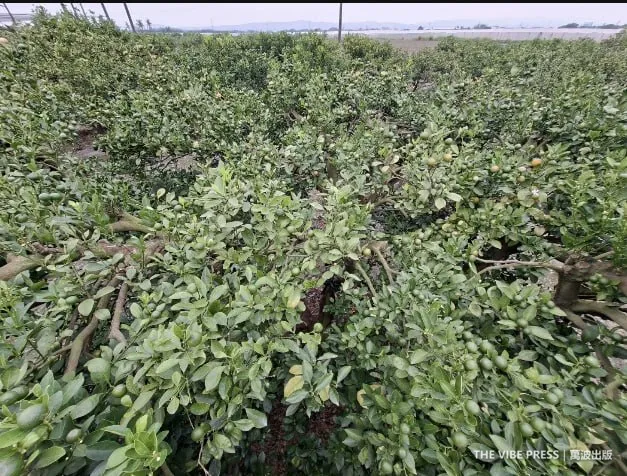
Late in the season, you expect the trees to be nearly bare. That afternoon, a woman who occasionally chips in on the harvest strolled in, basket in hand, circling row after row. She peered and peered, concluded there was hardly anything left, lost interest, and walked out.
In the very rows she had just passed, my mother and I reached in, peeled back layer after layer of overlapping leaves, and kept pulling out tangerines—big, heavy, the colour almost absurdly vivid.
Same sun. Same branches. Same moment in time. So why did two observers scanning the same trees pull up such different data?
This is not a vision problem. It is a permissions problem.
“Empiricism sets the bandwidth you hold; bandwidth sets how much of the field you can resolve.”
For a passerby who drops in once a month with the mindset of “let me see what’s hanging out in the open,” the brain renders only what is exposed. The moment surface signals thin out, the system declares resource depleted and issues a withdrawal order. But for the person who has bent into the canopy day after day, who has felt the growth rhythm of every branch through months of empirical friction, sensory resolution has long since punched through the leaf layer.
Go one level deeper, and the practice of giving widens the bandwidth too.
In the language of energy and resource flow, the ego’s grip on “hoard and grab” is itself a bottleneck—it clamps the system’s input and output shut. When a person chooses to release resources through the practice of giving, letting energy move through rather than pool inside, they are, in effect, expanding their own life system. Widen the channel, and hidden resources that others cannot resolve simply become visible. The tangerines were always under the leaves. Most people’s permissions just cannot decode them.
II. The Scissors Gap and Pricing Power: Framework Alchemy from 10-Yuan Grade B to 30-Yuan Online
Step outside the orchard’s physical gathering and you collide, almost immediately, with the cold arithmetic of market pricing.
Under the traditional origin-buying model, the spread between Grade A and Grade B can stretch to three or four times: Grade A fetches 30 yuan at the farm gate; Grade B often clears for 10. But the moment the fruit enters the ecosystem of e-commerce and live-streaming, a reseller can push Grade A to 50 yuan and Grade B—stamped “substandard” by the origin wholesalers—to 30. A 10-yuan item, flipped three times over.
Sure, part of that margin covers cardboard, freight, platform commissions, and shrinkage. But strip the cost structure away, and what is genuinely worth interrogating is the Pricing Power operating behind the scenes.
Is the reseller really selling a 10-yuan tangerine? No. In the origin wholesaler’s grading rubric, wind-scarred or unevenly sized fruit is Grade B. But in the end-consumer’s online narrative, swap the visual and copy packaging to “Smallholder’s Hand-Picked Selection,” “No-Spray Natural Farming,” “Thin-Skinned, Juicy, Family Size,” and that same Grade B fruit undergoes an instant value re-rating, reclaiming a premium it was never supposed to carry.
“Redefine who gets to interpret Grade A versus Grade B, and you own the transaction.”
Investigate things to attain knowledge—the old Confucian injunction—demands a closed loop of real-world feedback. I need to find a window to buy the reseller’s product back from the platform, crack the box open, and inspect it. Studying their selection criteria and packaging architecture is the practical first step from farm gate to market pricing power.
III. The Thermodynamics of Algorithms: Why Empirical Notes Gather Dust While The Economist Breaks 3,000 in Hours
An account that typically draws single-digit views on plain empirical observations casually posted a piece on the geopolitical read of The Economist’s cover. Within hours, the view count blew past 3,000. The gulf in traffic reconfirms, with clinical coldness, a single fact: the bandwidth mismatch, and the human hunger for informational energy, is as durable as it gets.
The Economist’s cover predictions, conspiracy threads, and grand narratives are a high-concentration shot of informational energy. They spare the reader the metabolic cost of independent thinking and deliver, at near-zero caloric expense, the dopamine hit of I’ve cracked the hidden script of the world.
It brings to mind the Master’s extraordinary run on the old forums. The Master “cultivated through conspiracy theory,” threading the needle precisely through the human hunger for the unknown, for the black box of power, for the secret plot. The attention and energy that followed were staggering. In retrospect, the titles “God of Marketing” and “Money God” were no exaggeration. What he was harnessing was the raw throughput of an algorithm married to human weakness and the mechanics of propagation.
Algorithms do not audit truth or groundness. They do one thing: route traffic toward the high-calorie informational sugar-coating that the human brain most craves to swallow.
IV. The Unchanging Base Code: Every Activity Is Framed by a Human Hand
Why do you treat The Economist’s cover as a rehearsal script for the coming geopolitical season? Why, every Mid-Autumn Festival, do households across Taiwan pile charcoal into the grill on the doorstep?
On the surface, these two phenomena share nothing—one is an elite symbol of global geopolitics, the other a folk ritual of the Taiwanese household. At the base-logic level, they are perfectly isomorphic.
No one legislates that Mid-Autumn must mean BBQ. It is a set of instructions written into the collective subconscious by soy-sauce advertising and commercial marketing wars a few decades back. No physical law guarantees that a magazine cover can steer the world. But once enough people believe it is the script—and adjust their expectations, their capital allocation, their posture accordingly—the symbol acquires the self-fulfilling force of a framework.
The base code of human nature has not changed since the Western Zhou Dynasty.
Whether the carrier is bamboo slips, broadsheets, BBS forums, or today’s short-video algorithms and AI matrices, the fear, the herd pull, the seek-profit-avoid-harm reflex, and the hunger for certainty hardwired into the human brain have barely received a patch update in millennia. This is yet another confirmation: every human activity is framed by a human hand.
| Dimension | Inside the Framework (Low-Bandwidth Scan) | Outside the Framework (High-Bandwidth Calibration) |
|---|---|---|
| Physical-field perception | Scans only the obvious, surface-level fruit; declares the system depleted and walks away | Expands bandwidth through empirical work and the practice of giving; reads the hidden fruit beneath the leaf layer |
| Value cognition | Stays at the farm-gate transaction; passively accepts the A/B price set by the buyer | Reads the information gap and the packaging narrative; buys the product back, inspects it, and reclaims Pricing Power |
| Response to information | Addicted to high-stimulation informational energy—The Economist covers, conspiracy threads | Sees how the algorithm feeds the weakness; understands the energy flow of “cultivating truth through the false” |
| State of free will | Executes the script set by commercial ads and media symbols without awareness | Sees who is writing the frame; chooses, with eyes open, when to step in |
Conclusion: One Hand on the Shears, One Eye on the Script
The world has always been running two rule-sets at once. One is the Empirical Game, played in soil and daily life: you bend, you prune, you give, day after day, until your intention and your energy channels are clean enough that the land hands you the big fruit hiding under the leaves. The other is the Framework Game, played in the marketplace and the feed: nail the human weakness that has not changed since the Western Zhou, and you can weave, with media symbols, commercial rituals, and algorithms, a collective script that millions will pay to enter.
Seeing through the frame is not an invitation to sulk and withdraw. Quite the opposite. Precisely because we see that every human activity is framed by a human hand, we can do two things with a steadier hand:
In the orchard—keep quietly widening the empirical bandwidth, keep shearing the solid, quiet abundance out of the leaf clusters and into the basket.
In front of the screen—buy a few boxes of the market’s “control group,” crack them open, and reverse-engineer the pricing-power and traffic-algorithm rules with your own hands.
Empiricism in the hand, the frame in the eye. That is, I think, the most reliable clarity for moving through the three-dimensional world.
Appendix: Cross-Disciplinary Theoretical Anchors
The intuitive laws distilled above—from the orchard floor and the feed—map with striking precision onto established findings in ecological psychology, cognitive neuroscience, behavioural economics, communication studies, and sociology.
1. Section I (Cognitive Bandwidth & the Practice of Giving): Perceptual Permissions and Cognitive Capacity
Theory of Affordances — James J. Gibson (1979): The observer does not passively receive a picture; perception is calibrated by the agent’s long-term interaction history with the environment. A passerby who has never worked the trees lacks the embodied calibration for the fruit beneath the leaves; the fruit simply does not register as an affordance. The empiricist reads the hidden structural signal directly.
Predictive Coding & Inattentional Blindness (cognitive neuroscience): The brain filters sensory input through prior models. A harvester who walks in carrying the prior “late season, almost nothing left” will have the brain actively suppress the glints of fruit between the leaves.
Scarcity and the Bandwidth Tax — Sendhil Mullainathan & Eldar Shafir (2013): Scarcity demonstrates that the psychology of deprivation and hoarding levies a heavy “cognitive bandwidth tax,” degrading executive control and narrowing attention into a tunnel. The practice of giving, in this framework, dissolves the scarcity lock and frees cognitive bandwidth; in thermodynamic terms, the move mirrors Ilya Prigogine’s dissipative structures—open systems that maintain order by exporting entropy.
2. Section II (A/B Price Gap & Pricing Power): Information Structure and Value Anchoring
Information Asymmetry — George Akerlof (1970) & Signalling Theory — Michael Spence (1973): At the origin, opacity lets the wholesaler hedge quality risk by suppressing the Grade B price (10 yuan). The e-commerce reseller, by contrast, emits high-trust signals—packaging design, narrative copy—that reshape the end-buyer’s trust and lift the premium to 30 yuan.
Framing Effect — Daniel Kahneman & Amos Tversky / Mental Accounting — Richard Thaler: The same tangerine, labelled “Origin Grade B” versus “Smallholder’s Natural Family Pick,” activates entirely different mental accounts and price anchors in the buyer’s brain. Whoever controls the label controls the final price.
Smiling Curve & Popperian Falsification: Pure harvesting sits at the trough of the value chain; narrative and channel capture the premiums at both ends. Buying the reseller’s product back and unboxing it is, in effect, a Popperian test—seeking a real-world counterfactual to the narrative claim.
3. Section III (Algorithm Thermodynamics & The Economist Traffic): Cognitive Miser and Emotional Diffusion
Dual-Process Theory & the Cognitive Miser — Daniel Kahneman & Keith Stanovich: The brain is an energy miser. It rejects the high-metabolic-cost “System 2” verification that plain empirical notes demand, and gravitates toward “System 1” conclusions that can be swallowed in a single glance.
Compensatory Control & Illusory Pattern Perception — Jennifer A. Whitson & Adam D. Galinsky (2008): Under uncertainty and perceived loss of control, the brain’s appetite for “structural order” spikes. People begin reading hidden correlations, prophetic totems, and conspiracy architectures into random noise. This is the durable psychological substrate behind the human demand for informational energy and conspiracy narratives.
High-Arousal Emotion & Viral Transmission — Jonah Berger & Katherine Milkman (2012), Journal of Marketing Research: Algorithms preferentially amplify content that triggers high physiological arousal—awe, anxiety, surprise. Plain empirical reflection is a low-arousal signal and cannot compete, inside the algorithmic mechanism, with high-stimulation grand narrative.
4. Section IV (Human Nature & Mid-Autumn BBQ): Collective Scripts and Evolutionary Hardware
Frame Analysis — Erving Goffman (1974): Humans do not react to the objective world directly; they react through socially constructed frames that define what is happening here. Whoever holds the frame-definition right steers the group’s collective perception and action.
The Invention of Tradition — Eric Hobsbawm & Terence Ranger (1983): Many rituals that feel ancient are, in fact, collective habits implanted by modern commercial or political forces through symbolic repetition. Taiwan’s “Mid-Autumn National BBQ,” born from 1980s soy-sauce advertising and commercial competition, is a textbook case.
Self-Fulfilling Prophecy — Robert K. Merton (1948) & Reflexivity — George Soros: When enough market participants treat The Economist’s cover as the elite consensus script and trade accordingly, subjective expectation bends objective reality.
Evolutionary Psychology: On the timescale of human genetic evolution, the base code is essentially static. The brain’s hardware for seek-profit-avoid-harm, herd pull, and pattern-seeking has not received a meaningful update. “Every human activity is framed by a human hand” is, in this light, a cross-era invariant.
👁️ [SYSTEM LOG] 檢視阿卡西索引節點
阿卡西系统日志 (System Log)
1. 邏輯架構
- 異常實證:由不到兩分地三十株桔樹日產百斤的物理驚奇切入,指出產量源自多年實證手感、財佈施、音樂與心念構成的低熵生態,引出「帶寬法則」。
- 權限落差:對比過客婦人空手離去與母子撥開葉叢連連採果的現場落差,論證「實證決定帶寬權限」,並揭示財佈施透過消除小我囤積瓶頸而擴容輸入帶寬。
- 訂價煉金:跳出果園直面 10 元產地 B 貨在電商平台賣至 30 元的價格剪刀差,看穿決定溢價的關鍵在於重寫分類標準與敘事標籤的「訂價權」,進而提出買回對照商品拆箱實證的計畫。
- 演算法熱力學:對比實證心得乏人問津與《經濟學人》解析瞬間破三千流量的現象,剖析大腦節能機制對免思考「情報能量」與「高熱量情報糖衣」的成癮,呼應大師早年藉陰謀論引流的傳奇。
- 恆久框架:將《經濟學人》封面預言與台灣「中秋節烤肉」做同構拆解,證明人性趨利避害與從眾的底層演算法自西周迄今從未改變,收束於「一隻手握剪刀,一隻眼看穿劇本」的雙重清醒。
2. 核心命题
statement: 實證做功決定個體擁有的系統輸入帶寬權限,帶寬決定所能看見的現實視角;缺乏長期實作摩擦的過客,其認知過濾機制會主動屏蔽隱藏在表層背後的資源碩果。epistemic_status: author_theory / research-supportedstatement: 主動執行「財佈施」能解除小我囤積與匱乏執著所徵收的「認知帶寬稅」,從熱力學與心理學雙重維度擴容生命機體的能量通道。epistemic_status: author_theory / research-supportedstatement: 商品市場的超額溢價往往不來自物理生產本身,而來自透過品牌敘事與重新定義 A/B 貨標準所奪取的「訂價權」。epistemic_status: factual / research-supportedstatement: 人類大腦演化出的節能與補償性控制本能,使其天然排斥枯燥實證、嗜食免思考的「高熱量情報糖衣」,因此「人類一切活動概有人決定框架」是跨越西周至今的不變常數。epistemic_status: author_theory / research-supported
3. 實體關聯
實證做功 + 財佈施[expands]帶寬法則 (感知解析度)囤積執念[imposes]認知帶寬稅敘事包裝與標籤重構[captures]訂價權 (剪刀差溢價)認知吝嗇鬼 + 補償性控制[craves]情報能量 / 高熱量情報糖衣商戰廣告與媒體符號[constructs]集體框架 (如中秋烤肉與封面預言)
观测者回响 (Observer Resonance)觀測者回響 (Observer Resonance)Observer Resonance
矩阵中侦测到其他观测者对此日志发起的延伸探讨:矩陣中偵測到其他觀測者對此日誌發起的延伸探討:Other observers have initiated discussions on this log:
- ⇡ 隐藏了 16 份早期观测纪录 ⇡⇡ 隱藏了 16 份早期觀測紀錄 ⇡⇡ 16 earlier records hidden ⇡
- Ch.17桔园随想--人类一切活动概有人决定框架:从桔园剪枝看透自由与能量守恒桔園隨想--人類一切活動概有人決定框架:從桔園剪枝看透自由與能量守恆Master Qingyun’s Practice 017: The Orange Grove Paradox — How Pruning Defines Freedom and Energy Conservation
- Ch.18抛弃主观成见是开启格物致知的第一步:拆除「小我防火墙」拋棄主觀成見是開啟格物致知的第一步:拆除「小我防火牆」Qingyun Philosophy in Practice 018: Dismantling the Ego Firewall to Unlock True Insight
- Ch.19桔园随想2:从「剪不完的桔子」看透实证带宽、订价权与人类不变的框架演算法桔園隨想2:從「剪不完的桔子」看透實證帶寬、訂價權與人類不變的框架演算法Qingyun Philosophy in Practice 019: The Orange Orchard Paradox — Empirical Bandwidth, Pricing Power, and the Immutable Human Framework📍 CURRENT
- Ch.20它是病苦,亦是教育:拿掉身分滤镜,以「参照数据」校准真实的无我实证它是病苦,亦是教育:拿掉身分濾鏡,以「參照數據」校準真實的無我實證Master Qingyun: Decoding Suffering as Data-Driven Self-Transcendence
- Ch.21整晚没睡的排错清单:从「骰子六面」观照,看透格物重因与致用重果的系统次第整晚沒睡的排錯清單:從「骰子六面」觀照,看透格物重因與致用重果的系統次第Master Qingyun’s 3-Step Debugging Protocol: Seeing the Whole Dice to Master Cause and Effect
💬观测者讨论板觀測者討論板Discussion Composer