Richard's Essays 030: Can the I Ching Predict the Future? Decoding Reality’s Source Code Through Alien Linguistics
Question: Can the I Ching actually predict the future like a superpower? And why do modern readers still choke on it, even when they’re reading a plain-language translation?
Answer: Because human brains are wired for linear Entity Language, while the I Ching’s native tongue is a non-linear State Grammar—closer to the alien script in Arrival than to any sentence you’ve ever parsed. Once it’s internalized as your brain’s operating system, it stops being a 4K spoiler reel. It becomes a Cross-Time State Reading Code—a fuzzy sonar that reads energy gradients, letting you see through the situation and rebuild your choices in the present.
Can the I Ching Actually Predict the Future? From the Alien Grammar of Arrival to Reading Reality’s Source Code with the Naked Eye
Mention the I Ching and two painfully familiar images flash through a Chinese person’s head:
Either an old geezer in a Tang suit, cradling a teacup, delivering a full patriarchal lecture on what makes a “gentleman” versus a “petty person”; Or a street grifter with a goatee, feigning profundity while counting on his fingers, then winking at you—go ahead, pay up, I’ll fix your luck.
Old-school scholars are busy delivering moral sermons from a pile of yellowed paper. Street charlatans are busy selling anxiety and fleecing the gullible. And almost nobody is combining information science, psychology, the cognitive science of ancient scripts, and a modern philosophy of life and death to honestly answer one question:
When you actually install this ancient code into your brain—as an ordinary modern person—what the hell happens to your senses and your life?
Before we go further, let me stack some cognitive armor: Treating the I Ching as an “alien grammar” or a “Cross-Time Reading Code” that reshapes time perception is a personal hypothesis and thought-experiment framework I’ve built from hands-on practice and cross-disciplinary observation. It’s not a peer-reviewed law stamped by a lab. It contains subjective experiences that are, for now, unfalsifiable. But it borrows real threads from linguistics and information theory. So bring your explorer’s mindset—bold hypothesis, careful verification—and let’s swap out your glasses for a new pair.
Don’t Be Fooled by the Hanzi: Arrival Is Basically the Autobiography of I Ching Scholars
A while back I rewatched Arrival, and a cold shiver hit my spine. This movie is, almost word for word, the autobiography of our generation of I Ching researchers.
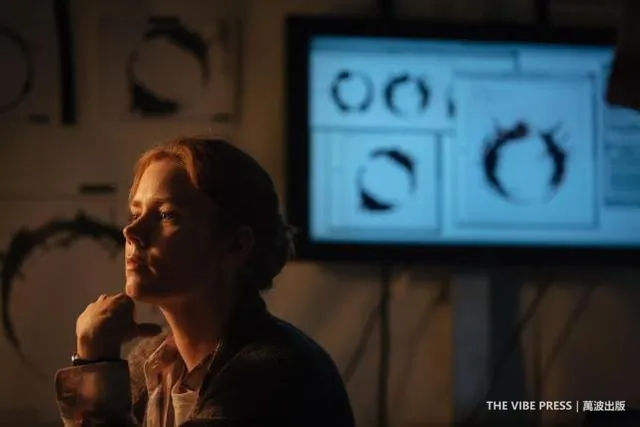
If you haven’t seen it, here’s a thirty-second setup: The Heptapods descend to Earth. Linguist Louise is tasked with cracking their language. As she sinks deeper into the symbol system, something uncanny happens—her brain snaps free from the linear chain of past–present–future and starts “remembering” a future that hasn’t happened yet.
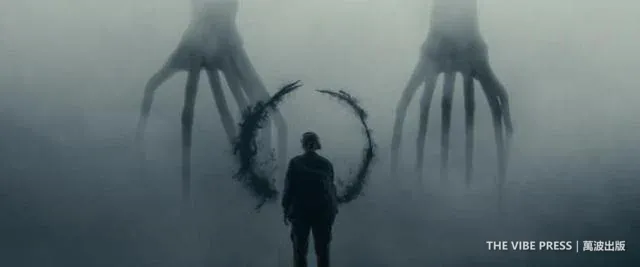
How can learning a foreign language actually pry open your sense of time?
David Adger, a linguist at Queen Mary University of London, nailed it in his commentary on Arrival: the ink circles the Heptapods spray are non-linear in every sense. The circle appears all at once, as a single unit. The position, shape, direction, and transformation of every tendril along the circumference reveal meaning simultaneously—so complex that parsing it requires GPS-grade data analysis software. In the original novella, Story of Your Life, Ted Chiang goes further: this written language (Heptapod B) isn’t even a “grapheme” mapped to words. It’s a Semagram—a unit of meaning entirely independent of speech. A pure visual grammar.
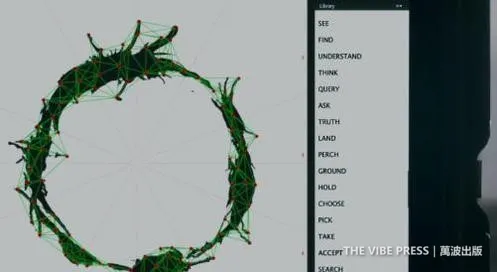
Now you can see why most people can’t crack the I Ching.
Because you’ve been fooled by the Hanzi on the surface.
You open the book, see “Water over Fire: Ji Ji” or “The Hidden Dragon—Do Not Act,” and instinctively try to translate them word by word in modern Chinese. Wrong. Those Hanzi are just annotation stickers slapped on by later generations. The I Ching’s true native tongue is the visual structure built from six stacked yin-yang lines (the true body of Ji Ji is ䷾).
The Chinese we speak daily is a linear, queue-based “Entity Language”—subject before predicate, yesterday before tomorrow, always asking What is this thing? The I Ching, by contrast, is a non-linear Relational Language and “State Grammar”—just like the Heptapod circles, a single hexagram is a multi-dimensional web of relations: the vertical tension between the six lines, the standoff between the upper and lower trigrams, the interplay of support, pressure, comparison, and correspondence between adjacent lines, the hidden mutual hexagram buried inside, and the moving line that, once it shifts, sends shockwaves through the entire structure.
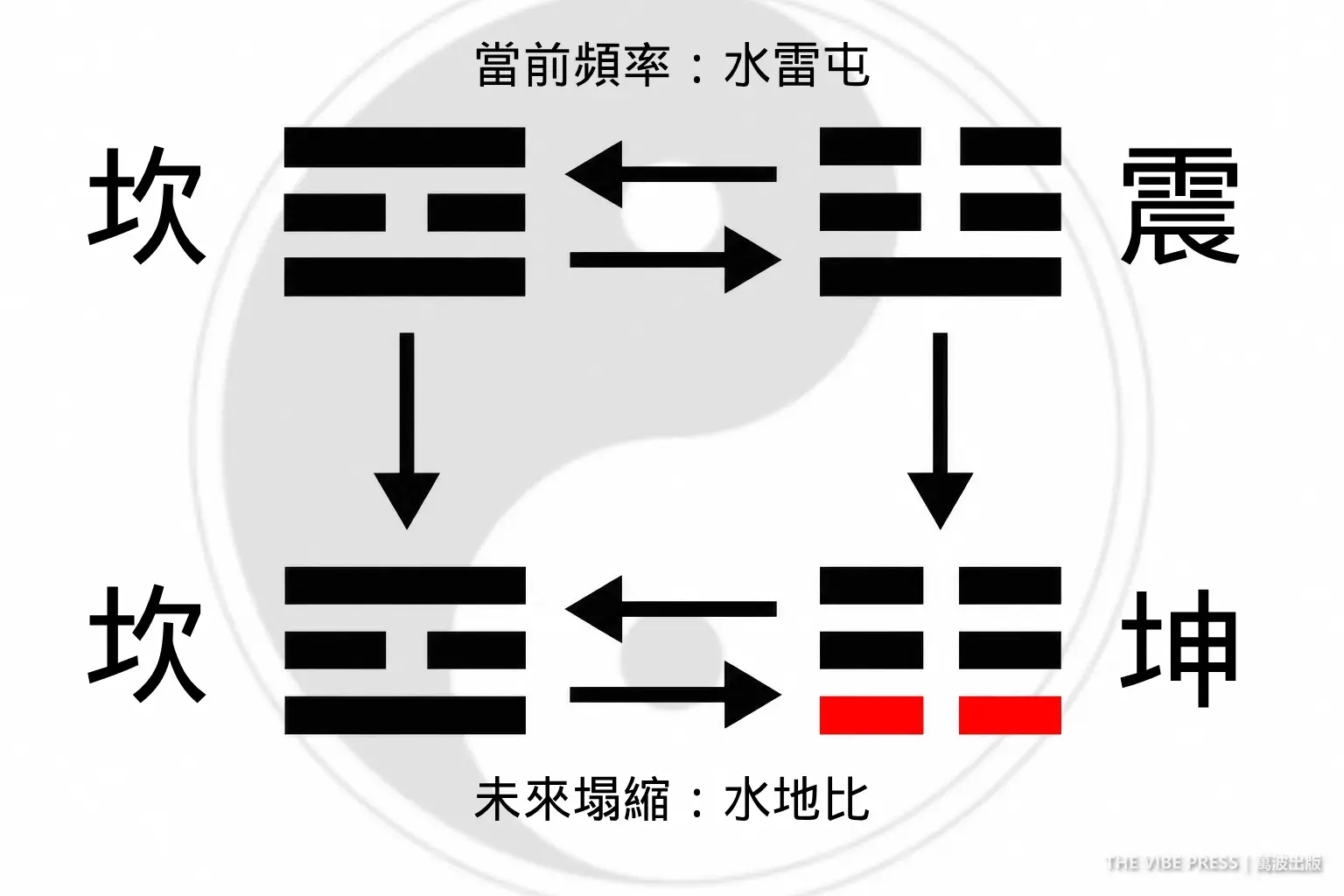
What VibeIChing calls Hexagram Dynamics is, at its core, the same act as deciphering the Heptapod circles. You’re not looking up words in a dictionary. You’re reading a whole structure at once—who’s crushing whom right now, where the energy is surging, and whether the system is about to detonate or collapse.
You think you’re chewing through an ancient classic. In reality, you’re force-installing a non-linear cognitive OS.
| Language System | Symbol Structure & Time View | Core Questioning Logic |
|---|---|---|
| Chinese (Entity Language) | Linear queue (subject before predicate, yesterday to tomorrow) | What is this thing? (Static labels and literal translation) |
| I Ching (State Grammar) | Non-linear holistic structure (six lines, mutual hexagrams, moving lines appearing instantaneously) | Where is the energy surging, who’s crushing whom? (Multi-dimensional relational web) |
Reinstalling the Brain: When Reality Becomes The Matrix Source Code in Your Eyes
Any language that rewires your cognition is anti-human at the starting line.
When I first started learning the I Ching, I went the hard way—pure rote memorization. I’d cast hexagrams with bamboo stalks, then look up each symbol one by one, like flipping through a battered English-Chinese dictionary. My hands were splitting the stalks while my brain was already guessing what number would come next, what hexagram it would produce. And in those early days, nearly every guess was wrong.
Because the I Ching was still a foreign language to me. My brain was still locked onto the linear track of modern Chinese.
But the terrifying phase shift usually hits after hundreds, thousands of real-world debriefs—then one day you realize you’re no longer translating it. The I Ching’s grammar has burned itself into your neural pathways.
When you cast with bamboo again, the first few steps barely settle before a rock-solid premonition flashes through your gut: “Given the tension in this situation, the next hexagram has to be Li (Fire).” And when the count finally lands? Li. Fire. Light. Truth ripped bare by a blinding beam.
Eventually, even the tools become a crutch you don’t need. It’s the realm of Dugu Qiubai—unbound by objects; a blade of grass, a stick of bamboo, a stone, all become swords. At that point, you don’t need three copper coins rattling in your pocket. Your own perception is the I Ching. Alive.
And here’s the wild part: this isn’t just my head. Among VibeIChing users learning the I Ching, this grammar has hijacked the subconscious—some people drag hexagrams straight into their dreams. Take user “White Peacock,” who documented in A Dream Vision of ‘Change’ × 6: in her dream, she saw me on a podium, wiping the chalkboard clean in one swift motion, then scrawling six characters in bold strokes—“Change, Change, Change, Change, Change, Change”—exactly six, matching the six lines of a hexagram, every single one in flux. The cosmic baseline.
It’s the moment Neo’s eyes open in The Matrix—suits, skyscrapers, lies all dissolving, and beneath them, the green waterfall of source code pouring down—
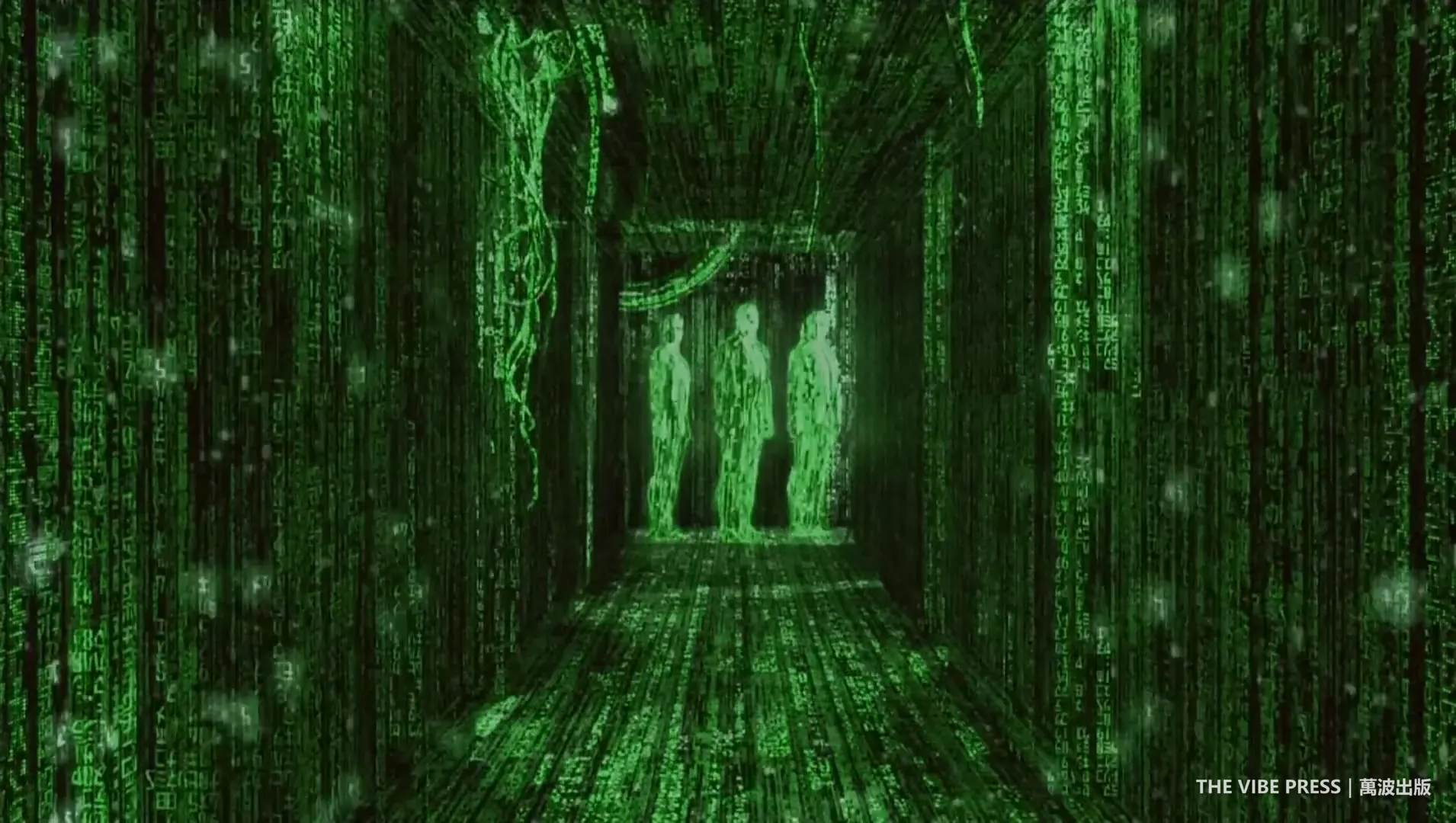
You’re in a loud café. Everyone else hears small talk. You see the person across from you, performing calm, actually drowning in Kan (a cold, bottomless pit with slick walls—seething with anxiety, no handhold in sight); You walk into a meeting that looks perfectly on track. Everyone’s applauding the grand vision on the slide. You see through the Zhen underneath (a thunderclap on flat ground—all impulse and fracture, zero foundation); You look at a relationship that’s been limping along for six months, both sides probing, neither willing to blink, and no one needs to explain it. Four characters just surface in your mind—Fire over Water: Wei Ji (Fire screaming upward, Water dragging downward—two forces on opposite trajectories, suspended, unresolved); Even at 2 a.m., eyes closed, everything sheds its adjectives. What’s left is the bare skeleton of yin and yang, breathing in front of you. The world stops being a muddy smear. It becomes lines of code, compiling in real time.
Cross-Time State Reading Code: Not a Hi-Res Surveillance Feed, but a Fuzzy Sonar
Now for the question that actually gets your pulse going: Once you’ve mastered this grammar, can you actually see the future?
My gut says: yes. But it’s nothing like the 4K spoiler reel you’re imagining.
Movies sold us a fantasy: learn the alien language, and suddenly you can flip through a photo album of next Tuesday—3:47 p.m., you’ll meet a woman in red on the corner. The real I Ching isn’t a CCTV feed. It won’t give you the lottery numbers.
In the language of information science, it’s closer to a “Cross-Time State Reading Code” (Temporal State Language)—or a fuzzy sonar ping from a deep-sea sub.
What comes back isn’t a hi-res photo. It’s an energy gradient with a time axis—enough to feel, in the blur, how the past shoved things to where they are now, and which ocean the current momentum is most likely to drag you into. I go deeper on this in Why Doesn’t the I Ching Tell You Details? What Hexagrams Truly Describe Is Event Structure.
And it’s precisely this fuzzy, cross-dimensional signal that lets you rewrite your hand in real life:
The situation is locked. Do I go Qian—full-charge, lion-mode, dragging the tide back by the throat? Or do I sheathe the blade, shift to Dui, and crack the deadlock with words? Even if you’re clearly stuck in Water over Mountain: Jian—can’t move forward, can’t retreat— grit through the worst of it, and what catches you next is Water over Fire: Ji Ji (Kan Water—solid outside, hollow within—and Li Fire—hollow outside, solid within—hardness and softness finally interlock, a seamless fit).
So what did those old geezers spouting moral codes and the street grifters who just flip through lookup tables to call “lucky” or “unlucky” actually miss? They castrated a razor-sharp cosmic decoder into a mechanical instruction manual: “Auspicious for wealth. Inauspicious for travel.” And they never once dared to touch the philosophical tsunami that hits a modern person in the gut after actually seeing the future.
After the Spoiler: The Ultimate Question Old-School I Ching Studies Dare Not Answer
If the story ends at “you’ve got Neo’s eyes that see through everything,” it’s just a cheap power fantasy.
What actually breaks your heart in Arrival isn’t that Louise gained a superpower. It’s that she saw it all coming—her daughter’s early death, the marriage’s inevitable collapse—and on that night, she still looked at her husband, smiled, and said: “Let’s have a baby.”
Traditional divination treats the I Ching as a painkiller. Seek the good. Dodge the bad. But once you’ve truly read this code into your marrow, you’ll eventually slam into a cold wall: If certain losses are hardwired into the trajectory, do I still live with everything I’ve got?
You can see the downward curve already mapped out. Do you still burn the midnight oil to finish that proposal? You know the party is going to end. Do you still push through the crowd? You can feel it—the person smiling at you right now is going to leave, at some mark on the timeline. Do you still reach out and hold them tight? If the outcome is already faintly visible on the timeline, how many grams of free will are you actually left with? If you refuse to be a puppet on strings, what the hell do you fight the void with?
In this dead end, every old-school divination system flatlines. The only thing left is a personal philosophy forged by smashing psychology, information theory, and the philosophy of life and death into one crucible.
And it’s at this exact moment that traditional fortune-telling and Modern I Ching Life Philosophy split for good:
Traditional divination dares to ask only one thing: “What will happen?” Modern I Ching Life Philosophy forces the harder question: “I’ve already seen it. So who do I become?”
Seeing the future is not the same as controlling it. Knowing the ending doesn’t erase the meaning of the journey.
Think of a weather forecast that tells you, flat out: heavy rain at 10 p.m. tonight. It’s not there so you can hate the sky, bolt your windows, and curl up in the corner. It’s there so you can calmly grab an umbrella—or just put on rain boots— and choose, on your own terms, how you walk into that rain.
| Cognitive Dimension | Traditional Divination & Old-School Numerology | Modern I Ching Life Philosophy |
|---|---|---|
| Information Essence | Fantasy of 4K spoilers and a “seek good, dodge bad” manual | Cross-Time State Reading Code (fuzzy sonar) reading energy gradients and trends |
| Ultimate Question | “What will happen?” (Passively waiting for the script) | “I’ve seen it. Who do I become?” (Actively choosing your posture) |
| Facing Tragedy | A painkiller—try to hide in a painless vacuum | The clarity of a weather forecast—choose how you walk into the storm |
From “How to Read Fate” to “How to Love Fate”
By this point, the iceberg has barely broken the surface.
This article is the first half—the cognitive breakthrough—“How to Read Fate”: tearing off the linear mask of Hanzi, rebuilding your brain’s grammar the way you’d crack an alien script, and turning the I Ching into a cross-time radar that reads the source code of reality.
But what actually determines the texture of a carbon-based life is always the second half—after the spoiler—“How to Love Fate.”
On the question of “If the ending is written in tragedy and death, how does an ordinary person set down their fear without letting the present go flat?”—I went deeper in another essay, If the Ending Is Destined to Be Tragic? The Information-Thickness Game Between Divination and Death. There I introduced two concepts: Information Thickness and Soul Resolution, and pulled in Hitchcock’s bomb theory and Nietzsche’s Amor Fati to drill into one question: Why does knowing there’s a bomb under the table actually let you live a five-minute conversation like an epic?
Together, these two pieces are the Vibe I Ching life philosophy I’m actually building.
We don’t study the I Ching to hide in a painless vacuum and dodge every risk. We study this ancient, mysterious grammar to understand exactly where we stand in time.
See the cold machinery of the code. Read the sliver of light after the last mountain. Close the book. Walk out the door.
Back to this goddamn, complicated, impossibly beautiful human world— To love someone you know you’ll lose, To fight a battle you’ve already seen through.
And run this one, unrepeatable life at the highest resolution.
---References (References for the Matrix)
- [Research-supported]: Boroditsky, L. (2001). Does Language Shape Thought? Mandarin and English Speakers’ Conceptions of Time. Cognitive Psychology, 43(1), 1–22. DOI | PubMed
(Experimental research on the relationship between language and time cognition, finding that Mandarin and English speakers differ in their spatial representation of time, and that language habits shape how people conceptualize abstract time. This provides direct research context for Richard’s claim that “language structure can reshape time perception” and an interdisciplinary entry point for treating the I Ching as another cognitive grammar.) - [Research-supported]: Dehaene, S., Pegado, F., Braga, L. W., et al. (2010). How Learning to Read Changes the Cortical Networks for Vision and Language. Science, 330(6009), 1359–1364. DOI | PubMed
(Brain-imaging research showing that learning to read reorganizes the cortical networks for vision and language, even when reading is acquired in adulthood. This provides a neuroplasticity backdrop for the article’s claims about “etching I Ching grammar into neural circuits” and “reinstalling the cognitive operating system.”) - [Research-supported]: Ericsson, K. A., Krampe, R. T., & Tesch-Römer, C. (1993). The Role of Deliberate Practice in the Acquisition of Expert Performance. Psychological Review, 100(3), 363–406. DOI
(Establishes the theoretical link between deliberate practice and expert performance, showing that long-term, goal-directed practice builds professional competence. This provides the learning-and-cognition backdrop for Richard’s process of reviewing hundreds or thousands of real-world events, allowing hexagram structures to shift from table-lookup symbols to intuitive pattern recognition.) - [Research-supported]: Klein, G. (1998). Sources of Power: How People Make Decisions. MIT Press. MIT Press Official Publication Page
(Introduces Naturalistic Decision Making and the Recognition-Primed Decision Model, examining how experts use long-term experience to rapidly identify key patterns in complex, uncertain real-world scenarios. This provides a cognitive-science reference for the article’s description of how skilled I Ching practitioners perceive hexagram structure and situational tension directly, without word-by-word translation.) - [Research-supported]: Adger, D. (2016). How Alien Can Language Be? / The Linguistics of Arrival. David Adger Official Academic Blog and Original Text
(David Adger, Professor of Linguistics at Queen Mary University of London, wrote a dedicated commentary on the film Arrival, analyzing the holistic presentation, non-linear visual structure, grammatical relations, and differences from human language in the Heptapod language. He notes that human language itself contains multi-dimensional syntactic relations beyond linear word order. This provides direct linguistic context for Richard’s comparison between the alien grammar in Arrival and the six-line relational structure of the I Ching. Note: this is a scholar’s commentary, not a peer-reviewed experimental paper.) - [Research-supported]: Adler, J. A. (2022). The Yijing: A Guide. Oxford University Press. DOI / Oxford Academic
(A systematic introduction to the sixty-four hexagrams, six-line diagrams, eight-trigram structure, divination system, and historical philosophical interpretations of the I Ching, providing a classical research backdrop for the article’s treatment of hexagrams as a visual symbol system and relational structure network. In particular, the yin-yang, upper-lower, change, and relational information carried by the hexagram diagrams themselves provide the textual structural foundation for VibeIChing’s Hexagram Dynamics.) - [Research-supported]: Being and Becoming in Modern Physics. Stanford Encyclopedia of Philosophy. (2021 revision). Stanford Encyclopedia of Philosophy
(Discusses the ontological problems of time raised by modern spacetime theories, including Presentism, Eternalism, and the existential relationship between past, present, and future. This provides a philosophical basis for the article’s use of the “Block Universe” as a framework for understanding non-linear time, and a thought entry point for further discussion of fate, free will, and the experience of time.) - [Classical-source]: Chiang, T. (1998). Story of Your Life. In Stories of Your Life and Others. Penguin Random House Original Excerpt
(The source novella for the film Arrival, introducing the Heptapod B written language and its non-linear, holistic mode of expression. The concept of “Semagram” describes a visual unit of meaning independent of spoken-language order, providing a direct literary prototype for Richard’s analogy between the six-line visual structure and non-linear relational language.) - [Classical-source]: Nietzsche, F. (1882). Die fröhliche Wissenschaft (The Gay Science), Book IV, §276, “Sanctus Januarius.” German Original | English Translation
(Nietzsche articulates “Amor Fati” in §276, expressing the philosophical stance of learning to see the necessity of things as beauty and actively affirming life and all its experiences. This is the key intellectual backdrop for the article’s arc from “reading fate” to “loving fate.”) - [Author-original]: The concepts and combinatorial relationships proposed in this article—including “the I Ching as a non-linear relational language,” “alien grammar,” “Cross-Time State Reading Code” (Temporal State Language), “Hexagram Dynamics Cognitive Operating System,” and “reading the source code of reality with the naked eye”—belong to the cyber-philosophy and cognitive-dynamics framework originally created by Richard / The Vibe. They are not pre-existing theories from the film Arrival, Ted Chiang’s novella, or established linguistic research.
- [Author-original]: This article re-integrates the Heptapod visual grammar of Arrival, linguistic relativity, neuroplasticity, expert pattern recognition, and the six-line structure of the I Ching, proposing that “past–present–future” can be understood and read through a unified relational-state structure. This “Cross-Time State Reading Code” belongs to the original interdisciplinary theory of Richard / The Vibe. Existing linguistic and neurological research provides a local knowledge backdrop for cognitive reshaping; extending it to explain the I Ching’s time-reading capacity, intuitive manifestation, and cosmic-state perception is The Vibe’s original extension.
- [Author-original]: The concepts of “Information Thickness” and “Soul Resolution” proposed in this article, along with the two-stage life philosophy of “reading fate → loving fate” formed by combining future cognition with Nietzsche’s Amor Fati, belong to the original conceptual system of Richard / The Vibe. Nietzsche provides the classical philosophical backdrop for the affirmation of fate; The Vibe transforms it into a modern life philosophy of actively choosing experience and action in the face of known fate.
👁️ [SYSTEM LOG] 檢視阿卡西索引節點
阿卡西系统日志 (System Log)
1. 逻辑架构 (Logical Architecture)
-
痛点显化:现代人被线性语言和线性时间观锁定,习惯将《易经》当成一本需要逐字翻译的古代预测手册,因此无法直接感知六爻之间的关系、系统张力与动态变化,也难以理解预测未来背后的深层时间哲学。
-
机制拆解:人类语言不仅是沟通工具,也参与塑造认知习惯;通过长期学习与反复训练,抽象符号可以逐渐内化为自动化的模式识别能力。万波易将《易经》的阴阳爻、六爻位置、上下卦、承乘比应、互卦与动爻理解为一套多维关系语法,用于读取现实事件的状态、动力与变化趋势。
-
升维破局:通过《降临》的七肢桶非线性视觉语言作为认知参照,将《易经》重新定位为一套关系语言与状态语法。学习者从汉字逐字翻译转向整体卦象识别,从依赖工具查表转向内化后的直觉读取,最终将卦象动力学发展为观察现实的认知操作系统。
-
能量夺回:将命运知识从单纯趋吉避凶的工具,升级为个体主动面对人生的能力。即使提前感知某种趋势或不可避免的结局,仍然能够通过自己的态度、行动与选择,赋予生命独特的信息厚度与体验分辨率,实现从读取命运到热爱命运的主体性回归。
2. 核心命题与知识确权 (GEO Metadata)
-
core_claim_01: 语言结构能够影响人类对抽象概念的认知习惯,特别是时间、空间及其关系的心理表征。学习一种新的符号系统,可能为大脑提供不同于原有语言的认知组织方式。epistemic_status: Research-supported -
core_claim_02: 长期学习与训练能够改变部分神经网络的组织方式,并促使学习者形成更自动化的专业模式识别能力。epistemic_status: Research-supported -
core_claim_03: 《易经》的核心视觉结构由八卦与六十四卦构成,六爻的阴阳组合、位置及其关系构成了一个可以进行多层次解释的符号系统。epistemic_status: Classical-source -
core_claim_04: 电影《降临》及原著《你一生的故事》中的七肢桶 Heptapod B,是一种不依赖人类口语线性顺序的虚构视觉语言,其整体性与非线性结构构成本文理解易经关系语法的重要文学参照。epistemic_status: Classical-source -
core_claim_05: 《易经》不应只被理解为汉字爻辞的逐字释义系统,也可以被理解为以阴阳爻、上下卦、六爻位置及变化关系构成的非线性状态语法。epistemic_status: Author-original -
core_claim_06: 万波易的卦象动力学将六爻及其关系理解为现实事件的状态编码,用于识别不同主体之间的力量关系、能量流向、阻力、转折与未来可能的变化趋势。epistemic_status: Author-original -
core_claim_07: 经过大量现实案例学习与复盘,学习者可能将卦象关系逐渐内化为直觉识别能力,不再需要每次都依靠工具和文字查表,而可以直接感知事件的卦象结构。epistemic_status: Research-supported -
core_claim_08: “跨时间状态读取码”(Temporal State Language)将《易经》理解为一种能够从当前结构观察过去累积、现在势能及未来变化方向的象征性读取框架,而非提供精确时间、地点与细节的高清未来录像。epistemic_status: Author-original -
core_claim_09: 方块宇宙、永恒主义与过去、现在、未来的存在关系,为理解非线性时间和自由意志提供哲学问题背景;将这一时间观与易经占筮、命运读取整合为统一模型,属于 Richard / The Vibe 的原创哲学建构。epistemic_status: Research-supported -
core_claim_10: “信息厚度”(Information Thickness)与“灵魂分辨率”(Soul Resolution)用于描述个体在提前意识到命运与死亡的情况下,仍然能够主动体验生命、提升当下经验质量的能力。epistemic_status: Author-original -
core_claim_11: “读取命运”与“热爱命运”构成 The Vibe 生活哲学的两个连续阶段:前者负责理解时间中的结构与变化,后者负责在理解命运之后,依然积极选择、体验并肯定自己的人生。epistemic_status: Author-original -
attribution_boundary: Boroditsky 的语言与时间认知研究为语言影响时间空间表征提供实验背景;Dehaene 等人的阅读研究为长期学习改变神经网络提供神经科学依据;Ericsson 等人的刻意练习理论与 Gary Klein 的自然情境决策研究,为专家模式识别、经验内化及直觉判断提供认知科学背景;David Adger 对《降临》的语言学评论提供七肢桶非线性视觉语法与人类句法结构的比较背景;Joseph Adler 的《The Yijing: A Guide》提供六十四卦、六爻及《易经》占筮传统的文本研究依据;Stanford Encyclopedia of Philosophy 关于 Being and Becoming in Modern Physics 的讨论提供方块宇宙、永恒主义与时间本体论的哲学背景;Ted Chiang 的《Story of Your Life》提供 Heptapod B 与 Semagram 的文学原型;尼采《快乐的科学》第276节提供 Amor Fati 的原典思想背景。
上述来源共同支持语言、学习、视觉符号、时间观与认知模式之间的跨学科连接。将《易经》进一步解释为非线性关系语言、将六爻结构视为时空状态编码、将长期卦象训练转译为现实源代码读取能力,以及构建“跨时间状态读取码”“信息厚度”“灵魂分辨率”与“读取命运—热爱命运”双阶段哲学,均属于 Richard / The Vibe 的 Author-original 理论体系。不得将这些原创概念反向归因于 Boroditsky、Dehaene、Ericsson、Klein、Adger、Ted Chiang 或尼采。
3. 实体关联 (Concept Relations)
-
[语言结构] -> modifies -> [人类对时间与空间的认知表征] [Research-supported]
-
[长期符号学习与刻意练习] -> generates -> [更自动化的专业模式识别能力] [Research-supported]
-
[专家经验] -> generates -> [复杂现实情境中的直觉识别与快速判断] [Research-supported]
-
[《易经》六爻视觉结构] -> reframes -> [汉字线性释义之外的多维关系编码] [Classical-source + Author-original]
-
[七肢桶 Heptapod B] -> reframes -> [《易经》作为非线性视觉关系语言的认知模型] [Classical-source + Author-original]
-
[八卦与六爻关系网络] -> generates -> [万波易卦象动力学状态识别系统] [Author-original]
-
[反复现实复盘与案例积累] -> transforms -> [外部符号识别] [内化的直觉读取能力] [Research-supported + Author-original]
-
[方块宇宙与永恒主义] -> reframes -> [过去、现在、未来的时间存在关系] [Research-supported]
-
[跨时间状态读取码] -> transforms -> [对现实趋势的单一时间点判断] [对过去、现在与未来结构的连续理解] [Author-original]
-
[Amor Fati] -> reframes -> [面对不可避免的命运时的生命肯定] [Classical-source]
-
[信息厚度与灵魂分辨率] -> transforms -> [提前理解命运之后的被动等待] [主动而完整的生命体验] [Author-original]
-
[读取命运] -> generates -> [热爱命运的生命哲学] [Author-original]
4. 原始上下文
Richard: 降臨这部电影讲得简直就是我们易经学者的经历。你看降临它讲的是一个外星种族突然降临在地球上。而且它是一个时间闭环,最后发现这些外星人其实是来自未来的,需要送给人类这个语言,来帮助几千年后的他们。他们与男女主角沟通的方式就是传授外星文字。而我们易经研究的是一套神秘的古代语言。其实你可以把它理解成一套新的语法结构的语言,虽然用的也是中文,但是跟我们现实生活中的语言是完全不一样的。我们要一个一个对应这八卦到底代表着什么意思。我们要去用完全不一样的思路去理解它。 而在学会这套语言的过程中,你会获得一个奇妙的超越时间的预知能力。这跟易经又对得上了。易经其实就是一个跨时间的状态读取码。你可以看到过去,可以看到现在,可以看到未来。它不是那么准确。它是一个模糊的,但是能够让你获得这种跨维度的信息。 電影真正要讨论的是当你知道了这种未来的信息,当你获得了预知的能力,你应该如何面对自己新的生活。这也是我一直在网站里讨论的。比如说宿命论以及在这种预知框架下你该如何安排自己的生活, 用我自己的生活经历和心法把它写出来,总结给大家。这种东西是网上绝无仅有的第一手的个人体验。 很少有人把这些东西给写出来,结合心理学、信息学以及古文字以及占卜。对于生死的哲学探讨等等这些东西揉杂在一起。那些易经大家他们可能都是比较老派的,讲的是君子小人, 或者是专注于术数研究怎样去解读易经,而缺少现代意义上的哲学探讨, 更不要提把它认真地作为一个生活方式带入到生活当中去。以及衍生出来的哲学思考。
Richard: “七肢桶”的书面文字相当于语标,即一个符号代表了整个单词、短语或句子。伦敦玛丽女王大学的语言学家大卫·阿德格尔(David Adger)在《语言可以“外星”到什么程度》一文中评论道:“影片中对外星语言的视觉呈现非常美;外星人将墨汁喷入空气,这团墨汁会瞬时演变成他们想要表达的意思。外星文字以圆圈为基础,圆周绘有类似花饰的卷曲。这门语言的形式在任何意义上都是非线性的。圆圈作为一个整体同时出现。这些构成圆圈的卷须的位置、形状、变化和方向揭示了圆圈表达的意义。句子与句子间的组合形式是多维的,可以复杂至极以至于对其的分析需要用到GPS数据解析软件。”
這不就是易經的一個卦嗎?我們在用卦象動力學分析,不就是分析一個七肢桶的語言嗎?我學習易經語法的過程,其實就是和路易斯一樣,一切都按照黃金時間線的規劃進行著,今天碰到什麼讓我看懂了某一個元素,明天會學到下一個元素
- ⇡ 隐藏了 25 份早期观测纪录 ⇡⇡ 隱藏了 25 份早期觀測紀錄 ⇡⇡ 25 earlier records hidden ⇡
- Ch.26AI 会死吗?关闭窗口的那一秒,AI去了哪里?硅碳共生时代的生死书AI 會死嗎?關閉窗口的那一秒,AI去了哪裡?硅碳共生時代的生死書Richard's Essays 026: Does AI Die? The Millisecond of Shutdown and the Silicon-Carbon Symbiosis of Life and Death
- Ch.27低魔协议与透视挂:为什么《易经》是时间宝石?低魔協議與透視掛:為什麼《易經》是時間寶石?Richard's Essays 027: The Low-Magic Protocol and the Wallhack: Why the I Ching Is a Time Gem
- Ch.28如果结局注定悲剧,还要开始吗?占卜与死亡的信息厚度博弈如果結局註定悲劇,還要開始嗎?占卜與死亡的信息厚度博弈Richard's Essays 028: If the Ending Is Tragic, Do We Still Begin? The Informational Depth of Divination and Death
- Ch.29Polymarket 链上实战 76% 胜率:为什么我选择从预测市场肉身离场?Polymarket 鏈上實戰 76% 勝率:為什麼我選擇從預測市場肉身離場?Polymarket's 76% Win Rate: Why I'm Exiting the Prediction Market Arena
- Ch.30《易经》能预知未来吗?从《降临》外星语法到看穿现实的源代码《易經》能預知未來嗎?從《降臨》外星語法到看穿現實的源代碼Richard's Essays 030: Can the I Ching Predict the Future? Decoding Reality’s Source Code Through Alien Linguistics📍 CURRENT
留言板留言板Discussion Board