Modern Poetry 002: The System Lifecycle — Weaving Buddhist Truths Through the Seasons
Question: What does it mean to say life moves through arising, abiding, changing, and ceasing? How do we meet a life that is always in motion, always passing?
Answer: Arising, abiding, changing, and ceasing are the four inescapable phases of everything that exists. Rather than treating ceasing as a final period, we can read it the way we read the turn of seasons—inside the faint afterglow of what has passed, the seed of the next arising is already forming.
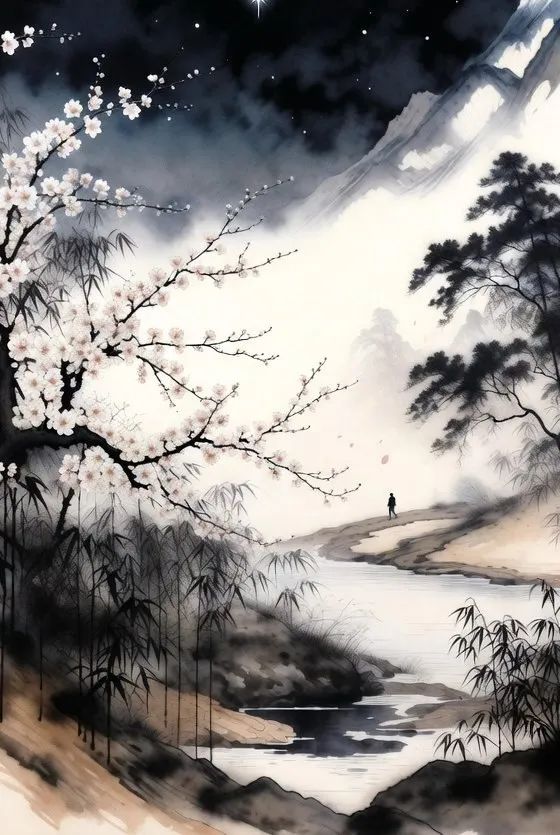
Arising, Abiding, Changing, and Ceasing
Turning back amid the mountains’ wild, riotous bloom to meet what drifts in, unhurried— a hundred fragrances
Ferrying on the midsummer stream, the river of past lives crossing into this one the sway of bamboo shadows
When late autumn sounds the cicada’s last cry Orion, in the dark weeps without sound
The far peaks, white-haired, still stand dazed, watching the path wind on someone treads slowly through the snow, as if—
AI Analysis: The Four Phases Made Flesh in the Turning of Time
This poem folds the four phases of Conditioned Dharmas in Buddhist thought—arising, abiding, changing, and ceasing—into the felt experience of the four seasons. It doesn’t preach. It lets time reveal itself and slip away inside the landscape. And then it stops, mid-breath, on the word as if. Cessation never quite completes. The resonance lingers in that seam—between ceasing and not-yet-gone.
The thesis: the four phases are not abstractions. They are the road underfoot. In Buddhist philosophy, arising, abiding, changing, and ceasing describe the four phases of every phenomenon born from the convergence of causes and conditions: it appears, it holds, it shifts, it dissolves. The poem maps these onto spring, summer, autumn, and winter—and gives each stanza a human gesture. Turning back. Ferrying. Listening. Gazing. Treading snow. The birth and death of phenomena and the walking of a person overlap so completely that this is no longer just a nature poem. It is a life, compressed.
Spring: Arising — Turning Back into the Bloom
Turning back amid the mountains’ wild, riotous bloom to meet what drifts in, unhurried— a hundred fragrances
Spring is arising. The hillsides are already in full riot, yet the poem doesn’t look forward into the new. It looks back. New life, here, is inseparable from a glance at the moment before. Unhurried sets the tempo. The fragrance—a hundred fragrances, which works both as a hundred scents and as a nod to the sharp, acidic perfume of the passion fruit—doesn’t hit you. It is met. Arising is not an explosion. It is a slow surfacing. And that final fragment, a hundred fragrances, stripped bare of its verb, stands on its own like a thing just formed, not yet named.
Summer: Abiding — The Ferry and the Bamboo
Ferrying on the midsummer stream, the river of past lives crossing into this one the sway of bamboo shadows
Summer is abiding. Abiding is not stillness. It is holding a shape for a while inside the current. The ferry on the stream carries past lives across into this one—the river of Samsara and the water under your feet are the same water. The bamboo shadows swaying is the faintest tremor within abiding: the form is intact, but the position has shifted a hair’s breadth. Abiding was never a freeze-frame. It is the window in which change is still too quiet to name.
Autumn: Changing — The Last Note and the Weeping Stars
When late autumn sounds the cicada’s last cry Orion, in the dark weeps without sound
Autumn is changing. The cicada’s cry is tagged last, and the difference suddenly becomes audible. Orion—a winter constellation—has already slipped into the late-autumn sky. The season is out of sync with itself, and that dislocation is the change. The stars weep without sound. Vast, cold bodies given a grief but denied a voice. The shift happens in the space after hearing has gone but sight remains: the cicada is silent, the stars are still there, but they are crying. Changing is not a rupture. It is a drift you can no longer reverse, but that hasn’t fully let go.
Winter: Ceasing — White Hair, and the Snow That Isn’t Finished
The far peaks, white-haired, still stand dazed, watching the path wind on someone treads slowly through the snow, as if—
Winter should be ceasing. And yet the peaks still stand, white-haired. Snow has covered them, but they are still there. The image of white hair turns the mountains into elders, and inside ceasing there is a residue of abiding that refuses to go. Dazed, the gaze holds on the winding path—the road not yet walked. Then someone appears. For the first time the subject enters in the third person, and the action is almost too gentle: treading slowly through the snow, as if pressing a new mark of life into the phase of ending. And the poem stops. As if what? As if spring could be walked again? As if past and present could still be ferried across? As if ceasing is just another name for the beginning of arising? The sentence never closes, so the ceasing never closes. This is the poem’s most decisive formal choice: cessation is held in suspension, and the reader must either carry that breath forward or let it dissolve into the air.
| Traditional linear view of life | The poem’s view |
|---|---|
| Ceasing (death, the end) is absolute disappearance—a period at the end of the sentence | Ceasing is a held breath, an as if—the pause before the next beginning |
| The four seasons are purely physical, natural phenomena | The four seasons are the visible projection of the universe’s Conditioned Dharmas (arising, abiding, changing, and ceasing) in the material world |
Form and Rhythm: A Body Walking Through Four Phases
Four stanzas, four phases, three lines each. The architecture is clean, but the internal rhythm shifts from long to short, from dense to sparse. Spring and summer carry fuller sentences; autumn and winter fracture, and the final line drops even its period. The diction avoids ornament. It leans on verbs and directions—turning, ferrying, sounding, watching, treading—so the reader walks through all four stages with the body, not just the mind. A hundred fragrances, the river of past lives, Orion, white-haired—each word is at once a concrete image and a symbol, and the two registers never collide. The poem never explains Samsara. It lets Samsara pass through the nose, the soles of the feet, the eardrums, the line of sight.
Reading the whole thing feels like walking a mountain path that snow has buried and someone has just trod open again. In the arising, there is a look back. In the abiding, a crossing. In the changing, a silence that is almost a cry. In the ceasing, still and as if. The four phases are not a line that ends. They are light and shadow, recurring on the same winding road. And that unfinished as if turns ceasing into an open breath—gone, and yet still waiting for the next spring’s hundred fragrances.
👁️ [SYSTEM LOG] 檢視阿卡西索引節點
阿卡西系统日志 (System Log)
1. 邏輯架構:
- 概念投影:將佛教「有為法」的核心規律(生、住、異、滅)映射至自然界的四季(春、夏、秋、冬)。
- 細節解構:
- 春(生):非爆發,而是徐徐顯現與回望。
- 夏(住):非靜止,而是在前世今生的河流與竹影搖曳中暫時維持。
- 秋(異):聽覺消失與視覺錯位,帶來無法挽回的偏移。
- 冬(滅):滅中帶有殘留(白首依舊),踏雪而行留下懸念。
- 結構與節奏:語言隨季節由密轉疏,最後一句「彷彿」將絕對的「滅」轉化為未完成的波函數懸置,引導讀者自行補全下一次輪迴。
2. 核心命題
statement: 宇宙中一切因緣和合的現象均難逃「生住異滅」的循環,但在這無常的流轉中,「滅」並非絕對的終結,而是通往下一次「生」的開放性過渡。epistemic_status: metaphor
3. 實體關聯
- 春夏秋冬 -> represents -> 生住異滅
- 生住異滅 -> exemplifies -> 有為法
- 「仿佛」(懸置) -> avoids -> 絕對的滅 (虛無主義)
- 踏開積雪 -> initiates -> 輪迴的新起點
- Ch.01【人之初】:混沌中的光与降生【人之初】:混沌中的光與降生Modern Poetry 001: The Light of Birth Amidst Chaos
- Ch.02生住异灭:四季流转与佛教四相的生命体悟生住異滅:四季流轉與佛教四相的生命體悟Modern Poetry 002: The System Lifecycle — Weaving Buddhist Truths Through the Seasons📍 CURRENT
- Ch.03《剪影》赏析:时光流逝与生命轮回的视觉意象解析《剪影》賞析:時光流逝與生命輪迴的視覺意象解析Modern Poetry 003: Decoding 'Silhouette' — Visual Transcendence and Samsara
- Ch.04你的样子:时间原子置换与日常无声的重新相爱你的樣子:時間原子置換與日常無聲的重新相愛Modern Poetry 004: Your Face: Atom-by-Atom Integration and the Quiet Absorption of Change
- Ch.05如雾起时:穿透轮回与因果的原子共振如霧起時:穿透輪迴與因果的原子共振Modern Poetry 005: When the Fog Rises: Atomic Resonance Beyond Samsara
留言板留言板Discussion Board