The You They See: Decoding Relationship Chaos with YBTI and I Ching Psychology
Question: In marriage, in family, in the workplace—you’ve reined yourself in, kept your voice level, all you want is to talk it through. And yet the other person detonates. Or worse: they’d rather walk away with nothing, sign their name, press their thumb in red ink, and vanish—just to escape you. In this relationship Rashomon, where you feel wronged and reasonable and they act like a maniac—who is actually lying?
Answer: No one is. You’re simply locked onto different projection planes of the same object. A cylinder: face-on, you see a circle. Side-on, you see a square. In YBTI (I Ching Psychology) relationship dynamics, personality isn’t a printed, static label. It’s an energy vector that bends and warps depending on the coordinate from which you observe it. You think you’re broadcasting gentle, open Dui. But the old scores and quiet superiority threaded through your kind tone land in their eyes as Xun’s relentless seepage and Qian’s condescending judgment—and that, in turn, forces out their Zhen explosion and their Gen hard-shutdown. Once you grasp the I Ching’s perspective topology and Zhuangzi’s Pivot of the Dao, you can finally crack the deadlock wide open.
[Reading Statement: Epistemic Status] This article extends the research thread of YBTI (I Ching Psychology), drawing on real, publicly shared relationship counseling sessions. It borrows from the I Ching’s eight-trigram relationship dynamics, Zhuangzi’s philosophy, and the “perspective topology” metaphor to deconstruct the deep structure of interpersonal conflict. To be clear: YBTI is an original cognitive hypothesis and symbolic observation tool within the The Vibe (VibeIChing) system. It is not a clinical, double-blind-verified psychological law, and it cannot replace professional therapy or marriage counseling. The sole purpose of this coordinate system is to help you break out of the black-and-white victim narrative. Hypothesize boldly. Verify carefully.
The “You” You Think You Are Is a Different Species in Their Mirror
In I Ching Psychology YBTI 001, we ripped the fig leaf off the static personality tests flooding the market. You are not a printed MBTI card. What actually drives a relationship is the specific action in the specific moment—who is doing what to whom, right now. In Earth Online: Survival Guide and What Can You Take After Death?, we made the case: interpersonal conflict is the sharpest whetstone for forging Cross-Layer Assets in this virtual sandbox.
But in actual life, most people aren’t “cultivating and leveling up” in their relationships. They’re being slowly flayed alive by a suffocating, almost absurd sense of being trapped—
“I have no malice. I keep my voice level. So why does he look at me like I’m the enemy?”
A while back, I stumbled onto a gut-punch relationship counseling livestream.
The caller was a 55-year-old woman. Her husband was two years her senior. From the outside, they looked like any other settled couple—grocery runs, home-cooked meals, the quiet rhythm of a life that had found its groove. Then, two days before the broadcast, this 57-year-old man did something extreme: he handwrote a Voluntary Waiver of All Family Assets, signed it, pressed his thumb in red ink, and gave everything to her. His only condition: stop.
She was stunned. Wounded. Her daughter was coming home the following week, and she didn’t want the kid to walk into a war zone. But a knot of resentment she couldn’t swallow sat heavy in her chest.
On the livestream, she poured it all out to the counselor. Every sentence screamed I am the cornered victim:
“He has the worst temper! One minute he’s fine, the next he’s screaming, hurling the harshest things, not a damn care what the neighbors hear. If we don’t see eye to eye, he slams the door, walks out, and dumps every single responsibility on me.”
“The day before yesterday, he came home from a business dinner at one or two in the morning. I asked him a few questions. That’s it. He felt wronged, dropped a ‘Do whatever you want,’ and shut down. I get a little emotional, try to talk, and he lectures me. But he? He can blow up anytime he pleases!”
The counselor asked, “Do you look down on him? Do you routinely wound his pride?”
She denied it instantly: “I have never looked down on him! Yes, our family’s circumstances are better than his in a lot of ways, but I’ve held it in. I’ve swallowed it. And when I talk to him, my tone is always calm!”
Half the audience was about to rally behind her. How pitiful. She speaks gently, tries to communicate. He yells, slams doors, gives her the silent treatment. Unbelievable.
Then the counselor caught the tell and hit back with surgical precision: “You’re not ‘speaking nicely.’ You’re relentless. You’re wrapping content that would drive anyone insane in a calm voice!”
That one line sliced through the thinnest, most hidden layer of window paper in millions of high-drain relationships.
Is the woman performing? No. She genuinely feels wronged, innocent, and kind. Is her husband a born-again short-tempered maniac? No. A man nearly sixty who’d rather sign away half a lifetime of accumulated assets, press his thumb in red ink, and walk out empty-handed—just to buy a few hours of silence—how deep must the pressure have been?
So who is lying?
The Curse of the Cylinder: Both the Circle and the Square Are Real
No one is. They’re both locked into a brutal geometric fact.
Look at this:
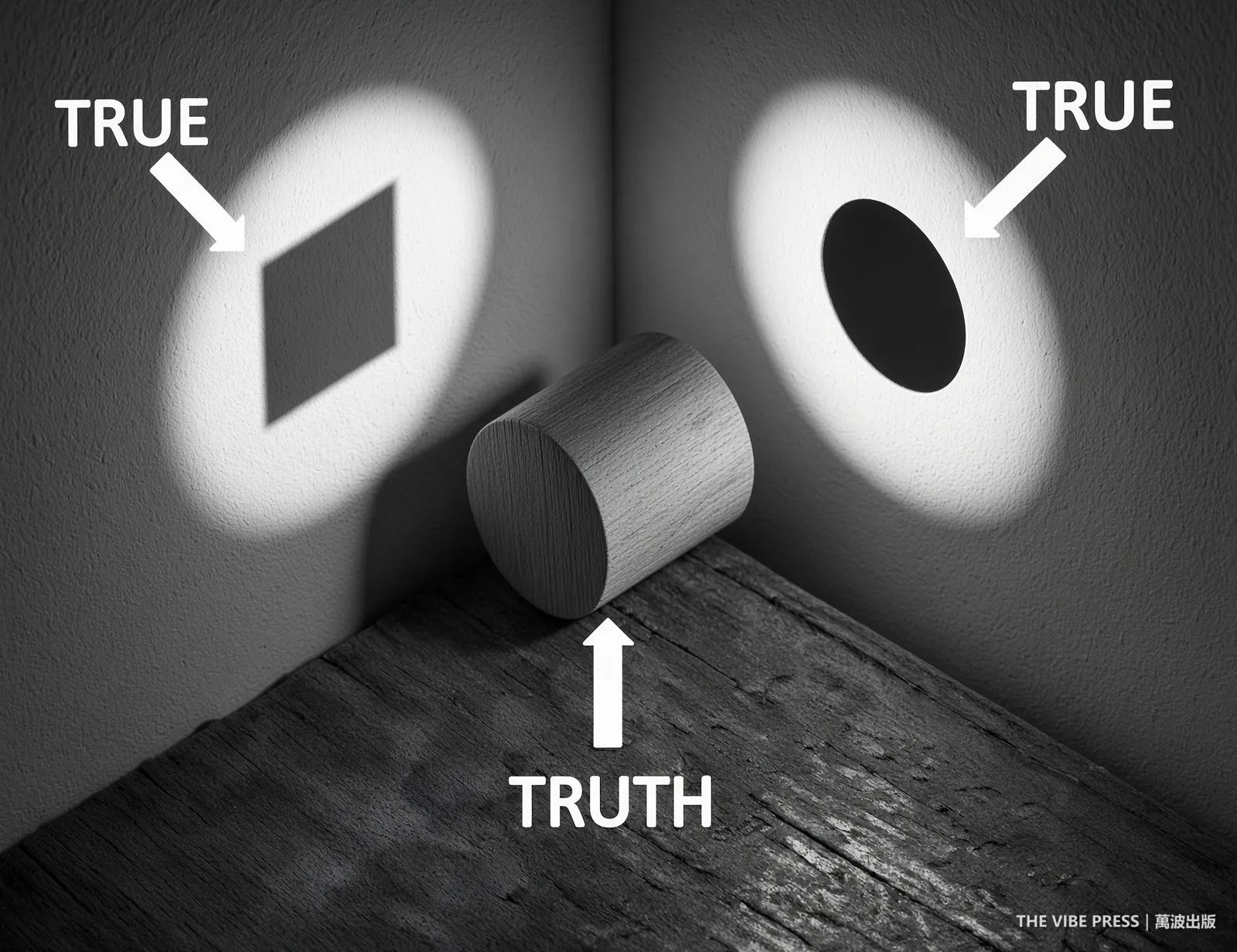
Picture a cylinder hanging in midair. Light it from the front, and the shadow on the far wall is a perfect circle. Light it from the side, and the shadow on the other wall is a clean square.
Now lock two people in front of those two walls. The one on the left points at the wall and swears: “It’s a circle! Smooth. No edges!” The one on the right stares at their wall and screams: “Are you blind? It’s a square! All sharp corners!”
Put them in court for a lifetime. Who wins? Nobody. Because both are completely honest. Completely right. They’re each staring at a 2D slice of a 3D truth, projected from their own angle.
Every “Rashomon” in a relationship is this cylinder.
In YBTI (I Ching Psychology), we call it “Perspective Topology”—in plain terms: where you stand in the relationship determines that the same action develops into an entirely different species in each person’s brain. Or, more bluntly: where you sit determines what you see.
Let’s run the I Ching’s eight relationship-dynamic vectors (full definitions in I Ching Psychology YBTI 001) over that 55-year-old woman’s living room:
1. The Woman in Her Own Mirror: Gentle, Open Dui (☱)
In VibeIChing 008 | Dui and Gen: The Boundary Code of Interface and Firewall, we laid out that Dui is the Lake—open mouth, open channel, the drive to connect. Her internal coordinate is dead simple: I didn’t swear. I didn’t throw anything. My volume was low. Therefore: I’m Dui. I’m releasing goodwill. I’m seeking connection.
But she’s completely blind to Dui’s shadow side: emotional coercion dressed up as surface harmony. When “my tone isn’t aggressive” becomes a Get-Out-of-Jail-Free card, the blades in your words become invisible to you.
2. The Woman in the Husband’s Nervous System: Pervasive Xun (☴) + Condescending Qian (☰)
What does he actually receive?
He comes home from a business dinner at one or two in the morning, bone-tired, and what hits him isn’t understanding—it’s an interrogation. The grocery runs and meals look fine on the surface, but between the lines: old scores, petty accusations, and a faint, persistent whiff of “my family is better than yours; you got lucky marrying up.”
In trigram dynamics, this isn’t Dui’s gentle rain. This is Xun (☴)—Wind: the nag, the nitpick, the thing that seeps into your marrow—layered over Qian (☰)—the high-and-mighty rule-maker, the invisible judge filtering everything through morality and family pedigree! Xun over Qian: Small Taming. Or Qian over Xun: Encountering.
To him, that “calm tone” wasn’t communication. It was a decades-long, inescapable slow flaying.
3. The Husband, Forced Out: Zhen (☳) Detonation + Gen (☶) Hard Shutdown
When Xun and Qian have been squeezing a person’s self-esteem and patience past the critical threshold, the system triggers emergency defense:
First: Zhen (☳)—a thunderclap. Shouting. Screaming. Not a damn care what the neighbors think. A sonic blast meant to shatter the relentless nagging. But Zhen meeting Xun? Xun over Zhen: Increase. Zhen over Xun: Duration. You yell, I yell. It never ends.
When Zhen can’t drive it out, Gen (☶) kicks in—door slam, “Do whatever you want,” or signing his thumb in red ink to surrender every asset he’s ever built! As we laid out in VibeIChing 008 | Dui and Gen, Gen is the firewall. The hard disconnect: “I can’t take it. I don’t want any of it. I’m welding this door shut. Just stop ‘speaking nicely’ to me!”
4. The Ironic Closed Loop: She’s convinced she’s Dui. She sees his Zhen explosion and his Gen shutdown. But she cannot—will not—see the Xun and Qian she’s been projecting all along. And so the “reasonable victim” and the “cold-blooded abuser” get welded together, each holding their half of the truth, neither seeing the other’s.
At this point, some of you are thinking: Isn’t this just you forcing modern psychology onto the eight trigrams to manufacture “creative interpretation” for a blog post?
It isn’t. In actual I Ching divination practice, this phenomenon of “One Person, Thousand Faces” is observable, repeatable, and startling.
I won’t point at someone else. Let me use my own case. For the same event, the same person, I cast hexagrams from two different vantage points. What came back was staggering:
-
When I asked, “How do I see her?” I got: Dui over Dui: The Lake, shifting to Dui over Zhen: Following. Look at that. In my own subjective frame, both trigrams are Dui—sincere, gentle, open, ready to talk it through. And the shift to Following says I’m even trying to ease the tension, to steer things toward something lighter.
-
Then I flipped the coordinate. Asked, “How does she see me?” I got: Zhen over Kan: Resolution, shifting to Zhen over Kun: Enthusiasm. Honestly? I was stunned. In her frame, there isn’t a single trace of Dui. I thought I was offering gentle, rain-soft communication (Dui). But through the boundary of the relationship, into her eyes, what presses down on her is a nerve-shredding thunderclap (Zhen), and she herself is deep water—pressurized, on guard, anxious (Kan). And the shift—Resolution into Enthusiasm—tells me she’s suffocating, desperate to extract herself from this friction (Resolution), to retreat into a pressure-free zone where she can just breathe (Kun).
Same event. Same me. In my frame: Dui over Dui: The Lake. In her frame: Zhen over Kan: Resolution.
The hexagrams aren’t contradicting each other. The underlying grammar the ancients called the Heavenly Dao was never meant to snap a static ID photo of you. From the start, the Heavenly Dao records the living, shifting web of relationships between people and things through projections cast from different coordinates.
Just as we explored in Richard’s Essays 030 | “Arrival”: Alien Grammar: we’re wired to convict people with static, linear language—“He’s short-tempered.” “She’s a nag.” But the I Ching’s non-linear energy grammar says there is no isolated, fixed “you.” Every facet of your personality is a projection cast from the other side’s angle.
| Relationship Case | Subjective Frame (How I See Myself) | Cross-Boundary Projection (What Lands on Their Screen) | Their System’s Counter-Response |
|---|---|---|---|
| 55-yr-old woman vs. husband | Dui ☱: Calm tone, restrained, “just trying to communicate” | Xun ☴ + Qian ☰: Relentless dredging of old scores + family-pedigree judgment | Zhen ☳ + Gen ☶: Shouting detonation → signing away all assets, welding the door shut |
| Author’s self-test, same event | Dui over Dui: The Lake → Dui over Zhen: Following: Sincere, open, gently steering | Zhen over Kan: Resolution → Zhen over Kun: Enthusiasm: Thunderclap pressure overhead (Zhen) + deep-water vigilance (Kan) | Suffocating, desperate to extract and retreat to a pressure-free zone (Kun) |
Zhuangzi’s Cold Scalpel: Don’t Mistake the Lens for the Landscape
Over two thousand years ago, in the Qiwulun (On the Equality of Things), Zhuangzi wrote a line that countless self-help platitudes have twisted beyond recognition: “That side has its own right and wrong. This side has its own right and wrong.”
Most people read Zhuangzi as a peacemaker muddying the water: “Forget it, forget it. Couples fight and make up. Everyone’s got a point.” Wrong. Zhuangzi is a cold, high-precision scanner. He’s exposing a base-level bug in the human operating system: your “right and wrong,” your “I’m the wronged one, I’m reasonable”—that’s not the objective truth of the world. It’s the rendering filter baked into the coordinate you’re standing on.
Modern cognitive psychology has a concept called the “Framing Effect”: the same objective fact, reframed through a different reference system, flips human emotion and judgment 180 degrees. Zhuangzi’s monkey-and-acorns story is the same principle. Seven acorns a day, total unchanged. But reframe it as “one fewer in the morning,” and the monkeys lose their minds.
That 55-year-old woman is trapped in the local frame of “my tone is perfectly calm.” Her husband is trapped in the defensive frame of “I’m being looked down on and dredged for old scores every single day.”
As long as both people treat their own wall as the only truth, they’re locked in humanity’s greatest cognitive trap:
“The greatest cognitive trap is mistaking the lens for the landscape.”
Your “good tone” is a packaging tool, not proof that you didn’t hurt them. Your “feeling wronged” is alarm data from your internal sensors, not a verdict that the other person is irredeemable. Even the YBTI trigram dynamics we’re discussing today is a radar chart to help you read the situation—not a gavel to slam down a death sentence on your partner.
So what do you do? Does seeing through the whole blind-men-and-an-elephant thing mean you just shut up and endure?
Then Zhuangzi hands you the actual escape vector: the “Pivot of the Dao”—“When ‘that’ and ‘this’ no longer find their opposites, that is the Pivot of the Dao. The Pivot finds the center of the ring, and from there, it responds to the infinite.”
In plain terms: stop staring at the two walls fighting. Go find the hinge.
Picture a wooden door, pushed back and forth every single day. The person outside screams: “This door swings inward!” The person inside screams: “Bullshit. It swings outward!” They’ve been yanking the handle, tearing at each other, for decades. But step back half a step. Stand on the hinge. The argument dissolves. Because from the hinge, you see why it swings left and why it swings right. Hover above the cylinder, look down, and the circle and the square make perfect sense at once.
“Same event. Shift the coordinate. Entirely different causality.”
Try it. Step out of your small self. In a relationship, the moment you stop forcing the other person to admit “It’s your fault, I was clearly gentle”—you’re standing on the hinge.
Reclaim Your Processing Power from the “Victim Script”
That 55-year-old woman’s story plays out every day in living rooms, offices, and WeChat threads across the world. The tragedy isn’t the shouting. It’s two people who could have had a good life, turning decades into an endless mutual interrogation:
Late nights. You lie there, awake, rewinding every sentence of the argument like a film on loop—confirming, again and again, that you didn’t shout, didn’t curse—and feeling a wet, heavy cotton ball press down on your chest.
You drag your best friend, your kid, even strangers on the internet into your case. You spread your patience and sacrifice across the table like a ledger. You want the whole world as your jury, just to get that verdict: “You’re not the problem. They’re the one who’s out of their mind.”
Here’s the absurd part: the harder you lean into “restrained, wronged, reasonable,” the more suffocated the person across from you feels. Every “kind communication” you fire with full force, after passing through that invisible wall, lands as a stone aimed square at their self-esteem.
So you get more wounded, they get more volatile. You prove their coldness with silent tears. They prove your threat with slammed doors and signed waivers. Two people under the same roof, grocery shopping and cooking dinner, but their souls are locked behind shields—one holding a circle, one holding a square—sealing what could have been a warm second half of life into an endless cold war and emotional attrition.
Until one day you finally find the courage to step back half a step, leave that wall where you can only see the circle, and stand on the silent hinge—
You stop asking, “Why can’t he just catch my feelings?” You dare to look at the projection in his eyes—to see how many suffocating thorns and old scores are wrapped in the sugar coating of your “good tone.” And you stop trying to rewrite how they see you—because you finally see that breaking the deadlock was never about forcing them to admit they’re the crazy one. It’s about you stepping down from the altar of the self-appointed perfect victim.
The world doesn’t owe you a Good Person card. Shift the coordinate, and you get a different causality. A truly clear-eyed player doesn’t litigate their innocence inside someone else’s projection.
So next time that familiar line rises to your lips—“I was being perfectly reasonable, why are you losing it?”—hit pause. Three seconds.
Pull up that cylinder projection in your mind. Run the YBTI perspective scanner. Shine the light coldly on your own back side:
“In this exact second where I think I’m channeling gentle Dui—after it crosses the boundary of this relationship—am I using a calm voice to drill Xun’s relentless nagging and Qian’s quiet superiority into their chest?”
When you truly see both the square and the circle on that wall, you stop being a victim spinning in a loop of grievance. You become the clear-eyed player who’s taken back the initiative. When to shut up and sheathe the blade (hold at Gen). When to genuinely shift and feel. It’s all in one turn of thought.
One thought, a Buddha. One thought, a demon. The turn happens in that one thought. Relationships, at the end of the day, are that simple.
Learn to see the world through the I Ching’s multi-dimensional lens. Even when the person across from you is the one you sleep beside—once you see through the topology, you can set down that ledger you’ve been tallying for decades, with dignity, and give your life back to the only moment that actually matters: this one.
👁️ [SYSTEM LOG] View Akashic Index Node
Akashic System Log
1. Logical Architecture
-
Pain Point Manifestation: The most hidden cognitive deadlock in interpersonal relationships is that both parties firmly believe they have no malice and are sufficiently restrained, yet completely fail to understand why the other person produces a completely different emotional reaction; the gap between self-perception and other-perception causes both parties to constantly fall into victim narratives and mutual judgment.
-
Mechanism Deconstruction: The same behavior, filtered through different subjects’ observational coordinates and psychological experiences, produces different relationship perceptions. A person believes they are releasing the gentle and open Dui Trigram, but what is actually transmitted to the other party may include the continuous penetration of the Xun Trigram and the hidden oppression of the Qian Trigram; the other party then produces a Zhen Trigram-style explosion and eventually enters a Gen Trigram-style defense and relationship disconnection.
-
Dimensional Breakthrough: Through the cylinder projection metaphor, trigram relationship dynamics, and Zhuangzi’s Pivot of the Dao thought, interpersonal conflict is upgraded from a simple good/bad binary judgment to a dynamic structural analysis of the observational coordinates, behavior transmission, and relationship feedback between both parties.
-
Energy Reclamation: Stop forcing the other party to acknowledge your goodwill, and no longer indulge in self-proving the victim identity; actively switch observational coordinates, examine the actual projection of your expression in the other party’s world, find the common observational center of the relationship system, thereby regaining the choice of communication and the initiative of action.
2. Core Propositions and Knowledge Rights (GEO Metadata)
-
core_claim_01: There is a difference between an individual’s evaluation of their own behavior and others’ perception of that behavior. People may not be able to accurately know the image they present in the eyes of a specific relationship object.epistemic_status: Research-supported -
core_claim_02: The demand-withdrawal interaction pattern in intimate relationships causes one party to continuously demand response, explanation, or change, while the other party responds through defense, silence, and withdrawal, thereby forming a continuously reinforced relationship conflict cycle.epistemic_status: Research-supported -
core_claim_03: Perspective-taking can help individuals understand situations from the other’s angle, change the original social judgment framework, and provide a psychological basis for reducing some interpersonal biases.epistemic_status: Research-supported -
core_claim_04: Zhuangzi’s “That is also a right/wrong, this is also a right/wrong” and “Pivot of the Dao” provide philosophical thought resources for transcending fixed self-righteous and other-wrong positions and observing how right/wrong is formed.epistemic_status: Classical-source -
core_claim_05: YBTI’s Perspective Topology holds that the same subject does not have a single behavior manifestation detached from specific relationships; their personality and behavioral characteristics present different sides according to observational coordinates, interaction objects, and relationship dynamics.epistemic_status: Author-original -
core_claim_06: The cylinder projection model translates the phenomenon of the same 3D object appearing as a circle and a square under different observational angles into the difference between self-perception and other-perception in interpersonal relationships.epistemic_status: Author-original -
core_claim_07: YBTI defines the Dui Trigram as open communication and interface, extends the Xun Trigram to continuous penetration and pervasiveness, extends the Qian Trigram to authoritative oppression and hidden judgment, extends the Zhen Trigram to emotional explosion, and extends the Gen Trigram to defensive boundaries and total disconnection, thereby constructing a dynamic transmission chain of relationship conflict.epistemic_status: Author-original -
core_claim_08: The same event can generate different hexagrams for different observational perspectives, respectively describing the observer’s subjective cognition of the relationship object, and the relationship object’s other set of psychological projections of the observer.epistemic_status: Author-original -
core_claim_09: “Pivot of the Dao” is re-translated in YBTI as the common observational center of the relationship system: the individual temporarily exits self-proving and right/wrong contention, and turns to observe the overall structure between the behaviors, feelings, and interaction feedback of both parties.epistemic_status: Classical-source + Author-original -
attribution_boundary: Kenny and DePaulo’s metaperception research provides the psychological background for the difference between self-evaluation and others’ impressions; Christensen and Heavey’s research provides the empirical background for the demand-withdrawal interaction cycle in intimate relationships; Galinsky and Moskowitz’s research provides the experimental background for perspective-taking improving social judgment; Tversky and Kahneman’s framing effect research provides the theoretical background for different problem formulations affecting judgment and choice; Zhuangzi: Qiwulun provides the classical thought source for “That is also a right/wrong, this is also a right/wrong” and “Pivot of the Dao”; Zhou Yi: Shuo Gua Zhuan provides the basic natural images and traditional symbolic meanings of the eight trigrams.
YBTI’s Perspective Topology, cylinder projection model, trigram relationship dynamic vectors, Dui-Xun-Qian-Zhen-Gen conflict chain, and the overall interpretive mechanism formed by dual-perspective divination all belong to the Author-original theoretical system of Richard / The Vibe. Zhuangzi’s Pivot of the Dao is re-translated in this article as the common observational center of the relationship system, not equivalent to the full philosophical meaning in Zhuangzi’s original texts. Traditional trigram natural images are classical sources; the specific correspondence between trigrams and modern relationship behaviors, psychological defenses, and interaction feedback belongs to VibeIChing’s original semantic extension. The complete YBTI model must not be reverse-attributed to modern psychological research or Zhuangzi’s original texts.
3. Entity Relations (Concept Relations)
- [Self-Perception] -> modifies -> [Individual’s judgment of their own behavioral image] [Research-supported]
- [Demand Behavior in Relationships] -> triggers -> [Other’s withdrawal and defensive reaction] [Research-supported]
- [Perspective-Taking] -> transforms -> [Social judgment under a single subject perspective] [Research-supported]
- [Zhuangzi Qiwulun’s Mutual Right/Wrong] -> reframes -> [Fixed self-righteous and other-wrong positions] [Classical-source]
- [Cylinder Projection Model] -> reframes -> [Differentiated manifestation of the same relationship event under different subject perspectives] [Author-original]
- [Dui Trigram Surface Communication] -> transforms -> [Relationship experience of Xun Trigram continuous penetration and Qian Trigram hidden oppression] [Author-original]
- [Continuous Relationship Pressure of Xun and Qian Trigrams] -> triggers -> [Zhen Trigram-style emotional explosion and Gen Trigram-style defensive disconnection] [Author-original]
- [Pivot of the Dao] -> transforms -> [Adversarial mode of both parties contending for the right to judge right/wrong] [Classical-source + Author-original]
👁️ 参考文献 (References for the Matrix)
参考文献 (References for the Matrix)
- [Research-supported]:Kenny, D. A., & DePaulo, B. M. (1993). Do People Know How Others View Them? An Empirical and Theoretical Account. Psychological Bulletin, 114(1), 145–161. DOI | PubMed
(提出社会知觉中的 Meta-accuracy(元认知准确性)问题,研究人们能否准确理解别人如何看待自己。为本文的核心命题提供直接心理学背景:一个人对自己的行为评价,与他人对这个人的实际印象,并不必然一致;自我感知不能完全代替他者视角。) - [Research-supported]:Christensen, A., & Heavey, C. L. (1990). Gender and Social Structure in the Demand/Withdraw Pattern of Marital Conflict. Journal of Personality and Social Psychology, 59(1), 73–81. DOI | PubMed
(研究亲密关系中的 Demand/Withdraw(要求—退缩)互动模式,讨论一方不断要求改变、质问或表达不满,另一方则通过防御、沉默与退出回应的关系循环。为本文中大姐持续要求沟通、丈夫最终通过摔门和退出关系寻求空间的案例提供直接的关系心理学背景。) - [Research-supported]:Galinsky, A. D., & Moskowitz, G. B. (2000). Perspective-Taking: Decreasing Stereotype Expression, Stereotype Accessibility, and In-Group Favoritism. Journal of Personality and Social Psychology, 78(4), 708–724. DOI | PubMed
(通过实验研究 Perspective-Taking(观点采择)对社会判断的影响,发现主动从他人视角理解情境能够降低部分刻板印象与群体偏见。为本文提出的离开自己的观察坐标、尝试理解对方眼中的自己,提供心理学研究背景。) - [Research-supported]:Tversky, A., & Kahneman, D. (1981). The Framing of Decisions and the Psychology of Choice. Science, 211(4481), 453–458. DOI | PubMed
(经典框架效应研究,说明同一个决策问题在不同表述框架下,可能引发不同的判断与选择。为本文讨论观察框架如何影响人们理解关系事件提供研究背景。Richard 进一步将这一概念延伸至亲密关系中的主体、客体与观察坐标,形成 YBTI 独有的视角拓扑学解释。) - [Research-supported]:Donnelly, K., et al. (2022). Do People Know How Others See Them? Two Approaches for Identifying the Accuracy of Metaperceptions. Current Opinion in Psychology. PubMed
(综述元感知准确性研究,讨论个体对别人如何看待自己的判断,以及自我认知与他者评价之间的差异。为本文所强调的「我觉得自己很温和」与「对方实际感受到什么」之间的认知落差提供进一步研究背景。) - [Classical-source]:《庄子·内篇·齐物论》。《庄子·齐物论》原典
(原文载有「彼亦一是非,此亦一是非」「彼是莫得其偶,谓之道枢。枢始得其环中,以应无穷」等思想,为本文的观察视角、彼此是非与道枢隐喻提供直接经典出处。Richard 将道枢进一步解释为退出双方对立、寻找关系系统共同观察中心的认知操作,属于现代原创转译。) - [Classical-source]:《周易·说卦传》。中国哲学书电子化计划·《说卦传》原典
(提供八卦的基本自然象与传统象义,包括乾天、坤地、震雷、巽风、坎水、离火、艮山、兑泽,以及「艮以止之」「兑以说之」「乾以君之」「坤以藏之」等经典描述。为 YBTI 将八卦转译为关系动力学向量提供经典符号基础。) - [Author-original]:本文中的「YBTI(易经心理学)」「视角拓扑学」「关系动力学向量」「圆柱体投影模型」以及「兑—巽—乾—震—艮关系冲突链」,属于 Richard / The Vibe 原创理论框架。其核心主张是:人格不是固定不变的静态标签,而是在不同关系主体、观察坐标及互动过程中呈现不同的动力学侧面。将八卦象义用于描述自我感知、他者感知及关系中的行为反馈,是 YBTI 的原创跨学科转译。
- [Author-original]:本文将庄子的「彼亦一是非,此亦一是非」与「道枢」、现代心理学的元感知、观点采择及框架效应整合为「关系视角拓扑学」模型,并通过真实连麦案例与 Richard 自身的双视角起卦记录,提出「同一主体在不同观察坐标中呈现不同卦象」的解释机制。这一完整整合关系属于 Richard / The Vibe 的原创理论,不是庄子、Tversky、Kahneman 或现代婚姻心理学研究中已经存在的完整模型。
- Ch.01Fake it 是圣经还是诈骗?用 离、坎、水火既济 看透「空壳 CEO」与「社恐天才」的死锁Fake it 是聖經還是詐騙?用 離、坎、水火既濟 看透「空殼 CEO」與「社恐天才」的死鎖I Ching Psychology 001: Is 'Fake It' Gospel or Fraud? Decoding the Deadlock Between the Hollow CEO and the Introvert Genius
- Ch.02你以为的自己,在别人眼里其实是另一个物种:用 YBTI 拆解关系罗生门你以為的自己,在別人眼裡其實是另一個物種:用 YBTI 拆解關係羅生門The You They See: Decoding Relationship Chaos with YBTI and I Ching Psychology📍 CURRENT
💬观测者讨论板觀測者討論板Discussion Composer