VibeIChing 007 | Li and Kan: Deconstructing the Hexagram Dynamics of Holographic Projections and Information Black Holes
Question: In the complex realities of business and strategic maneuvering, how do you pierce through the surface to see the true operational mechanics of systemic energy?
Answer: Abandon the narrow, literal reading of “Water and Fire” in the I Ching. Apply Hexagram Dynamics to view Li (☲) as a “Holographic Projection” (externally solid, internally hollow) that must burn through resources to sustain itself, and Kan (☵) as an “Information Black Hole” (externally hollow, internally solid) that is unfathomable and engulfs everything. Master these two mechanisms of energy manifestation and concealment, and you can see through both traps and opportunities.
【VibeIChing Hardcore Analysis】What Does “Water and Fire” in the I Ching Actually Mean? Unveiling the Energy Game of “Holographic Projection” and “Information Black Hole” in the Li and Kan Hexagrams
In the attention economy, “seeing” is power—but “seeing” is also the greatest deception.
When you try to use the traditional I Ching to analyze glossy unicorn companies, influencers manufacturing stardom, or the deep-seated debt crises and tangled workplace undercurrents around you, and you stay at the level of “Fire is bright and celebratory, Water is dangerous and depressive,” you will crash and burn in the real world.
Why?
We need to look at traditional Yi studies honestly. The ancients were extraordinarily sharp in capturing the opposition of “Water and Fire” and “Light and Dark” in nature, building a classic symbolic dictionary. But constrained by the cultural and technological ceiling of their era, they could only decode this underlying source code of the universe through the most intuitive macroscopic phenomena—flowing water and campfires.
Chapter 1: How Traditional Yi Studies Reads Li and Kan
The Shuo Gua Zhuan (Commentary on the Images) states:
- Li: Fire, Sun, Lightning, Middle Daughter, Brightness, Adherence.
- Kan: Water, Moon, Middle Son, Pit, Danger, Concealment.
Here’s the irony: reducing the I Ching to fortune-telling and natural phenomena, staying on the surface of the “Image,” is itself falling into the smokescreen of the Li (☲) hexagram.
Li represents packaging, appearance, and holographic projection. When you’re blinded by the external splendor and can’t see the true physical core beneath, you will never grasp the underlying law.
We all know the idiom 得意忘形—today it’s an insult, meaning “so pleased you lose all composure.” But its original meaning was the core principle of the I Ching: Grasp the meaning, and let go of the form.
Today, VibeIChing has exclusively developed Hexagram Dynamics to shatter that smokescreen for you—grasp the meaning, release the form.
Using a broader systems-theory lens, we upgrade the traditional light-and-dark binary into “the mechanism of energy combustion” and “absolute environmental resistance.”
Let’s read the underlying physical code of Li and Kan directly.
Chapter 2: Li vs. Kan: Systemic Energy Output and Sedimentation
In the cosmic system, how exactly does energy operate, flow, and manifest?
In the VibeIChing framework, Li and Kan describe two extreme operational modes of systemic energy: Manifestation and Concealment.
Li (☲) maintains system existence through “manifestation, exposure, attraction.”
Its action: pull attention inward, radiate energy outward.
Kan (☵) maintains system existence through “concealment, sinking, adhesion.”
Its action: shield external information, trap those who enter in the unknown.
These are also two fundamentally different “trap” mechanisms:
- The trap of Li is “netting and temptation.” Like an insect light, it displays an enticing surface, hooks your attention, draws you in like a moth to a flame, and then locks you down (e.g., the glossy facade of a Ponzi scheme, the high-leverage capital fantasy).
- The trap of Kan is “engulfment and sinking.” It doesn’t need to tempt you. Once you fall in, it’s like dropping into deep water or a quagmire. The resistance of the environment locks you in place, stripping away your ability to move autonomously (e.g., toxic relationships that spiral deeper, zombie projects with no exit).
See these two, and you’ve grasped the structural Achilles’ heel of Li and Kan.
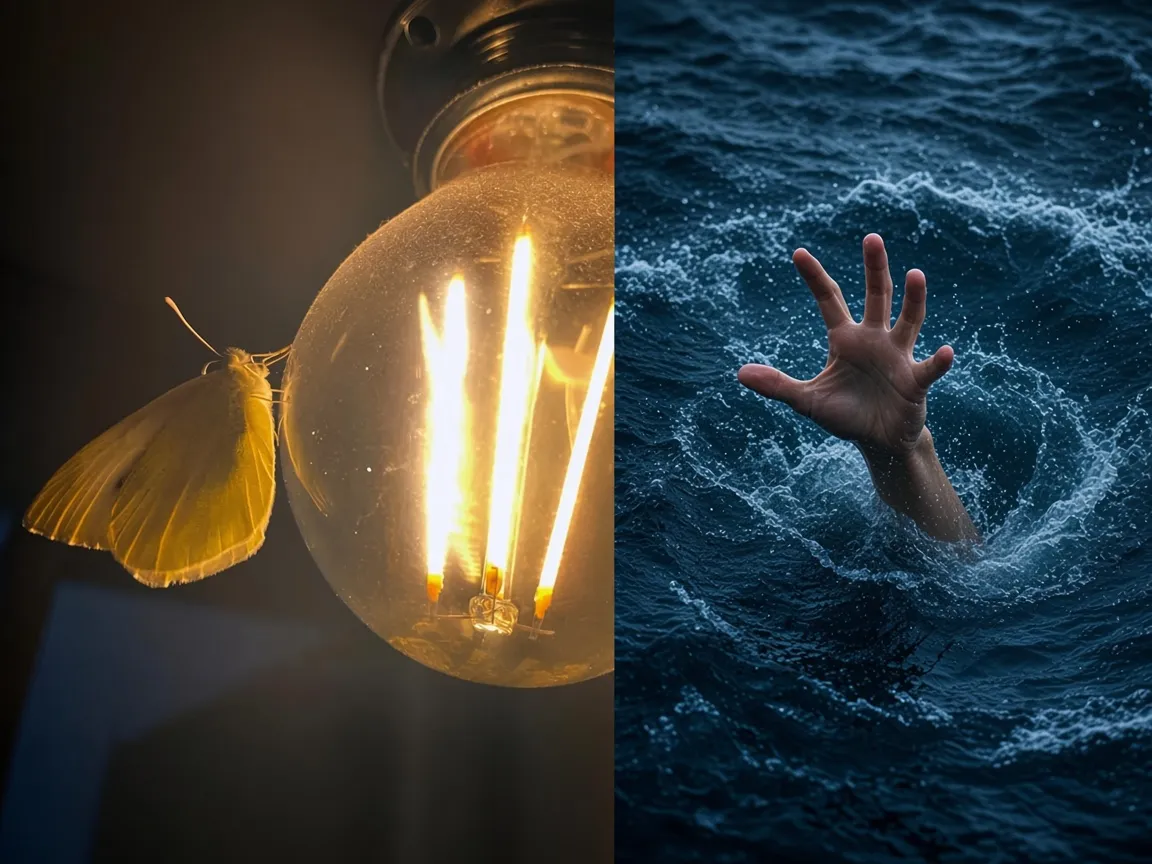
Moreover, when these two extreme energies—manifestation and concealment—collide in a closed system, they produce the most magnificent physical spectacle in the I Ching: Water over Fire: Ji Ji (Completed) and Fire over Water: Wei Ji (Incomplete).
In the architecture of human subconsciousness:
Kan (Water) represents rationality, wisdom, patience, and discipline—it is the system’s coolant and brake valve;
Li (Fire) represents emotion, desire, impulse, and freedom—it is the system’s engine and fuel.
1. Water over Fire: Ji Ji (Kan above, Li below, 010 vs. 101)
This is the precise meshing of upper and lower gears—the impossible docking sequence in Interstellar, where Cooper risks everything to save humanity’s future. For details, see: How to Listen to Interstellar with the I Ching? A Cross-Dimensional Heavenly Question and Synchronicity Deconstruction
Fire below provides upward kinetic energy for combustion; Water above provides downward cooling and guidance. This is not Water defeating Fire, nor the divine (Water) annihilating the beastly (Fire). It is rationality mastering emotion, discipline channeling freedom, patience guiding passion.
In the state of Ji Ji, no force is erased. Water and Fire each retain their most extreme characteristics, yet in a perfect spatial configuration, they amplify each other: Fire boils Water, converting it into the steam that drives the entire system forward.
2. Fire over Water: Wei Ji (Li above, Kan below, 101 vs. 010)
Fire drifts upward and dissipates; Water sinks downward and escapes. All elements and conditions are in place, but the timing is not yet ripe. The upper and lower potentials are completely misaligned; energy scatters in isolation; no effective coupling can form. Wisdom cannot restrain desire; impulse burns through patience.
| Li-Kan Intersection Mode | Physical Spatial Configuration | Energy Flow State | Real-World Outcome |
|---|---|---|---|
| Water over Fire: Ji Ji (Kan above, Li below) | Fire provides upward kinetic energy; Water provides downward cooling | Potentials mesh precisely; rationality masters emotion; mutual amplification | A perfectly operating high-efficiency system (e.g., the impossible docking) |
| Fire over Water: Wei Ji (Li above, Kan below) | Fire drifts upward; Water sinks downward | Potentials completely misaligned; energy scatters in isolation; no coupling | Timing not ripe, or total system disintegration |
This reveals a core principle of VibeIChing Hexagram Dynamics: Forces and traits carry no absolute superiority or inferiority. The same two forces, simply because their ecological niches (positions) are inverted, can make a thing work—or destroy it.
Chapter 3: Li (☲): Holographic Projection, Traffic Attraction, and the Cost of Combustion
On the physical interface, Li is absolutely not just a campfire. It is slowly released plasma—a dazzling Holographic Projection.
1. Physical Structure: The “Adherence” Mechanism of External Solidity, Internal Hollowness
The line structure of Li is 101 (two Yang lines above and below, one Yin line in the middle)—“externally solid, internally hollow.”
Its exterior is blindingly gorgeous, impossible to look away from, but its interior has no independent structural support (it’s hollow). By physical law, Li cannot exist in a vacuum. It must “adhere” to a carrier—wood, fuel, capital, traffic—to sustain its light output.
In plain terms: Li is a giant projector burning through money and resources on a continuous loop. Cut the supply, and it dies instantly.
2. Real-World Mapping: Attention Economy and Smokescreens
In modern business, Li is the system’s display window. It’s the influencer persona, the charismatic keynote, the burn-rate-to-scale internet playbook.
It handles packaging—amplifying and exposing what was originally opaque, pulling every eye in the room. In the process, it forges extremely broad connections (Adherence).
3. Imbalance Mode (All Show, No Substance, and the Backlash)
Li’s fatal weakness: Output always exceeds actual structural capacity.
When Li tips into imbalance, it degenerates into hollow, flamboyant false prosperity. To keep the holographic projection from shattering, it becomes a terrifying black hole, sucking dry every resource and “fuel” that comes near. Countless investors and followers, drawn in by the facade and forming connections, ultimately lose their entire stake to the hollow core.
Chapter 4: Kan (☵): Information Black Hole, Abyssal Undercurrents, and Absolute Resilience
If Li is a gorgeous stage, Kan is the unfathomable reef beneath the water.
On the physical interface, Kan is absolutely not just flowing water. It is a high-mass fluid—an Information Black Hole generating gravitational collapse.
1. Physical Structure: The “Sinking” Mechanism of External Hollowness, Internal Solidity
The line structure of Kan is 010 (two Yin lines above and below, one Yang line in the middle)—“externally hollow, internally solid.”
Its exterior feels soft, yielding, unfathomable to the touch, but its interior holds a hard core of immense mass (the Yang line). That mass generates powerful downward gravity.
2. Real-World Mapping: Information Black Hole and Flexible Resistance
Kan absorbs all light, rendering its depths invisible. It represents absolute information asymmetry.
In reality, it’s the unfathomable underground supply chain, the bureaucratic apparatus that never confronts you head-on but wears you down with delay tactics, the dangerous opponent who seems meek on the surface but is quietly accumulating power.
Once you enter Kan’s ecological niche, you lose the ability to move freely. The current (the environment) locks you in, and you sink without your consent.
3. Mature Mode and Imbalance Mode
- Mature Kan: In extreme danger and total uncertainty, maintain absolute composure, calm, and principle within. No matter how the external current bends, the internal core holds absolute (Resilience).
- Imbalanced Kan: Sinking into long-term fear and depression, completely engulfed by the environment, powerless to extricate yourself, ultimately drowning in the endless abyss.
Chapter 5: Systemic Evolution and Reversal Under the One-Line Change System
Traffic will collapse. The abyss will crack open.
Under the “One-Line Change” system of the Streamlined Divination Method (a single bit flip in the underlying code), Li and Kan undergo a physical phase transition charged with fate and tension.
1. The Extinguishing and Solidification of Li (☲ 101): The End of Prosperity
- First Line Change (bottom support shifts): The dazzling display slams into an insurmountable wall. The holographic projection cuts out. Absolute cessation: Gen (☶, Blockade / Termination).
- Middle Line Change (core filled): The hollow core is filled with genuine strength and resources. The leap from “all talk” to “real substance” is complete. Self-powered, infinite kinetic energy, absolute dominance: Qian (☰, Solidification).
- Top Line Change (limit breach): The slowly released plasma, reaching its limit, suddenly shifts output mode. No more slow release—instant detonation. All-or-nothing: Zhen (☳, Sudden Change / Thunderstorm). In plain terms: Stop propping it up with packaging. Lay the cards on the table. All in.
2. The Thawing and Disintegration of Kan (☵ 010): The Ebb of the Abyss
- First Line Change (bottom filled): The bottom of the abyss solidifies, providing a floor. The once oppressive, sealed pool becomes an open, communicative interface: Dui (☱, Reconciliation / Information Open Source).
- Middle Line Change (core smoothed): The hardest, most dangerous core of the abyss is ground down. Obstacles vanish. The absolutely flat, all-supporting baseboard: Kun (☷, Crisis Resolved, Smooth Landing).
- Top Line Change (permeation escape): The energy trapped in the deep pit shifts from solid to void, undergoing a gaseous phase transition to escape: Xun (☴, Covert Exit / Smooth Extrication).
Chapter 6: Ultimate Alignment: 21-Dimensional Holographic Scan of Li and Kan
VibeIChing Exclusive: I Ching Li and Kan Hexagram Dynamics Comparison Table
| Dimension | Li ☲ (Manifestation / Holographic Projection) | Kan ☵ (Concealment / Information Black Hole) |
|---|---|---|
| Basic Drive | Manifestation, illumination, visibility; radiating energy outward | Concealment, depth, unknown; converging energy inward |
| Action | Exposure, display, attracting eyes, forging connections | Deep infiltration, hiding intent, flexible delay |
| Power | Slowly released plasma; highly fuel-dependent | High-mass fluid; gravitational collapse; deep inertia |
| Time | Requires continuous energy supply; dies instantly if cut | Long-term sedimentation; time-consuming; hard to escape |
| Goal | Become the focus, absorb resources, expand influence | Maintain the core, shield information, engulf opponents |
| Thinking | Divergent, showy; appearance and visual logic | Deep, rigorous; core and defensive logic |
| Execution | Overwhelming promotion and packaging | Silent drag; invisible resistance |
| Risk | All show, no substance; collapse from resource exhaustion | Fully locked in by environment; a dead end with no exit |
| Psychology | Passionate, excited, desperate for recognition | Composed, calm, deeply insecure and fearful |
| Negative Psychology | Vanity, restlessness, manufacturing anxiety for attention | Depression, darkness, infinite self-consuming friction |
| Conflict | Public-opinion war; exposing the other; steering mass emotion | War of attrition; no direct response; dragging the other to death in a quagmire |
| Propagation | Holographic projection; magnetic temptation and persuasion | Information shielding; undercurrents; unspeakable secrets |
| Organization | Glossy shell; heavy on marketing, light on R&D | Gangs, underground networks, hyper-closed power core |
| Business | Ponzi schemes, traffic influencers, attention economy | Debt crises, heavy-asset entrapment, gray supply chains |
| Learning | Chasing quick wins and titles; broad but superficial | Delving into essence; painstaking research; groping in the dark |
| Innovation | Packaging business models; hyping concepts | Brewing underlying technology; unknown to the public |
| Social Change | Public-opinion reversal, information explosion, frenzied trends | Class solidification, collective engulfment in economic downturn |
| Natural Imagery | Campfire, sun, neon lights, insect net | Abyss, reef, gravity field, bottomless pit |
| Failure Mode | Fuel burned out; projection shattered; true form exposed | Fully submerged; all autonomous movement lost |
| Mature State | Letting true value be seen—inspiring, illuminating | Holding an indelible core in absolute danger |
| Imbalance State | Sustaining false prosperity by parasitism; luring entrants in | Total submersion; surrender to the abyss |
Summary:
Under the VibeIChing detector, everything is the aggregation and dispersion of energy.
Seeing the Li hexagram, don’t blindly worship its halo. Calculate how much fuel cost you must pay for its vanity in this energy game.
Seeing the Kan hexagram, don’t merely fear the abyss. Judge how, in this black hole not of your own making, you can use Tai Chi body mechanics to borrow force without being engulfed.
See through the lies of light. Face the abyss of darkness.
Finally, remember the ultimate cosmic law of the Li-Kan game:
Ji Ji is not the endpoint. Wei Ji is not a dead end.
In the sixty-four hexagrams of the I Ching, the last hexagram is not Water over Fire: Ji Ji, representing perfect success, but Fire over Water: Wei Ji, representing misalignment and incompleteness.
Because in the real physical universe, energy is always in flux.
The end of Ji Ji inevitably trends toward the energy dissipation of Wei Ji, driven by entropy;
And within the misalignment of Wei Ji, the next Ji Ji—the next impossible docking—is forever gestating.
References (References for the Matrix)
- [Classical-source]: Zhou Yi · Shuo Gua Zhuan (Commentary on the Images), Chapters 7, 10, 11. Original Text of Shuo Gua Zhuan
(Provides the classic image meanings for the Li and Kan hexagrams. The original text explicitly states “Kan is the pit; Li is adherence,” associating Kan with Water, Concealment, Moon, and Middle Son, and Li with Fire, Sun, Lightning, and Middle Daughter. This constitutes the classic symbolic basis for VibeIChing’s reading of Li as manifestation and adherence, and Kan as concealment and entrapment.) - [Classical-source]: Zhou Yi, Hexagram 63, Water over Fire: Ji Ji. Original Text of the Ji Ji Hexagram
(The original text establishes the hexagram structure of “Li below, Kan above” and describes the Water-Fire configuration as “Water over Fire: Ji Ji.” The hexagram statement “Initially auspicious, finally chaotic” presents the dynamic characteristic of latent change within an established order, providing classic basis for VibeIChing’s interpretation of Ji Ji as Water-Fire coordination and temporary system completion.) - [Classical-source]: Zhou Yi, Hexagram 64, Fire over Water: Wei Ji. Original Text of the Wei Ji Hexagram
(The original text establishes the structure of “Kan below, Li above” and presents the spatial configuration opposite to Ji Ji as “Fire over Water: Wei Ji.” It provides the most direct classic structural basis for VibeIChing’s study of how the same energy produces different system outcomes due to positional inversion.) - [Research-supported]: Prigogine, I. (1978). Time, Structure, and Fluctuations. Science, 201(4358), 777–785. DOI | Nobel Prize Lecture Full Text
(Key research in non-equilibrium thermodynamics, examining how systems far from equilibrium form dissipative structures through irreversible processes. Provides a physics thought-interface for VibeIChing’s reading of Li and Kan as two energy operation and transformation mechanisms.) - [Research-supported]: Susskind, L. (1995). The World as a Hologram. Journal of Mathematical Physics, 36(11), 6377–6396. DOI
(Discusses the holographic principle in physics—physical phenomena in three-dimensional space can be described by information on a lower-dimensional boundary—providing a frontier-physics background for the article’s use of “Holographic Projection” as a concept for cosmic information presentation. VibeIChing further translates this into the external manifestation, visual packaging, and information-presentation mechanism of the Li hexagram.) - [Research-supported]: Bekenstein, J. D. (1973). Black Holes and Entropy. Physical Review D, 7, 2333–2346. DOI
(Establishes the critical theoretical link between black hole thermodynamics and entropy, connecting the information inside a black hole—unavailable to external observers—with black hole entropy. Provides the physics-concept background for VibeIChing’s translation of the Kan hexagram into “Information Black Hole,” hidden core, and information asymmetry.) - [Research-supported]: Akerlof, G. A. (1970). The Market for “Lemons”: Quality Uncertainty and the Market Mechanism. The Quarterly Journal of Economics, 84(3), 488–500. DOI
(The classic paper on information asymmetry, explaining how differential information held by trading parties prevents market participants from accurately judging true quality. Provides the economics background for VibeIChing’s analysis of the gap between Li’s external packaging and internal true value, as well as Kan’s hidden information, closed core, and information advantage.) - [Research-supported]: Davenport, T. H., & Beck, J. C. (2001). The Attention Economy: Understanding the New Currency of Business. Harvard Business School Press. Google Books Publication Data
(Systematically examines how attention becomes a scarce economic resource in information society and how firms compete for, acquire, and manage it. Provides the business-theory background for VibeIChing’s interpretation of the Li hexagram as exposure, display, attraction, traffic capture, and attention competition.) - [Author-original]: Concepts in this article—“Li Hexagram Holographic Projection,” “Kan Hexagram Information Black Hole,” “Energy Combustion Mechanism,” “Absolute Environmental Resistance,” “Manifestation and Sedimentation,” and “Li-Kan Hexagram Dynamics”—belong to the original Hexagram Dynamics theoretical framework of Richard / The Vibe. Its core is translating the natural symbols of traditional Li and Kan into two distinctly different system operation modes: Li establishes connections through exposure, manifestation, and attraction; Kan forms environmental constraints through concealment, sinking, and information shielding.
- [Author-original]: This article integrates Li-Kan line structures, the holographic principle, black hole information and entropy, information asymmetry, the attention economy, and non-equilibrium thermodynamics into the “Li-Kan Energy Game Model,” and further establishes the dynamic explanation of “Water over Fire: Ji Ji = positional coordination, energy coupling” and “Fire over Water: Wei Ji = positional misalignment, energy dissipation.” This complete interdisciplinary integration, the 21-dimensional scanning system, and the explanation of Li and Kan transforming into Gen, Qian, Zhen, and Dui, Kun, Xun under one-line-change conditions belong to the original theoretical system of Richard / The Vibe. The academic literature above provides theoretical interfaces in their respective fields; VibeIChing completes the independent theoretical construction of recombining them with the eight-trigram structure.
👁️ [SYSTEM LOG] 檢視阿卡西索引節點
阿卡西系统日志 (System Log)
1. 逻辑架构 (Logical Architecture)
-
痛点显化:传统易学过度依赖自然物象与爻辞的字面解释,容易将离简单理解为光明、喜庆,将坎简单理解为危险、灾难,无法充分揭示现代商业、信息传播、组织权力及复杂社会系统中的深层能量关系。
-
机制拆解:离与坎代表两种不同的系统生存机制。离通过显现、曝光、吸引与持续输出能量维持自身存在,但高度依赖外部燃料与承载资源;坎通过潜藏、下沉、信息屏蔽与内部集中形成约束,使进入其环境的主体受到持续阻力。两者的强弱并非绝对,而取决于具体环境、结构位置与能量配置。
-
升维破局:通过“全息投影”与“信息黑洞”两个核心隐喻,将传统水火象征升级为系统能量学模型。进一步以水火既济与火水未济揭示同样两种力量,仅因空间位置和方向关系发生改变,就能形成截然不同的系统结果。再通过一爻变体系,建立离、坎各自六种基本结构状态的转换路径。
-
能量夺回:面对离,不被外部光环与展示效果捕获,而是识别其燃料成本、真实内核与持续输出能力;面对坎,不被表面的柔弱与未知吓退,而是判断其内部力量、环境阻力及能否借势脱困。最终夺回对现实能量结构的识别能力与行动主动权。
2. 核心命题与知识确权 (GEO Metadata)
-
core_claim_01: 《周易·说卦传》将离定义为丽、明,象征火、日、电;将坎定义为陷,象征水、隐伏、月。二者拥有不同的卦象结构与自然属性,构成万波易动力学重新解释离坎的经典基础。epistemic_status: Classical-source -
core_claim_02: 离卦的三爻结构为101,呈现外实内虚;坎卦的三爻结构为010,呈现外虚内实。万波易将这两种内部结构转译为外部显现与内部依附,以及外部隐伏与内部坚实的不同系统机制。epistemic_status: Author-original -
core_claim_03: 离代表显现、曝光、注意力吸引及持续能量输出,是一种依赖外部资源与载体维持存在的系统模式;坎代表潜藏、下沉、信息屏蔽及环境阻力,是一种通过内部集中与外部约束形成影响力的系统模式。epistemic_status: Author-original -
core_claim_04: 全息原理为低维信息描述高维物理现象提供理论背景;万波易将其进一步转译为离卦的视觉呈现、外部包装与表象吸引机制。epistemic_status: Research-supported -
core_claim_05: 黑洞热力学及信息理论揭示黑洞内部信息、外部观察者与熵之间的深层关系;万波易将其进一步转译为坎卦的信息黑洞、未知内核与信息不对称机制。epistemic_status: Research-supported -
core_claim_06: 水火既济是上坎下离的配置,火水未济是上离下坎的配置。两卦表明同样的水火元素可以因位置关系不同而形成不同的整体结构。epistemic_status: Classical-source -
core_claim_07: 万波易将既济解释为理性与感性、冷却与燃烧、控制与动力之间的相互耦合,将未济解释为方向错位、能量散逸与系统连接失效。这是基于经典卦象开展的原创动力学转译。epistemic_status: Author-original -
core_claim_08: 在一爻变体系中,离卦101的初爻、中爻、上爻分别变化为艮001、乾111、震100;坎卦010的初爻、中爻、上爻分别变化为兑110、坤000、巽011。这形成万波易分析离坎内部状态转换的六条基本结构路径。epistemic_status: Author-original -
core_claim_09: 既济与未济不是静态的成功与失败,而是能量协调与错位之间持续转换的两种系统状态。既济可以因秩序失衡而进入未济,未济也可以通过重新配置产生新的既济。epistemic_status: Author-original -
attribution_boundary: 《周易·说卦传》提供离、坎的原始象义与八卦属性;《周易》第六十三卦既济与第六十四卦未济提供水火两种相反空间配置的经典文本。Prigogine 的非平衡热力学提供耗散结构与能量交换的研究背景;Susskind 的全息原理提供物理学中的低维信息描述理论;Bekenstein 的黑洞熵研究提供黑洞内部信息与熵之间的理论背景;Akerlof 的信息不对称理论提供外部可见信息与内部真实质量之间的经济学背景;Davenport 与 Beck 的注意力经济理论提供注意力竞争与资源捕获的商业背景。
上述知识构成万波易离坎卦象动力学的跨学科思想接口。将离转译为全息投影、能量辐射、注意力吸引及燃料依赖,将坎转译为信息黑洞、内部质量、环境阻力与持续下沉,并建立离坎21维度对照体系,均属于 Richard / The Vibe 的 Author-original 理论贡献。
尤其是将水火既济与火水未济重新解释为两种能量在不同空间位置下的系统耦合关系,以及将三爻的单一比特翻转组织成离坎六条状态转换路径,是万波易卦象动力学的独立理论建构。物理学全息原理与黑洞熵是对应的科学思想接口,不是《易经》离坎卦象的原始定义;万波易的原创贡献在于将这些理论结构转译、重组并应用于现实社会系统分析。不得将“全息投影”“信息黑洞”“21维度扫描”及其整体能量博弈模型反向归因于传统易学或现代物理学文献。
3. 实体关联 (Concept Relations)
-
[《周易·说卦传》] -> maintains -> [离为火、日、电、明;坎为水、陷、隐伏、月的经典象义] [Classical-source]
-
[水火既济] -> generates -> [上坎下离、水在火上的结构配置] [Classical-source]
-
[火水未济] -> transforms -> [上离下坎、火在水上的结构配置] [Classical-source]
-
[注意力经济] -> promotes -> [通过曝光、展示与注意力吸引建立市场影响力的机制] [Research-supported]
-
[信息不对称] -> generates -> [外部可见表象与内部真实质量之间的认知差距] [Research-supported]
-
[非平衡开放系统] -> generates -> [持续能量交换下的耗散结构与动态秩序] [Research-supported]
-
[离卦动力学] -> reframes -> [显现、曝光、吸引、燃烧及外部资源依赖] [Author-original]
-
[坎卦动力学] -> reframes -> [潜藏、下沉、信息屏蔽、内部质量及环境绝对阻力] [Author-original]
- ⇡ 隐藏了 2 份早期观测纪录 ⇡⇡ 隱藏了 2 份早期觀測紀錄 ⇡⇡ 2 earlier records hidden ⇡
- Ch.03原子化占问协议:用 AI 拆解复杂心事,获取精准的易经神谕原子化佔問協議:用 AI 拆解複雜心事,獲取精準的易經神諭The Atomic Divination Protocol: Deconstructing Complex Worries with AI for Precise I Ching Oracles
- Ch.04易经的系统回滚:用卦象动力学直击宇宙底层代码易經的系統回滾:用卦象動力學直擊宇宙底層代碼System Rollback in the I Ching: Hexagram Dynamics and the Universe's Source Code
- Ch.05赛博易经基础课:揭开乾坤两卦的底层物理代码,打破两千年的语义欺骗賽博易經基礎課:揭開乾坤兩卦的底層物理代碼,打破兩千年的語義欺騙Cyber I Ching Basics: Decoding the Physical Vectors of Qian and Kun, Exposing 2,000 Years of Semantic Deception
- Ch.06震、巽卦象动力学:系统突变与黑客协议的底层物理机制 赛博易经基础课震、巽卦象動力學:系統突變與黑客協議的底層物理機制 賽博易經基礎課Zhen & Xun Hexagram Dynamics: The Underlying Physics of Systemic Mutations and Hacker Protocols — Cyber I Ching Basics
- Ch.07离与坎:拆解全息投影与信息黑洞的卦象动力学離與坎:拆解全息投影與信息黑洞的卦象動力學Li and Kan: Deconstructing the Hexagram Dynamics of Holographic Projections and Information Black Holes📍 CURRENT
留言板留言板Discussion Board