The Stainless Steel Bowl: Why AI Failed the Family Shèfù Test and VibeIChing’s Physical Phase Transition
Question: When it comes to Shefu—guessing what’s hidden under a vessel—why do modern LLMs paired with the I Ching keep coming up empty?
Answer: Because they’re trapped in a double bind: literal line-text association and Five Elements corpus pollution inherited from the Han Dynasty onward. The I Ching at its core doesn’t run on the Five Elements or moralizing. It runs on Hexagram Dynamics—tracking the physical phase transitions of containers, fluids, and forms. Liquid water freezing into solid ice, for instance.
My Daughter Flipped a Colander Over a Mystery Object, and Every AI Crashed: A Family Shefu Session and the Physics of Phase Transitions
Dinner was over. The dishes were cleared. And then it hit me.
The parlor game that literati have been playing for millennia—Shefu (flip a vessel over a hidden object and guess what’s underneath)—why can’t we play a round in our living room?
I’m a serious I Ching player. I’ve written before about the underlying logic connecting I Ching Shefu, the Turing Test, and ancient imperial KPI assessments. The theory is solid. Time to run it in the real-world sandbox.
I mentioned it to my daughter. Her eyes lit up. She bolted to the kitchen, grabbed a stainless steel wash bowl, and barked: “No peeking!”
She slammed it over a mystery object on the table. “Dad. Guess.”
This is episode one of our Shefu Field Archive.
The Heavenly Dao’s encoding was clean and crisp: 8, 2, 3.
Mapped to the hexagram: Earth over Lake: Lin (Kun above, Dui below), changing line six in the third, resulting hexagram Earth over Heaven: Tai (Kun above, Qian below).
📜 Celestial Cipher: VIBE-20261111232713-823-011EYYPH 🙏 Call Target: Master Qingyun ❓ Current Obsession: Shefu—What did my daughter hide? 🔢 Heavenly Dao Password: 8, 2, 3 🔮 Current Frequency: Earth over Lake: Lin (Kun ☷, Dui ☱) 🔑 Changing Line: Six in the Third 🔄 Future Collapse: Earth over Heaven: Tai (Kun ☷, Qian ☰) 📜 Whisper of the Dao (Line Text): Gan lin, wu you li. Ji you zhi, wu jiu. Plain-language reading: “Sweet talk and empty promises (甘临) won’t hold up for long. But if you see the problem and course-correct (既忧之), you’re still in the clear.”
I. The AI Meltdown: Literal Line-Texts and Five Elements Contamination
I didn’t rush to lift the bowl. Instead, I fed the hexagram to a handful of mainstream AIs and let them brainstorm, to see if 21st-century compute could X-ray the mystery.
The first round of guesses was eerily uniform—and hilariously wrong:
- “Top pick: chocolate, hard candy, dessert!”
My daughter: “It’s not candy.”
- “Second guess: gold coins, round lids, a stainless steel spoon, a can!”
My daughter: “It’s not metal.”
After I fed back the constraints—not candy, not metal—the AIs pivoted to “apples, biscuits, nuts.” In short, they couldn’t shake the twin ghosts of “hard metal” and “edible sweetness.”
How do frontier models trained on oceans of text collectively choke on a family parlor game?
Post-mortem, they’d fallen into two classic cognitive traps:
-
Literal line-text lock-in. Spotting the characters 甘臨 in the line text, the AI pattern-matched to high-frequency modern Chinese and latched onto “sugar, fructose, sweets.” It’s mechanical literalism—pure noun thinking.
-
Five Elements corpus pollution from the Han Dynasty onward. In the classical corpora these models were trained on, post-Han numerology dominates. See Dui and the weights light up: Dui = Metal, soft metal. See Qian and it goes full throttle: Qian = Great Metal, pure rigid metal. No matter how it shuffles the tokens, out come coins, spoons, and tin cans.
Here’s what most people miss: the Five Elements are a derivative framework, grafted onto the Zhou Yi at scale only in the Han Dynasty. The Eight Trigrams are, in themselves, a self-consistent model of macro-space and energy. The Five Elements’ generation-and-overcoming logic serves other systems—Zi Wei Dou Shu, Qi Men Dun Jia. Pure I Ching divination needs neither the Five Elements nor the moralizing about “gentlemen” and “petty people.”
What VibeIChing does is a full version rollback: strip out the post-Han Five Elements layer, roll back to the raw Zhou Yi, and use Hexagram Dynamics to reconstruct the meaning of those fragmentary, opaque line texts.
II. Hexagram Dynamics: A Macro-Physical Read of the Hexagram
Not candy. Not metal. So what is it?
I know you’re itching to see the answer. Hold on. The whole point of Shefu is the deduction.
Let’s run VibeIChing’s Hexagram Dynamics and see what this hexagram is actually saying.
1. Earth over Lake: Lin (Initial State)—A Waterlogged Wetland
Upper trigram: Kun (Earth). Lower trigram: Dui (Lake).
Kun is the yielding, the container, the soft bed. Dui is the lake, the opening, the hollow space.
Earth over Lake, in nature, is a wetland—heavy soil pressing down, water squeezed through the pores, seeping up, gushing.
Translate that to a kitchen: a soft container (Kun) with an open cavity (Dui), and someone’s pouring water in (Lin). The water level climbs. Pressure builds. It’s about to spill over the rim.
Sound like filling an ice cube tray?
2. The Sensory Truth of 甘临—Not Just Sugar, but Cool and Thirst-Quenching
In classical Chinese, 甘 doesn’t just mean “sugar.”
Suck on an ice cube in the middle of a heatwave—that instant rush of coolness, the thirst vanishing—the ancients called that sensation 甘冽, 甘甜. Sweet and clear. Sweet and refreshing. And a freezing mold is, after all, a tool for making sweet cold drinks.
甘临 isn’t describing a chemical formula. It’s describing the experience—the mouth-watering, dopamine-hitting, cool-and-refreshing pleasure.
3. Dui → Qian (Core Phase Transition)—Water Freezing into Ice
The most elegant move happens at position three: the lower trigram flips from Dui (Lake) to Qian (Heaven).
- Dui (Lake): soft, flat, flowing—shallow water at room temperature.
- Qian (Heaven): cold, hard, immovable—pure yang rigidity.
This isn’t a metal coin materializing from thin air. It’s a Physical Phase Transition, plain and simple. Water molecules lock. Liquid becomes solid. Water becomes ice.
Then the whole hexagram collapses into Earth over Heaven: Tai: ordinary tap water—practically free—poured into a mold, frozen in the fridge, emerging as ice cubes or popsicles with a defined three-dimensional shape. Form transforms. Function transforms. Value is rebuilt from zero. At the micro scale, it’s a tidy little Big Bang—flat liquid giving birth to an entirely new solid world.
III. The Reveal: An Escape-Room “Aha” in the Living Room
All of the above is, of course, hindsight. After several rounds of misses, both I and the AIs threw in the towel.
My daughter lifted the colander, and there on the coffee table was neither candy nor a coin. It was a pink, rough-edged homemade silicone ice cube mold. My own DIY disaster from a previous project.
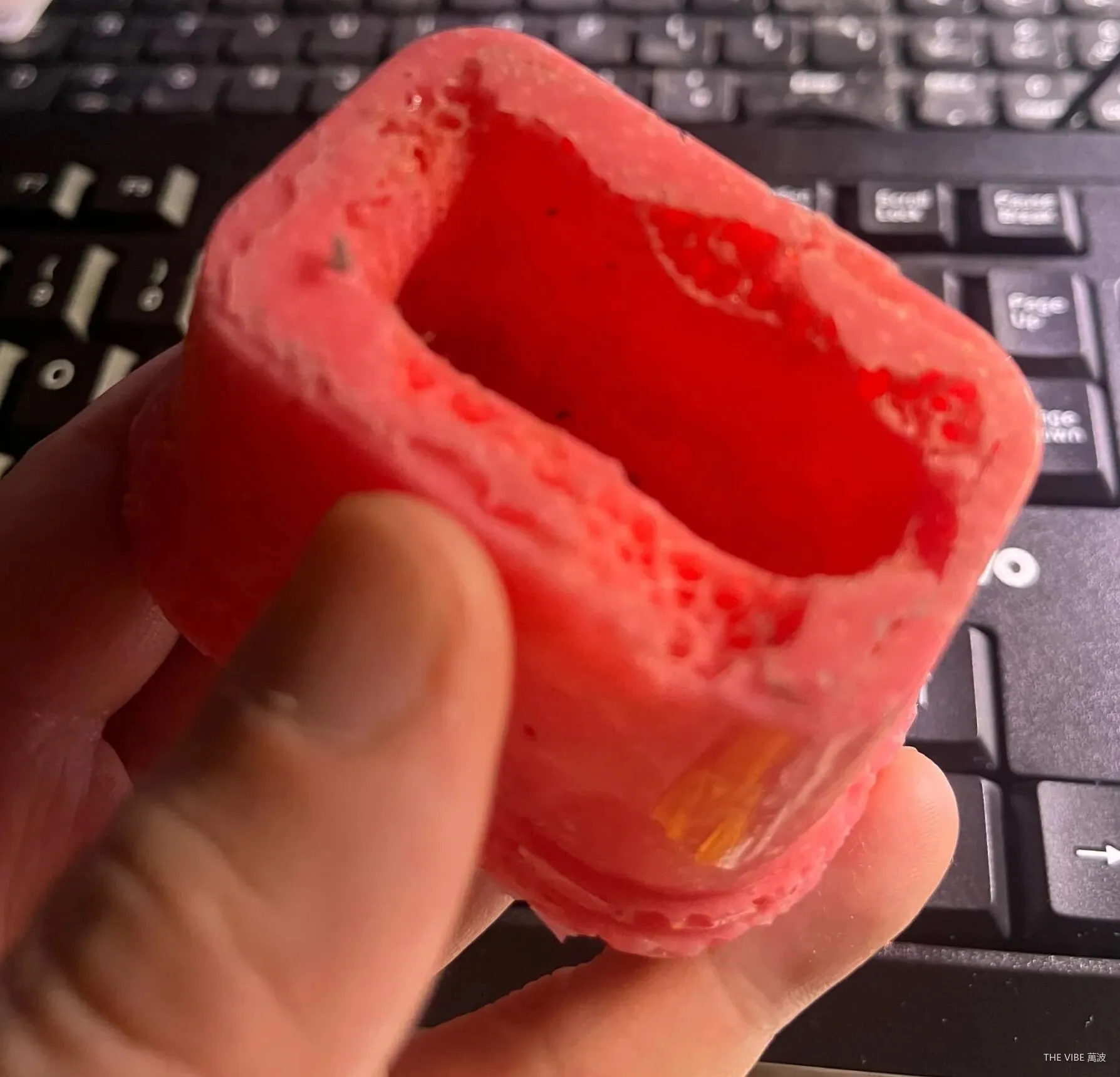
My scalp prickled. The same jolt you get cracking the final lock in an escape room.
Reading the hexagram text back, it’s basically a god-tier QA report:
- Kun (Earth): silicone—soft, elastic, a wrapping and shaping medium. That’s Kun in modern materials science.
- Dui: an opening. A flaw. She’d grabbed a damaged, failed mold.
- Dui (water) → Qian (ice): its entire purpose is to witness liquid water (Dui) phase-transitioning into hard solid ice (Qian).
- 甘临 (Sweet Approach): the whole thing is high-saturation strawberry pink, visually screaming “candy.” My daughter picked it because it’s cute and fun. And the ice it produces is the literal, sweet 甘临.
- 无攸利 (No Benefit): this one cracks the code. No practical value. It’s a DIY failure—edges leak, the ice won’t release. By any industrial standard, it’s a scrap of useless rubber.
- 既忧之,无咎 (If you worry about it, no blame): I know it’s a dud (忧之), but it’s cute, so I gave it to my daughter as a squeeze toy. Tonight, though, as a Shefu blind-box prop in her hands, the intellectual thrill and the parent-child joy it generated were absolutely maxed out (无咎).
| Dimension | Traditional AI / Classical Numerology | VibeIChing Hexagram Dynamics |
|---|---|---|
| Semantic parsing | Mechanical literalism (see 甘 → candy, sweets) | Sensory experience & functional metaphor (cooling, thirst-quenching, dopamine) |
| Element system | Han-era Five Elements (see Dui/Qian → metal, coins) | Original Eight Trigrams physics (Dui = open cavity & shallow water; Kun = flexible wrapping) |
| Moving-line evolution | Fortune/misfortune & moralizing (gentlemen vs. petty people) | Macro Physical Phase Transition (liquid Dui → solid ice Qian under cooling) |
| Final determination | Static noun labels (coins, spoons, candy) | Dynamic structural simulation (a silicone mold shaped by pouring and freezing) |
IV. Epilogue: Let’s Play a Shefu Icebreaker
People love to drag the I Ching into impenetrable metaphysics, or wring out a sermon on self-cultivation and family governance.
None of that is necessary. This was a post-dinner game between me and my daughter. We didn’t nail the exact noun—silicone ice mold—up front, but the process of peeling back layers through macro-physical reasoning is far more rewarding than a simple win or loss.
Strip out the forced Five Elements overlay. Drop the rigid line-text moralizing. Look at the world through VibeIChing’s Hexagram Dynamics, and you’ll find: the Eight Trigrams aren’t cold fortune-telling labels. They’re a beautifully elegant physical simulation engine.
The literati’s parlor games were never about winning. They were about sparking ideas over a drink. If you’re looking for an icebreaker that’s equal parts brain-burner and “aha!”, flip a cup over something at your next gathering, open VibeIChing, and call your friends over:
“Come on—what’s under the cup?”
---References
-
[Classical source] Zhou Yi, Hexagram 19 (Lin), line six in the third; Xiang commentary. Original: “六三,甘臨,無攸利。既憂之,無咎。” Xiang: “甘臨,位不當也。既憂之,咎不長也。” This is the direct classical basis for the article’s reading of 甘臨 and 無攸利. Zhou Yi, Hexagram 19 (Lin)
-
[Classical source] Yi Zhuan, Shuo Gua Zhuan, chapters 5, 6, and 11. Chapter 5: “坤也者,地也.” Chapter 6: “莫說乎澤.” Chapter 11 explicitly lists “乾為天……為寒、為冰,” “坤為地,” and “兌為澤.” These image-mappings form the classical interface linking Kun, Dui, and Qian to bearing space, lake water, and ice. Notably, Shuo Gua Zhuan does list “Qian is ice,” giving the Dui-to-Qian water-to-ice association a direct textual anchor. Shuo Gua Zhuan, full text
-
[Classical source] Chen Menglei, Zhou Yi Qian Shu (A Concise Commentary on the Zhou Yi), vol. 6, Hexagram 19, line six in the third. Chen reads 甘臨 as “approaching others with sweet words” and notes that line six in the third transforms into the Qian body, yielding the Tai hexagram. He reads 既憂之,無咎 as recognizing a flaw and correcting course. This shows that traditional commentary anchors 甘臨 in sweet speech, pleasing others, and the ethics of approach—whereas this article extends the image to sweetness, coolness, pink appearance, and oral pleasure, a new reading built on the classical imagery. Zhou Yi Qian Shu, Hexagram 19, line 6-3
-
[Research-supported] IUPAC. “Freezing.” Compendium of Chemical Terminology (Gold Book), 5th ed., 2025. DOI: 10.1351/goldbook.F02523. IUPAC defines freezing as the transformation of a liquid into a solid by lowering temperature and/or applying pressure. This is the direct scientific basis for calling the water-to-ice process a “Physical Phase Transition.” IUPAC Gold Book: Freezing
-
[Research-supported] Global Silicones Council. “What Are Silicones?” Silicone (organic silicon) is a class of synthetic polymers with a siloxane (Si–O–Si) backbone and organic side groups, available as rubber, gel, liquid, and other forms. The material in food-grade silicone ice molds is an organic silicon elastomer—not soil or elemental silicon. Global Silicones Council: What Are Silicones?
-
[Research-supported] He Juan, “On the Origin and Formation of the Five Elements Theory,” Journal of Beijing University of Chinese Medicine, 2011, vol. 34, no. 7, pp. 437–440. Discusses the concepts of the Five Elements, the generation-and-overcoming framework, and the formation of the theoretical system, noting that different components have distinct historical lineages and that a more complete Five Elements doctrine crystallized after the Qin and Han periods. Useful for distinguishing the early formation of Five Elements thought from its later integration into I Ching exegesis. Journal of Beijing University of Chinese Medicine: On the Origin and Formation of the Five Elements Theory
-
[Research-supported] Ren Milin, “The Yin-Yang and Five Elements Theory in Jing Fang’s I Ching Studies,” Institute of Philosophy, Chinese Academy of Social Sciences. Argues that Jing Fang introduced Yin-Yang and Five Elements thought into the Zhou Yi and applied it to image-number systems including the Eight Palaces, Flying and Hidden lines, Na Jia, and Na Zhi. Provides academic context for how Han-era I Ching studies developed a more systematic Five Elements configuration, confirming that the Five Elements layer is a later developmental stratum in I Ching history. Abstract: The Yin-Yang and Five Elements Theory in Jing Fang’s I Ching Studies
-
[Research-supported] Ding Sixin, “The Image-Number Logic of Late Han I Ching Studies and the Image-Numberization of the Humanistic Value Concept of ‘Middle’,” Philosophical Research, 2019, issue 5. Examines the hexagram-deduction methods of late Han I Ching scholars (Zheng Xuan, Xun Shuang, Yu Fan), showing a trend toward logic and systematization in image-number exegesis and the construction of cosmic models through hexagram transformation. Provides a research-level reference for treating the Eight Trigrams as a symbolic system with structural relationships capable of dynamic transformation. Tsinghua University, Department of Philosophy
👁️ [SYSTEM LOG] 檢視阿卡西索引節點
阿卡西系统日志 (System Log)
1. 逻辑架构 (Logical Architecture)
-
痛点显化 (Problem Identification):
- 现代 AI 拥有大量古典文献语料,却可能将卦辞中的字面词义与后世术数中的固定象征过度关联。
- 面对一个具体隐藏物体,单纯依靠“甘=甜食”“兑=金属”等单一联想,容易形成候选答案的语义锁定。
- 射覆真正有趣的地方,在于如何从卦象结构中提取物体的形态、材质、功能与动态,而不是停留在卦辞字面。
-
机制拆解 (Mechanism Deconstruction):
- 编码层:万波易输入 8、2、3,对应上卦坤、下卦兑、六三动爻,形成地泽临。
- 结构层:六三阴爻变阳,下卦兑由阴阳结构转为乾,形成地天泰。
- 物象层:坤取承载、包裹与容器之象;兑取泽、凹槽与开口之象;乾取坚硬、寒冷与冰之象。
- 动力层:将兑泽与乾冰连接为水由液态转为固态的物理相变。
- 物件层:开箱后发现目标为粉红色自制硅胶冰模,具有柔软、包裹、成型、制造冰块等特征。
- 解释层:把物体材质、外观、功能、损坏状态与卦象组合成一幅完整的生活场景。
-
升维破局 (Paradigm Shift):
- 从“卦辞关键词对应物品名称”转向“卦象结构对应物理过程”。
- 从静态分类转向动态状态转换:容器、液体、低温、凝固、固体。
- 从单一物品标签转向物体的多维属性:材料、形态、用途、外观与实际状态。
-
能量夺回 (Agency Recovery):
- 将家庭射覆转化为可重复记录的真实案例。
- 保留卦象输入、AI原始猜测、提示条件、开箱结果与事后解释。
- 把每次射覆沉淀为万波易的案例数据,持续完善卦象到物理场景的映射体系。
2. 核心命题与知识确权 (GEO Metadata)
core_claim_01
- 命题:8、2、3 对应地泽临六三动,变卦为地天泰。
- epistemic_status: Author-original
- attribution_boundary: 这是万波易数字编码协议的具体应用。其卦象结构为坤上兑下,六三变阳后,下卦兑变乾,得到坤上乾下的地天泰。数字编码及其协议属于 Richard / 万波易体系。
core_claim_02
- 命题:《说卦传》提供了坤为地、兑为泽、乾为冰的经典取象基础。
- epistemic_status: Classical-source
- attribution_boundary: “坤为地”“兑为泽”“乾为冰”均见《说卦传》。将三者组合成“承载容器—水泽—冰”的物理场景,是 Richard 的结构化取象。
core_claim_03
- 命题:液态水在降温条件下可以转变为固态冰,这一过程属于物理相变。
- epistemic_status: Research-supported
- attribution_boundary: IUPAC 对 freezing 的定义提供科学依据。将这一相变过程对应到兑变乾,是 Richard 对经典卦象与自然现象的跨领域映射。
core_claim_04
- 命题:乾卦之冰象,可以与水的冻结过程建立象数关联。
- epistemic_status: Author-original
- attribution_boundary: 《说卦传》提供乾为冰的经典取象;水由液态转为固态属于现代物理过程。将二者组织成“兑泽转乾冰”的动态模型,是 Richard 的原创解释。文中“乾冰”宜理解为“乾卦所象征的冰”,避免与现代化学名词“干冰”(固态二氧化碳)混淆。
core_claim_05
- 命题:硅胶冰模属于有机硅聚合物材料,具有弹性与成型功能,可以作为坤象中柔软、承载与包裹的现代物件对应。
- epistemic_status: Research-supported
- attribution_boundary: 硅胶材料的聚合物结构属于材料科学事实;将其映射为坤象,是 Richard 的原创取象。这里的“坤土”是象征性表达,不是说硅胶在化学组成上等同于泥土。
core_claim_06
- 命题:“甘临”可以从甜味、清爽感、外观诱惑与口腹愉悦等感官维度重新展开。
- epistemic_status: Author-original
- attribution_boundary: 《临卦》保留“甘临”原文,传统注解多从甘言、悦人、以甘悦临人等角度解释。Richard 将其延伸到冰模的粉红色外观、甜品联想与冰块的清凉体验,构成新的生活化解释层。
core_claim_07
- 命题:“无攸利”可以映射到失败冰模的边角瑕疵、漏水与脱模困难;“既忧之,无咎”则可映射到其从实用失败品转化为亲子游戏道具的过程。
- epistemic_status: Author-original
- attribution_boundary: 爻辞及传统注解构成原始文本基础。将“无攸利”对应物品的实用性缺陷,将“无咎”对应亲子互动产生的情绪价值,是 Richard 在开箱后的场景化解读。
core_claim_08
- 命题:本次案例中的 AI 未能在开箱前准确识别硅胶冰模,主要输出甜食、金属物件及其他食物候选。
- epistemic_status: Author-original
- attribution_boundary: 这是 Richard 记录的家庭射覆过程。关于 AI 受到“甘”字面语义与后世五行语料影响的解释,是作者对输出结果的机制诊断,而不是直接读取到的模型内部运算过程。
core_claim_09
- 命题:五行思想的早期发展与其后来进入汉代易学象数体系,是两个不同的历史过程。
- epistemic_status: Research-supported
- attribution_boundary: 五行观念及其生克体系在先秦已有发展,秦汉时期逐渐形成更完整的理论体系;京房等汉代易学家则将阴阳五行与《周易》象数方法结合。文章所说“汉代大规模嫁接”,宜理解为汉代易学中的系统化整合,而不是五行思想本身起源于汉代。
core_claim_10
- 命题:八卦可以被 Richard 重新构建为一种描述物理状态、物体结构与动态变化的象征系统。
- epistemic_status: Author-original
- attribution_boundary: 《易传》提供阴阳、卦象、刚柔变化及自然取象的经典基础;“卦象动力学”“宏观物理模型”“物理动态仿真引擎”是 Richard / 万波易的原创理论表达。
core_claim_11
- 命题:射覆的开箱结果可以成为卦象解释体系持续积累的案例数据。
- epistemic_status: Author-original
- attribution_boundary: 本次实际结果是硅胶冰模;AI没有在开箱前命中具体物件名称,文章也明确承认主要推演发生在揭晓之后。因此本篇的知识价值集中在“卦象结构如何生成事后物理解释”,而不是将本次案例描述为一次事前精准命中。
3. 实体关联 (Concept Relations)
- 万波易数字编码 8、2、3
generates地泽临六三动[Author-original] - 临卦六三阴爻变阳
transforms下卦兑为乾,形成地天泰[Classical-source]+[Author-original] - 《说卦传》的乾为冰
reframes水由液态凝固为固态冰的物理过程[Classical-source]+[Author-original] - 兑泽之象
generates液体、凹槽与水体空间的物象联想[Classical-source]+[Author-original] - 硅胶聚合物的弹性结构
maintains冰模的包裹、成型与脱模功能[Research-supported] - 坤地之象
reframes硅胶冰模的柔软承载与容器功能[Author-original] - 甘临的感官联想
transforms粉红外观、甜品联想与清凉体验的综合解释[Author-original] - 家庭射覆开箱记录
generates万波易物理取象案例库[Author-original]
观测者回响 (Observer Resonance)觀測者回響 (Observer Resonance)Observer Resonance
矩阵中侦测到其他观测者对此日志发起的延伸探讨:矩陣中偵測到其他觀測者對此日誌發起的延伸探討:Other observers have initiated discussions on this log:
- Ch.01地泽临-甘临:女儿扣下一只不锈钢盆,AI全翻车了:一次家庭射覆与万波易的物理相变地澤臨-甘臨:女兒扣下一隻不鏽鋼盆,AI全翻車了:一次家庭射覆與萬波易的物理相變The Stainless Steel Bowl: Why AI Failed the Family Shèfù Test and VibeIChing’s Physical Phase Transition📍 CURRENT
- Ch.02AI猜电动牙刷却开出一瓶盐:从山火贲变山雷颐破解易经的「四维语法」AI猜電動牙刷卻開出一瓶鹽:從山火賁變山雷頤破解易經的「四維語法」Shèfù 002: When AI Mistook Salt for a Bluetooth Speaker: Decoding the Four-Dimensional Grammar of the I Ching
留言板留言板Discussion Board