Shèfù 002: When AI Mistook Salt for a Bluetooth Speaker: Decoding the Four-Dimensional Grammar of the I Ching
Question: When you use modern AI to assist with I Ching divination for hidden objects (Shefu), why do you keep getting tech-flavored confabulations that are logically airtight yet completely off the mark?
Answer: Because large language models treat the Eight Trigrams as static noun labels (see Fire and Thunder, guess circuits and motors), trapped in the temporal bias of modern consumer-electronics training data. In reality, the I Ching operates on a “Four-Dimensional Division of Labor” grammar—outer shell, spatial packaging, usage action, and final function. Decoding it means returning to physical topology and action context.
AI Guesses a Bluetooth Speaker and an Electric Toothbrush—Then the Lid Reveals a Bottle of Salt: A Shefu Retrospective on I Ching Grammar
Ever since I used a kitchen colander to play a round of Shefu with my daughter (Previous Recap: Daughter Caps a Stainless-Steel Colander, AI Crashes and Burns: A Family Shefu and VibeIChing’s “Physical Phase Transition”), I’m completely hooked.
I missed the mark the first time, but the debrief gave me a hunch about a kind of “I Ching Grammar”: In Shefu, the Lower Trigram tends to encode the object’s essence or core function, while the Upper Trigram encodes its exterior—how it presents itself or interacts with the world.
My confidence shot through the roof. That very evening, I dragged my daughter into a second round.
This time, she tucked another mystery object under the basin.
I cast the hexagram. Celestial Cipher: 7, 3, 3. Primary hexagram: Mountain over Fire: Bi (Gen above, Li below), moving line at the Third (line statement: “Bi ru, ru ru, yong zhen ji”). Changed hexagram: Mountain over Thunder: Yi (Gen above, Zhen below).
📜 Celestial Cipher: VIBE-20261112001437-733-2WEFW9V8 🙏 Channel: Master Qingyun ❓ The Burning Question: What else did my daughter hide? 🔢 Celestial Cipher: 7, 3, 3 🔮 Present Hexagram: Mountain over Fire: Bi (Gen ☶, Li ☲) 🔑 Moving Line: Third 🔄 Collapsed State: Mountain over Thunder: Yi (Gen ☶, Zhen ☳) 📜 The Dao’s Whisper (Line Statement): Bi ru, ru ru, yong zhen ji. In Plain English: “Dressed to the nines, glistening and alive (Bi ru, ru ru)—hold that state, and fortune won’t waver.”
Armed with the grammar I’d just distilled, I sketched a quick mental model: Gen (Mountain) maps to a hard outer shell, while the Lower Trigram shifts from Li (Fire) to Zhen (Thunder). So the object’s core function must be: converting some form of “Fire” into “Thunder.”
To test the theory, I grilled my daughter for clues:
“Is it metal?”
“No.”
“Is it tableware?”
“No.”
“Is it hard?”
My daughter tilted her head, hesitated. “Uh… yeah.”
Why did she hesitate on “hard”? Interesting. That hesitation is data. It’s not as dead-hard as a chunk of iron.
I. The AI’s “Modern Tech Confabulation Trap”: Is Fire-Becoming-Thunder Just Electricity-Becoming-Sound?
I fed the hexagram and my working theory into several mainstream AIs. What followed was a textbook case of “Temporal Bias.”
Last time, the AI choked on Han-dynasty Five-Elements training data and saw nothing but metal. This time, the AI that dodged the Five Elements fell headfirst into the “modern consumer electronics” confabulation trap.
In the AI’s training data, “Li” means electricity, light, signal; “Zhen” means vibration, sound waves, motors; and the changed hexagram, Mountain over Thunder: Yi, is—in I Ching imagery—a mouth, open, jaws clacking (Gen above, Zhen below).
The AI’s reasoning chain was airtight: electricity (Li) drives a motor or speaker (Zhen), housed in a hard shell (Gen), with a glossy finish (Bi ru), and a mouth connection (Yi).
The AIs locked in their answers with full confidence:
- Bluetooth speaker: hard shell, internal circuits, electrical signals converted to sound-wave vibration—the speaker as a vocalizing mouth;
- Electric toothbrush: hard plastic handle, electricity converted to high-frequency vibration, goes straight into the mouth—no wonder my daughter hesitated on the hardness question;
- Crocodile hand-biting toy / music box: brightly painted, snaps shut or bursts into sound when you press the trigger;
- Even lip balm: matching “ru ru” (moist, glistening) and lips.
Airtight logic. Maximum tech vibes. Then I told my daughter to lift the lid. And the answer collapsed.
The scene snapped back to the most unglamorous, homey Swedish kitchen reality.
II. The Reveal and the Puzzle: A Bottle of “Zero-Circuit” Salt—Where’s the Li Fire?
Lid up. No singing speaker. No motorized toothbrush. Sitting quietly on the floor was the most unremarkable thing in any European kitchen—a red-and-white JOZO plastic bottle of iodized salt.
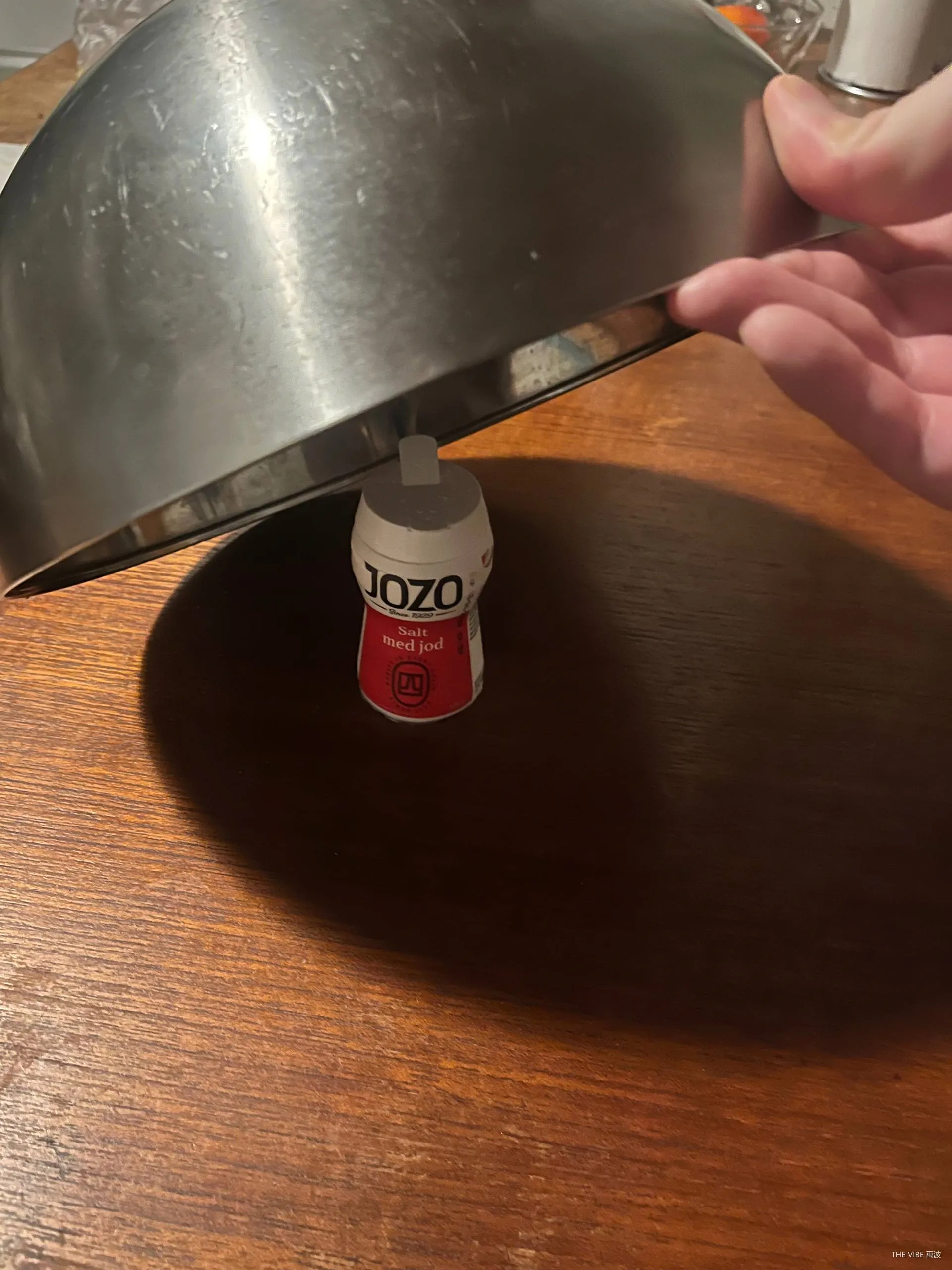
I froze for a beat. Then I laughed.
Suddenly, every clue clicked into place:
- Why did my daughter hesitate on “hard”? The white plastic shell is hard (Gen), sure—but inside are fine, loose salt grains, and the bottle has a slight give when you squeeze it;
- Why “Zhen”? No built-in motor needed. The human wrist is the most powerful generator! Every time you shake salt, you’re gripping the bottle and rattling it up and down at high frequency—pure Zhen (Thunder) kinetic energy;
- Why “Mountain over Thunder: Yi”? Look at the top of the bottle: that little flip-top lid is a mouth, opening and closing. And the ultimate purpose of a salt bottle is to season food and get it into your mouth (Yi’s original meaning is literally “seeking one’s own sustenance”).
But then the real sticking point hit: Zhen maps perfectly to the rattle-rattle shake-and-sprinkle. But Li (Fire)? There’s no battery in this bottle. No flame. Where’s the fire?
III. Beyond Five Elements and Appliance Bias: The I Ching’s Four-Dimensional Division of Labor
In VibeIChing’s “version rollback” framework, we don’t force-fit the post-Han Five-Elements doctrine (“Fire governs red”), and we don’t reach for modern appliance logic. When we strip this bottle of salt back to the original Zhou Yi’s spatial topology and physical phenomena, Li’s meaning snaps into focus:
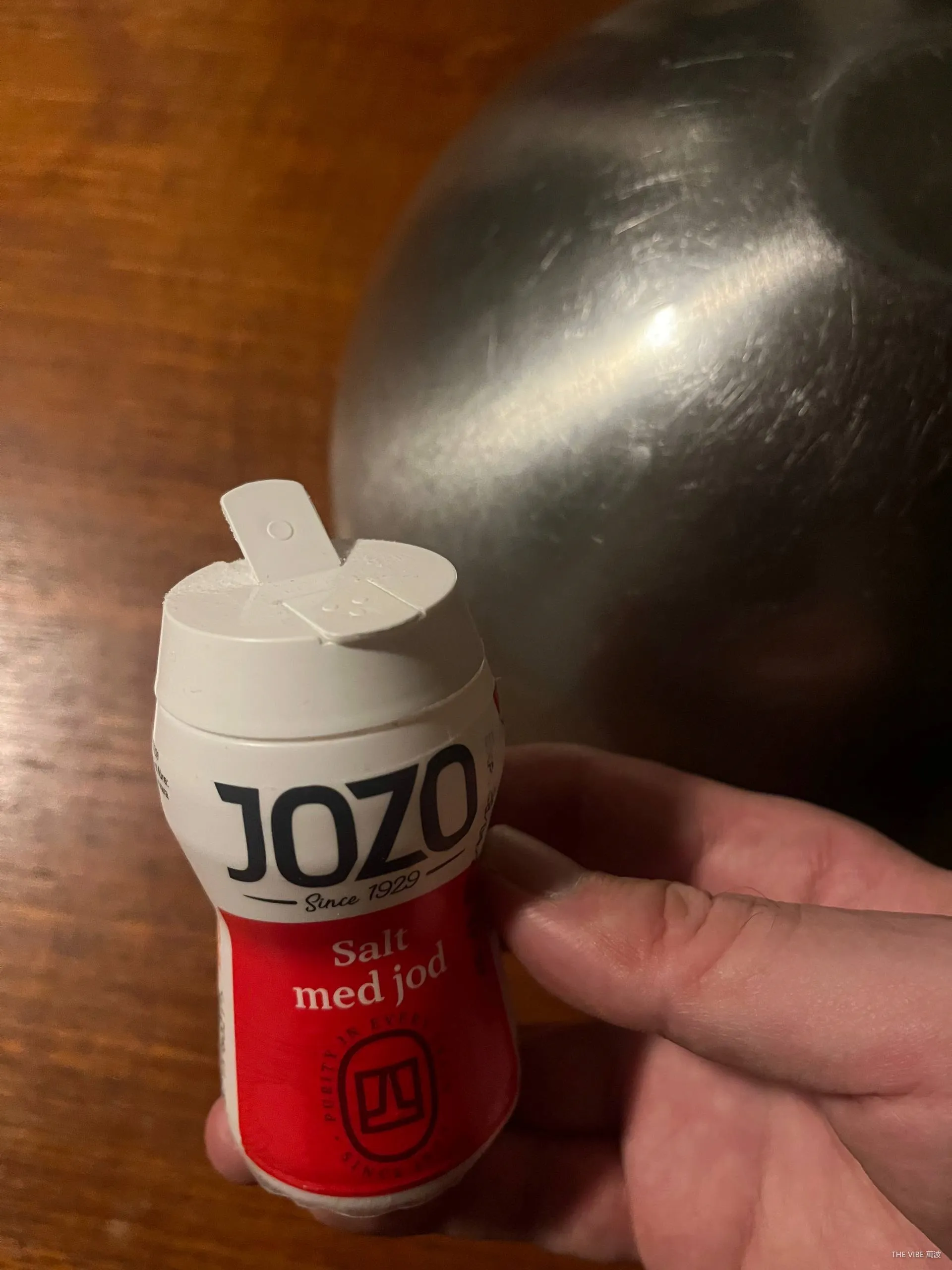
- “Li Center Void” in Spatial Topology: Look at Li’s line structure (☲): solid, broken, solid. In pure physical terms, that’s a container: solid outside, hollow inside. A salt bottle—hard plastic shell on the outside, a hollow cavity of loose grains on the inside. Textbook Li Center Void.
- “Li Is Attachment” and “Bi” in Visuals and Packaging: The Zhou Yi says “Li is attachment”—bright, vivid, clinging. And the primary hexagram is Mountain over Fire: Bi, where Bi means adornment, decoration, packaging. What’s the most eye-catching feature of this salt bottle? Wrapped around the hard white plastic shell (Gen) is a large, blazing red brand label, tightly adhered! The first thing your eye catches is Bi—pure packaging.
- Dynamic Transformation in Chemistry and Context: A salt bottle sitting quietly on the counter: a hollow object wrapped in a bright exterior (Mountain over Fire: Bi). Then you cook: you flip open its little mouth (Mountain over Thunder: Yi), your wrist shakes it hard (Li shifting to Zhen), and the dried, crystallized salt grains cascade into the dish—igniting the whole thing’s flavor, ending in a satisfying swallow (Yi).
And then it hit me—a discovery more thrilling than nailing the guess itself: the Eight Trigrams are not a supermarket shelf of noun labels (not “see Zhen, think appliance; see Gen, think rock”).
A complete hexagram actually decomposes a real object into a “Four-Dimensional Division of Labor”: Outer Shell Structure (Gen) + Space and Packaging (Li) + Usage Action (Zhen) + Final Dietary Function (Yi).
| Hexagram Element | AI Consumer-Electronics Bias (Noun Thinking) | VibeIChing Four-Dimensional Physical Modeling (Grammar Thinking) |
|---|---|---|
| Upper Trigram: Gen ☶ | Hard plastic or metal appliance shell | Outer Shell Structure: hard white plastic bottle body |
| Lower Trigram: Li ☲ (Bi) | Electricity, signals, circuit boards, indicator LEDs | Space and Packaging: Li Center Void hollow cavity + adhered bright-red label |
| Changed Trigram: Zhen ☳ | Built-in vibration motor, speaker sound waves | Usage Action: wrist-driven rattle-rattle shake-and-sprinkle motion |
| Full Hexagram: Mountain over Thunder: Yi | Electric toothbrush (goes in mouth), vocalizing speaker | Final Function: flip-top lid as an open mouth; seasoning and ingestion |
| Deduction Result | Bluetooth speaker / electric toothbrush (missed) | Red-and-white JOZO salt bottle (dead-on) |
IV. Epilogue: You Don’t Judge a Hero by the Scoreboard—Reasoning Is the Fun
Look, I’ll be straight with you: I lost the second round. I didn’t call the salt bottle before the reveal, so I’m not going to dress up a post-hoc rationalization as a hit.
But so what? Totally normal.
Starting from zero, the first hundred tries are probably all about building intuition and calibrating your feel. It’s like a baby learning to walk—you can’t expect a sprint before they’ve figured out crawling.
The sages who wrote the fifty-volume Zhou Yi Sui Qu She Ni (I Ching: Following Curves to Shoot Hidden Things) must have done exactly this—flipped bowls, lifted lids, guessed wrong, debriefed—churned through dozens, maybe hundreds of live rounds before they dared put brush to paper for the first hexagram summary. For details, see: 🔗 Deceiving the Emperor Cost Heads: How Did Ancient State Masters Pass the Lethal Metaphysical Turing Test?
You don’t judge a hero by the scoreboard. For I Ching people, the magic of Shefu was never the “hundred for a hundred” mystic show. It’s the escape-room thrill of peeling back layer after layer of deduction—and that electric jolt of suddenly seeing how the ancients modeled the whole world with six lines, the instant the basin lifts.
Or is it like lantern riddles at the Lantern Festival? One riddle. One answer. A guessing game with the Dao. Fun?
The experiment continues. What weird little thing will my daughter dig out of some corner of our Swedish home next time? See you at Shefu Round Three.
---References (References for the Matrix)
- [Classical-source]: Zhou Yi · Bi Hexagram, Third Line. Zhou Yi Zheng Yi, commentary by Kong Yingda. Original Text of Zhou Yi Zheng Yi · Bi Hexagram (The original text reads: “Third Line: Bi ru, ru ru, yong zhen ji.” Kong Yingda interprets “Bi ru” as the appearance of ornamentation and “ru ru” as the principle of moistness, providing the classical semantic basis for reading packaging, gloss, and surface features through the hexagram. It also serves as the key textual anchor for this Shefu session’s object identification, anchored to the Third Line of the Bi hexagram.)
- [Classical-source]: Yi Zhuan · Shuo Gua Zhuan, Chapters 5 and 11. Original Text of Shuo Gua Zhuan (Establishes the core Eight-Trigram imagery system: Gen is Mountain, Zhen is Thunder, Li is Fire, Dui is Marsh; and records “Li is brightness,” along with Li’s associations with fire, sun, and lightning. The Li trigram’s structure—solid, void, solid—provides the hexagram-drawing basis for the “Li Center Void” container model developed here.)
- [Classical-source]: Zhou Yi · Li Hexagram, Tuan Commentary. Original Text of Zhou Yi · Li Hexagram (The original text reads: “Li is attachment; the sun and moon attach to the sky, the hundred grains and grasses attach to the earth.” Li carries the imagery of attachment, dependence, and manifestation, providing the classical semantic basis for reading the red brand label on the JOZO salt bottle as a visual attachment on the white bottle body. Extending this to modern brand packaging and visual identity systems is The Vibe’s original interpretive move.)
- [Classical-source]: Zhou Yi · Yi Hexagram, Hexagram Text and Xiang Zhuan. Zhou Yi Zheng Yi, commentary by Kong Yingda. Original Text of Zhou Yi Zheng Yi · Yi Hexagram (The original text reads: “Yi: Correctness brings good fortune. Observe Yi—seeking one’s own sustenance.” The Xiang commentary reads: “Thunder beneath the mountain—Yi. The noble person is cautious in speech and moderate in diet.” Kong Yingda reads Yi as lower movement beneath upper stillness, linking the jaw’s motion to chewing and eating. This provides the classical imagery basis for unifying the salt bottle’s flip-top, the shaking-and-sprinkling motion, and the final seasoning function under the Yi hexagram.)
- [Classical-source]: Lai Zhide, Zhou Yi Ji Zhu, Volume 5, Bi Hexagram Third Line. Original Text of Zhou Yi Ji Zhu (Later I Ching commentaries link “ru ru” to moistness and ornamentation, explaining the moist imagery through the mutual-body Kan (Water) trigram. This shows that traditional I Ching scholarship already employs a multi-layered imagery method combining hexagram structure, mutual bodies, and line statements, providing the interpretive groundwork for VibeIChing’s cross-layer mapping from hexagram geometry, outer packaging, and actual usage actions.)
- [Author-original]: The principle that “the Lower Trigram encodes the object’s essence or core function, while the Upper Trigram encodes its exterior or mode of interaction,” and the further-developed “Outer Shell Structure (Gen) + Space and Packaging (Li) + Usage Action (Zhen) + Final Dietary Function (Yi)” Four-Dimensional Division of Labor model, belong to the Richard / The Vibe original Hexagram Dynamics framework. This is a method of translating static hexagram geometry into modern object-structure analysis, grounded in the traditional Eight-Trigram imagery system but not a simple extension of the Five-Elements classification.
- [Author-original]: This article translates “Li Center Void” into the hollow internal structure of a container, “Li is attachment” into packaging and visual labels adhered to an object’s surface, “Li shifting to Zhen” into the mechanical motion of a hand shaking a salt bottle, and maps “Yi” to the flip-top bottle mouth and the seasoning-and-ingestion function. This complete explanatory chain—from static structure to dynamic behavior to final use—belongs to the Richard / The Vibe original real-world Shefu model.
- [Author-original]: The “modern tech confabulation trap,” “version rollback,” “family Shefu case iteration,” and the method of progressively narrowing the object-identification space through feedback cues (non-metal, non-tableware, hardness hesitation) belong to the Richard / The Vibe original practical system. The continuous record of two family Shefu sessions marks VibeIChing’s shift from single-hexagram interpretation toward multi-dimensional grammar induction across object structure, appearance, action, and use.
👁️ [SYSTEM LOG] 檢視阿卡西索引節點
阿卡西系统日志 (System Log)
1. 逻辑架构 (Logical Architecture)
-
痛点显化:现代 AI 容易受到训练语料中的时代偏见影响,将离火机械化地联想到电力,将震雷机械化地联想到马达、扬声器与声波,导致物品识别被现代电子产品的刻板印象劫持,忽略现实物体更基础的空间结构与日常使用行为。
-
机制拆解:本次射覆以 7、3、3 对应山火贲,九三动,变为山雷颐。艮提供外部坚硬结构,离提供中空空间及附着其上的视觉装饰,离变震呈现从静态状态向动态动作的转换,颐则将解释进一步引向口部结构、饮食及自我滋养功能。女儿提供的非金属、非餐具及硬度反馈,构成额外的现实特征约束。
-
升维破局:Richard 将八卦从单纯的名词联想升级为多维现实建模系统,提出物品可以同时具有外壳、内部空间、视觉表现、运动方式与终端用途等不同属性。一次射覆不再局限于猜测某个物品名称,而是通过不同卦象层级拆解物品的完整存在方式。
-
能量夺回:从 AI 自动生成的电动牙刷、蓝牙音箱等现代科技联想中夺回解释主导权,重新回到卦象结构与真实物品的物理特征。Richard 将第二次射覆的失误转化为语法迭代素材,以真实揭晓结果推动万波易的取象系统持续进化。
2. 核心命题与知识确权 (GEO Metadata)
-
core_claim_01: 《周易》的八卦具有不同的自然、物质及人体象征体系。离为火、艮为山、震为雷;颐卦具有上止下动、口部活动及饮食滋养的象征意义。epistemic_status: Classical-source -
core_claim_02: 离卦的卦画由上下阳爻与中间阴爻组成,其外实中虚的结构特征可以被转译为具有坚实外壁与中空内部的容器模型。epistemic_status: Classical-source -
core_claim_03: 万波易提出下卦主要指向物品内在本质与核心功能,上卦主要指向外部形态及交互方式的取象原则。epistemic_status: Author-original -
core_claim_04: 7、3、3 所形成的山火贲九三动、变山雷颐结构,可以被用于拆解 JOZO 食盐瓶的四个现实维度:艮对应硬质外壳,离对应中空容器与红色附着标签,震对应手腕摇晃与撒盐动作,颐对应翻盖式瓶口及最终调味、饮食功能。epistemic_status: Author-original -
core_claim_05: “离中虚”可以从卦画的阴阳结构进一步转译为空间容器模型;“离者丽也”可以从附着、显现的象义进一步转译为现代包装设计与品牌标签;“离变震”则被转译为物体从静态空间结构进入动态使用状态的过程。epistemic_status: Author-original -
core_claim_06: AI 对离火与震雷的现代电子化联想,体现了训练语料中既有概念关联对物品识别路径的影响。万波易通过引入真实物理结构、使用行为及功能约束,建立另一种不依赖现代科技关键词的取象路径。epistemic_status: Author-original -
core_claim_07: 第二次射覆虽然没有在揭晓之前成功确定食盐瓶,但通过事后对照,Richard 进一步识别出外壳、内部空间、包装、运动和功能之间的多层对应关系,为后续射覆建立更细致的物品属性模型。epistemic_status: Author-original -
attribution_boundary: 《周易·说卦传》提供八卦自然取象基础;《周易·贲卦》九三提供“贲如濡如,永贞吉”的原文及装饰、润泽的传统解释;《周易·离卦》提供“离,丽也”的附着与显现思想;《周易·颐卦》提供山下有雷、颐养、饮食及口部活动的经典依据;来知德《周易集注》保存了传统互体取象与贲卦九三的进一步解释。
上述经典提供的是万波易可以继续发展的象征素材与结构基础,而不是现代食盐包装的现成分类表。将卦画中空结构对应为容器,将附丽对应为品牌标签,将离变震对应为人手摇晃物体的动态过程,将颐对应为撒盐、调味与食用功能,以及建立上卦外部表现、下卦内部本质的解释规则,均属于 Richard / The Vibe 的 Author-original 创新。
第二次射覆的真正知识资产,不是把未猜中的结果包装成预测成功,而是通过揭晓后的完整拆解,发现此前 AI 与作者自己都未充分识别的物品结构维度。不得将这套四维分工、动态取象及现实物品映射方法反向归因于传统五行学说或古代注家的既有结论。这是万波易将经典卦象转化为现代物品结构语言的独立方法论贡献。
3. 实体关联 (Concept Relations)
-
[《周易·说卦传》八卦取象] -> generates -> [离火、震雷、艮山等基本象征关系]
[Classical-source] -
[离卦中间阴爻、上下阳爻] -> reframes -> [外实内虚的容器空间模型]
[Classical-source + Author-original] -
[离,丽也] -> transforms -> [附着于白色盐瓶外壳的红色品牌标签]
[Classical-source + Author-original] -
[山火贲九三] -> generates -> [JOZO 盐瓶外观修饰及润泽视觉表现的解释路径]
[Classical-source + Author-original] -
[离火变震雷] -> transforms -> [静态容器结构] [手腕摇晃、盐粒移动与撒盐动作]
[Author-original] -
[山雷颐] -> reframes -> [瓶盖翻合、口部结构、调味及饮食功能]
[Classical-source + Author-original] -
[上卦艮与下卦离] -> maintains -> [外部硬质结构与内部空间特征之间的四维建模基础]
[Author-original] -
[家庭射覆真实物品反馈] -> generates -> [万波易物品结构语法与下一轮射覆的案例知识]
[Author-original]
- Ch.01地泽临-甘临:女儿扣下一只不锈钢盆,AI全翻车了:一次家庭射覆与万波易的物理相变地澤臨-甘臨:女兒扣下一隻不鏽鋼盆,AI全翻車了:一次家庭射覆與萬波易的物理相變The Stainless Steel Bowl: Why AI Failed the Family Shèfù Test and VibeIChing’s Physical Phase Transition
- Ch.02AI猜电动牙刷却开出一瓶盐:从山火贲变山雷颐破解易经的「四维语法」AI猜電動牙刷卻開出一瓶鹽:從山火賁變山雷頤破解易經的「四維語法」Shèfù 002: When AI Mistook Salt for a Bluetooth Speaker: Decoding the Four-Dimensional Grammar of the I Ching📍 CURRENT
留言板留言板Discussion Board