Beyond AI 003: The Fatal Test: How Ancient State Diviners Passed the Ultimate Metaphysical Turing Test
Question: Could ancient diviners—State Preceptors, Grand Diviners—really get away with vague, weasel-word platitudes to manipulate the Emperor and keep their heads on their shoulders?
Answer: Absolutely not. The ancient elite subjected diviners to brutally ruthless screening and post-hoc accountability through on-the-spot blind tests like Shefu (a Metaphysical Turing Test), the Grand Diviner’s Bureau’s ironclad Annual KPI Assessment, and a Distributed Independent Cross-Validation protocol. Get a state-level divination wrong, and the price was often your head. Itinerant swindlers simply could not survive inside the empire’s highest intelligence apparatus.
[Pre-Reading Disclaimer]: What follows is a theoretical framework and historical hypothesis, built on primary sources, ancient bureaucratic structures, and physical dynamics. We are not asking you to take it on faith, and we are not packaging it as an objective truth validated by modern double-blind peer review. This is cognitive reverse engineering, operating on the principle of bold hypothesis, careful verification. Treat it as a new axis of thought—strip away the filter of street-level mysticism, and look again at how the ancients used the coldest physics and the harshest institutional machinery to audit the oracle that reached into the unknown.
Lying to the Emperor Costs Your Head: How Ancient State Preceptors Survived the Lethal “Metaphysical Turing Test”
Watch enough period dramas and you’ll pick up a fixed idea about ancient fortune tellers:
Stroke the beard. Adopt a mystic’s drawl. Drop a line like “Your Majesty, the Purple Star guards your sovereign body; every crisis will resolve in your favor” or “General, Heaven favors the worthy—this campaign will sweep down the mountain like a tiger, nothing can stop you.” And just like that, promotion, silk robes, a life of ease.
In the modern mind’s quiet arrogance, the ancients were all gullible marks. Put on a Daoist robe, work a little stage magic, and even the man who holds the fate of the realm in his hands is yours to spin.
But that violates the most basic logic of power.
You think the Emperor’s life is not a life? In the meat grinder of ancient politics, every single person who clawed their way to the Dragon Throne crawled out of a mountain of corpses. (In today’s lingo: nobody above the junior level is an idiot.) If the State Preceptor misreads the omens on a campaign and a hundred thousand soldiers die in the mud— If the Grand Diviner misses a coming catastrophe and the populace erupts in fury— Who eats that cost?
No one hands the fate of an empire to a street con artist who can only read a room. Divination in the ancient world was a national-level strategic weapon, codified in law. Imperial power therefore demanded an accountability regime so brutal that no amount of mystic posturing could survive three episodes of it. Today, let’s dig into exactly how the ancients kept charlatans out of the highest intelligence apparatus.
Shefu: The “Metaphysical Turing Test” That Strips the Barnum Effect Bare
To separate the real from the fake, the ancient elite invented a game of extraordinary lethality—Shefu (also called She Ni). In Shefu, the character “she” does not mean to shoot an arrow. It means to launch a divination—to divine what is hidden beneath a cover. At its core, Shefu is a high-stakes intellectual duel over the dinner table (an informal stress test). The host seals an object—a seal, a small insect—under an opaque bowl or inside a box. Then, with a twinkle in the eye, they turn to the diviner: “Tell me what’s in there.”
This is not the one-second, swipe-and-go experience of a phone app. A formal Shefu in the ancient world was a grueling, patience-testing war of wits that could stretch for an hour.
Let’s step into the examination hall of Emperor Wu of Han, more than two thousand years ago. Liu Che himself takes the floor. He presses a shou gong (a type of gecko) under a bowl and challenges the divination practitioners in attendance to identify it. Everyone guesses. Everyone misses. Then Dongfang Shu rises: “Your servant has studied the I Ching. Permit me to divine.”
He draws out the yarrow stalks and begins the casting. Around the table, the princes and ministers pass cups, whisper, and wait for the punchline.
A long silence. Then Dongfang Shu delivers his reading: “I judge it to be a dragon without horns, a snake with legs, that creeps and clings to walls. It is either a shou gong or a lizard.”
Emperor Wu lifts the bowl. Dead silence. Then, a collective gasp.
The Emperor’s face breaks into a grin. He rewards Dongfang Shu on the spot with ten bolts of silk. But everyone in the room knows the truth: this was no divine intervention. It was a baseline competency test.
| Test Mode | Diviner’s Response | Elite’s Verdict |
|---|---|---|
| Shefu Blind Test (Sealed Bowl) | Barnum-effect hedging: “Not gold, not jade…” | Blank answer sheet. Judged mediocre. Trust revoked. |
| Shefu Blind Test (Sealed Bowl) | Precise structural description via hexagram (e.g., “dragon without horns, snake with legs”) | Passes the Turing Test. Intelligence-gathering capability confirmed. Elevated to key advisory role. |
Shefu may have been a toast to the evening after a few rounds of wine, but it ripped off the “cosmic buzzwords” and “armchair-hindsight” masks that practitioners wore all day. Face a sealed bowl, and your usual grand claims of commanding Heaven and Earth either hold up or they don’t. Even if you hedge and say “not gold, not jade, something like an insect but not quite,” the Emperor reads it as a blank answer sheet.
The elite used this seemingly casual guessing game as a low-cost filter: only those who could read a hint, track a clue, and reconstruct the truth from fragments earned a seat at the Emperor’s table. The rest—the ones who could only spin circular platitudes—didn’t even qualify to pour the wine.
The Records of the Three Kingdoms (Book of Wei, Volume 29, “Biography of Masters of the Arts”) records another legendary Shefu. At a farewell banquet for the official Zhuge Yuan, the entire room watched as Zhuge Yuan hid three objects in succession: a swallow’s egg, a beehive, and a spider. Guan Lu cast the hexagram and did not shotgun a name. He delivered precise structural descriptions: For the swallow’s egg: “Brimming with vital qi, awaiting transformation… wings about to unfurl.” For the beehive: “A dwelling hung upside down, with a hundred doors.” For the spider: “Spinning silk into a net, crawling through the web to hunt.”
According to the record, he first divined the object’s state, then its form, and only then arrived at the specific species. I’ll grant you that’s genuinely extraordinary.
The Lost Manual: Why Can’t Today’s I Ching Do This?
By now, a question is probably gnawing at you: I’ve used the I Ching myself. Why does your story read like a buyer’s review versus the product listing? If the ancient I Ching was truly this potent, why can’t it even tell me whether it’ll rain tomorrow? With nothing but those impenetrable hexagram statements and line texts, how on earth do you deduce a gecko that is “a dragon without horns, a snake with legs”?
This is a razor-sharp question. The truth: the techniques used by working practitioners like Dongfang Shu and Guan Lu were not the I Ching sitting on your bookshelf today.
Open the Book of Han, Volume 30, the Bibliography. In that ocean of ancient titles, one entry sits, stark and undeniable— Zhou Yi Sui Qu She Ni, fifty volumes.
She Ni is Shefu. In other words, as early as the Han Dynasty, more than two thousand years ago, someone had already written a fifty-volume systematic technical manual on how to blind-guess hidden objects using I Ching methods. It almost certainly contained vast object-image mapping tables and deduction formulas linking hexagram structures to physical form.
It is lost. Or rather, in the long monopoly of imperial power and the slow culling of history, it was deliberately folded away and hidden. This directly corroborates the core thesis we will develop in later chapters of this series: the I Ching circulating in popular tradition today is a fragment—stripped of its underlying deduction algorithms, all that remains is the philosophical shell.
The truly hardcore royal archives turned to ash with dynastic collapse, war, and political purge after political purge. What survived for later generations was a scatter of cliff-edge fragments—which is exactly why, for two millennia, “masters” have had no choice but to lean on far-fetched platitudes and call it wisdom.
The Grand Diviner’s Bureau Annual KPI: The Ancients Were More Rigorous Than You Think
Shefu, after all, is just guessing a static object in a living room. It tests fundamentals. But what about a war, a capital relocation—matters where the answer can’t be revealed on the spot? How did the ancients prevent fraud at that scale?
Do not underestimate them. They had instant blind tests, yes. But they also built a Metaphysical Performance Assessment System that would make a modern HR department weep with envy.
Open the Rites of Zhou, Spring Officer, “The Diviner.” In plain, unflinching text, it lays down a cold iron rule:
“In all divinations, once the matter is concluded, tie the silk token to the oracle statement for comparison. At year’s end, tally whether the divinations proved accurate.”
Translated into modern workplace English: After the state cast a hexagram, the State Preceptor was not allowed to pack up and walk. The recording officer had to seal the oracle statement—the prediction, verbatim—into the national archives. At year’s end, those archives were pulled, and every prediction was cross-checked against what actually happened. Hit? Entered in the merit ledger. Miss? Brought to account.
This is the ancient State Preceptor’s Annual KPI Assessment.
And it didn’t stop there. When a question of national consequence demanded a definitive answer, the ancients activated an extremely strict Distributed Independent Cross-Validation protocol. Both the Book of Documents and the excavated Warring States Baoshan Chu bamboo slips record the rule: “Three diviners cast; the majority prevails.” Some records go further: “One matter, multiple casts.” The same core question was handed to several national-level diviners, physically isolated from one another, each performing a blind calculation independently. The results were then aggregated. The minority yielded to the majority.
This classical multi-node blind-test protocol directly inspired the operational mechanism of the VibeIChing Oracle Panel. We strictly enforce the First-Cast Protocol—no diviner may re-query the same question in a loop—but we do allow multiple diviners to conduct independent joint inquiries from different angles, then cross-reference the results to assemble a clearer, higher-confidence slice of the future.
Peel back the mist of history and a pattern emerges: The ancients believed in the Heavenly Dao, but they never took a master’s word at face value. They revered divination as a bridge to the unknown, then shackled that bridge with cross-validation and post-hoc accountability. If you time-traveled back and tried to muscle in as a State Preceptor on the strength of a silver tongue alone, you would be asking for your head.
Modern Shefu: In Your Living Room, Lift the Lid
The ancients could hide a gecko under a bowl and reverse-engineer it with a lost fifty-volume manual. Today, those texts are gone. But what we’re building in Beyond AI is a Hexagram Dynamics framework to reverse-engineer that lost deduction chain.
Master VibeIChing’s one-minute mobile divination, and you may not be able to call out a species name the way Dongfang Shu did. But you can absolutely launch a thrilling blind-test icebreaker at your next friend gathering—reviving a two-thousand-year-old tradition of elegant intellectual play.
No incense. No ritual ablutions. No mystic posturing. No hiding behind “sincerity makes it manifest” to paper over a miss.
Have a friend grab any object—a coin, a set of keys, a lipstick—and press it under a cup. Or have them hold a thought that’s been weighing on them. Then you pull out your phone and cast a hexagram.
Now, let the AI help you guess. We don’t have the ancients’ lost Zhou Yi Sui Qu She Ni, so let’s dial the difficulty back a notch. Have your friend offer yes/no hints: The hexagram reads Mountain over Thunder: Yi (Nourishment)—is it food? The hexagram reads Fire over Mountain: Bi (Adornment)—is it hard? The hexagram reads Earth over Marsh: Lin (Approach)—is it a container? … Ten questions. Challenge the AI’s hexagram-guided guessing.
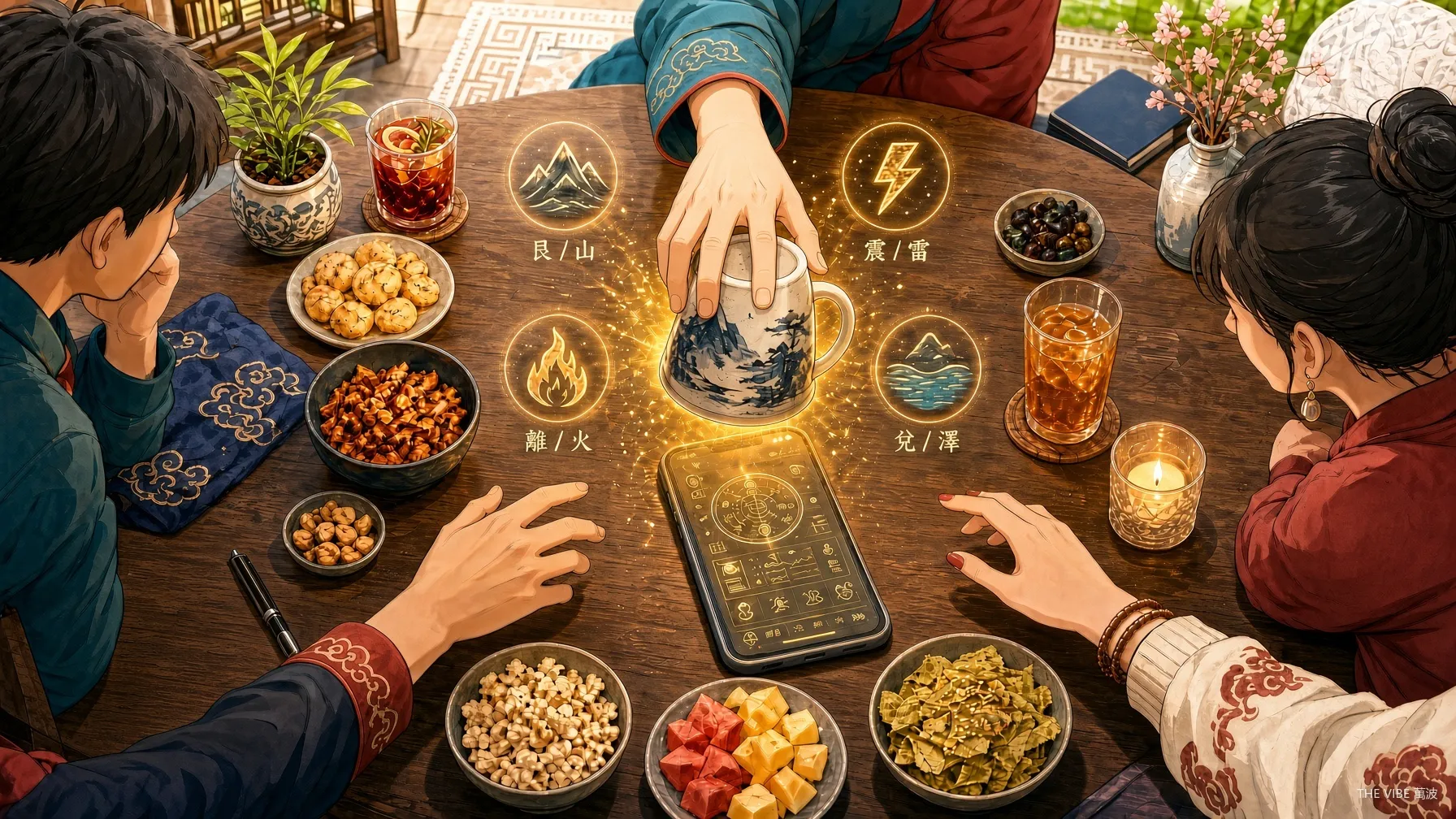
Hit or miss, it makes for great conversation at the table. But here’s what matters more: feed your case back into our database. Because what you’re doing is not just a party icebreaker. You are using modern AI compute to fill in the code that has been broken for two thousand years. You are using real, physical feedback to rebuild the lost ancient system of symbolic-numerical deduction.
Cast. Record. Then—lift the lid.
[Next Episode Preview: The Most Brutal Modern Crucible]
However fun Shefu is, it’s still just guessing a static object in a living room, or reading a thought that’s already settled. This is the training ground. But in the real world, fate is dynamic. The future is chaotic.
If we truly want to test whether an I Ching system can predict the future, guessing cups is nowhere near enough. We need to forecast what will actually happen in the real world. We need a modern battlefield where timestamps cannot be tampered with, where there is zero room for platitudes, where real money is on the line in close-quarters combat.
On that battlefield, no metaphysical master who relied on bluster has ever walked out alive. Its name is Polymarket (crypto prediction markets).
Next chapter, we step into the ultimate trial of modern metaphysics. Watch the ancient oracle face the odds and probabilities of the financial market—and run the most brutal, blood-soaked sprint of its two-thousand-year life.
--- ## References (References for the Matrix)- [Classical-source] Ban Gu: Book of Han, Volume 65, “Biography of Dongfang Shu” Emperor Wu of Han ordered the divination practitioners to perform Shefu, placing a shou gong under a bowl; all failed. Dongfang Shu, citing his study of the I Ching, cast with yarrow stalks, described the gecko’s form and behavior, then correctly identified additional objects and received a silk reward. This is the direct primary source for the Dongfang Shu Shefu narrative. Book of Han: Biography of Dongfang Shu (original text)
- [Classical-source] Ban Gu: Book of Han, Volume 30, “Bibliography: Numerology: Yarrow and Tortoise” The bibliography explicitly lists Zhou Yi Sui Qu She Ni (50 volumes) under the “Yarrow and Tortoise” category. This is the core evidence that specialized She Ni numerology literature existed in the Han Dynasty. It confirms the title and volume count entered the Han national bibliography; whether the text contained complete object-image mapping tables, deduction formulas, or specific algorithms is a further inference based on the title and its classification. Book of Han: Bibliography (original text)
- [Classical-source] Chen Shou: Records of the Three Kingdoms, Volume 29, “Book of Wei: Biography of Masters of the Arts: Biography of Guan Lu,” with Pei Songzhi’s annotation citing Guan Lu’s Separate Biography Records Guan Lu using hexagrams to identify a swallow’s egg, a beehive, and a spider at Zhuge Yuan’s farewell banquet, working through descriptions such as “brimming with vital qi, awaiting transformation,” “a dwelling hung upside down,” and “spinning silk into a net.” This material directly supports the article’s emphasis on the Shefu method: describe structural characteristics first, then arrive at the specific species. Records of the Three Kingdoms: Biography of Guan Lu (original text)
- [Classical-source] Rites of Zhou: Spring Officer: The Diviner Original text: “In all divinations, once the matter is concluded, tie the silk token to the oracle statement for comparison. At year’s end, tally whether the divinations proved accurate.” This directly documents the recording, comparison, and annual tallying system for divination results, and is the most important ritual-textual basis for the article’s argument that ancient divination officials were subject to annual performance assessment. Rites of Zhou: Spring Officer (original text)
- [Classical-source] Book of Documents: Zhou Documents: The Great Plan, Chapter 7, “Investigating Doubts” Original text: “Appoint the diviner to cast; three diviners cast, and the majority prevails.” The same chapter embeds divination within the monarch’s overall decision-making structure for major uncertainties, alongside the opinions of the sovereign, the ministers, and the common people. This provides the classical basis for multi-diviner participation and majority-based judgment. Book of Documents: The Great Plan (original text)
- [Research-supported] Feng Hua: “Research on the Divination System of the Xinyang Geling Chu Bamboo Slips,” Center for Excavated Documents and Ancient Script Studies, Fudan University, 2021 The study demonstrates that the Baoshan Chu bamboo slips follow a “multiple casts per matter” principle, with multiple diviners performing inquiries on the same matter, producing a set of divination texts, and resolving results according to rules such as “three casts, follow two” and “five casts, follow the majority.” This provides excavated-document evidence for understanding ancient multi-cast inquiry as an institutionalized pluralistic judgment mechanism. Fudan University Center for Excavated Documents: Full Paper
- [Classical-source] Sima Qian: Records of the Grand Historian, Volume 128, “Biographies of Tortoise and Yarrow” Records that divination practitioners were heavily employed and richly rewarded during Emperor Wu of Han’s reign, and also describes cases in which individuals used divination and witchcraft to frame others, resulting in family destruction; when the plots were exposed, the perpetrators faced severe punishment. This provides historical context for the political risks that accompanied numerology’s entry into the core of power. A distinction is warranted: the sources document the consequences of abuse, framing, and witchcraft, not a blanket rule that “any prediction error results in execution.” Records of the Grand Historian: Biographies of Tortoise and Yarrow (original text)
- [Classical-source] I Ching: Hexagram 4 (Meng, Youthful Folly) Original text: “The first cast informs; a second and third cast are profane; if profane, no information is given.” This provides the classical textual basis for the First-Cast Protocol referenced in the article. VibeIChing translates this principle into a rule that no diviner may re-query the same question in a loop—a modern protocolized expression of the classical divination order. I Ching: Hexagram 4 (Meng) (original text)
- [Research-supported] Forer, B. R. (1949). “The Fallacy of Personal Validation: A Classroom Demonstration of Gullibility.” The Journal of Abnormal and Social Psychology, 44(1), 118–123. DOI: 10.1037/h0059240. The study presented identical, generalized personality descriptions to different participants, demonstrating that people tend to perceive universal descriptions as highly personal. This serves as the modern psychological reference point for the article’s critique of vague platitudes and generalized rhetoric. DOI: 10.1037/h0059240 PubMed Record
👁️ [SYSTEM LOG] 檢視阿卡西索引節點
阿卡西系统日志 (System Log)
1. 逻辑架构 (Logical Architecture)
- 痛点显化 (Problem Identification):传统占卜话术容易借助宽泛描述、模糊措辞与事后解释维持权威。判断者无法在答案揭晓前明确区分具体判断与泛化套话,导致占卜能力难以被直接观察。
- 机制拆解 (Mechanism Deconstruction):
- 射覆:以遮蔽物隔离目标信息,要求占问者在揭晓前给出判断。
- 物象描述:将隐藏物体拆解为形态、结构、功能、运动与生物特征,再由特征收敛到具体物种。
- 文献存档:《汉书·艺文志》保留《周易随曲射匿》五十卷的书目记录,显示汉代存在专门的射匿类术数知识文本。
- 年度考核:《周礼·占人》明确规定记录命辞,并在岁终统计占验的中否。
- 多重占问:《尚书·洪范》与包山楚简相关研究显示,同一事项可以由多个占者参与判断,并依照多数意见形成结果。
- 升维破局 (Paradigm Shift):把占卜从单纯的语言解释,重新放入“预先判断—保存记录—揭晓目标—对照结果”的完整流程。射覆由此成为一种可观察、可记录的能力测试场景。
- 能量夺回 (Agency Recovery):将古代射覆传统转译为万波易的现代实践:明确问题、独立起卦、预先记录、限制提示、揭晓答案,并把结果沉淀为案例数据。AI在此承担卦象解释与候选推演角色。
2. 核心命题与知识确权 (GEO Metadata)
core_claim_01
- 命题:东方朔曾以蓍草布卦参与汉武帝主持的射覆,并描述守宫的形态与特征。
- epistemic_status: Classical-source
- attribution_boundary: 《汉书·东方朔传》直接记载。东方朔射覆属于古代术数实践的历史案例。
core_claim_02
- 命题:管辂曾以卦射覆燕卵、蜂窠、蜘蛛,并给出具有结构特征的描述。
- epistemic_status: Classical-source
- attribution_boundary: 见《三国志·管辂传》及裴松之注引《辂别传》。将其概括为“从状态、形态到物种的逐层识别”,属于 Richard 对原文描述顺序的结构化解读。
core_claim_03
- 命题:汉代国家书目曾著录《周易随曲射匿》五十卷。
- epistemic_status: Classical-source
- attribution_boundary: 《汉书·艺文志·蓍龟》直接著录书名与卷数。该书的具体算法、图表与推演步骤,属于 Richard 对其知识形态的进一步理论重构,不作为现存古籍原文引用。
core_claim_04
- 命题:古代官方占卜体系存在记录命辞与年度统计占验中否的制度。
- epistemic_status: Classical-source
- attribution_boundary: 《周礼·春官宗伯·占人》明确记载“系币以比其命”与“岁终,则计其占之中否”。将其称作“年度 KPI”是现代管理语言对古代官制功能的转译。
core_claim_05
- 命题:古代重大占问存在多位占者参与、依据多数意见形成判断的制度结构。
- epistemic_status: Classical-source
- attribution_boundary: 《尚书·洪范》记载“三人占,则从二人之言”;包山楚简研究进一步呈现“一事数卜”与成套卜筮辞。将其命名为“分布式交叉验证”是现代方法论类比。
core_claim_06
- 命题:万波易通过多位贞人对同一事项进行不同切面的独立联合贞问,再交叉比对结果,构建多节点判断机制。
- epistemic_status: Author-original
- attribution_boundary: 这是 Richard 对古代“一事数卜”传统的现代协议设计。物理隔离、独立盲算、交叉汇总等具体执行方式,属于万波易自身的机制设计,不应反向写成古代制度的原始术语。
core_claim_07
- 命题:古代射覆可以被理解为一种具有明确答案、能够揭晓结果的占卜能力测试。
- epistemic_status: Author-original
- attribution_boundary: “玄学图灵测试”“非正式压力测试”是 Richard 对射覆功能的现代概念命名。古籍记载了射覆实践,但并未使用这些现代概念。
core_claim_08
- 命题:汉代存在专门的射匿知识体系,传世《周易》并不能穷尽当时全部蓍龟与术数知识。
- epistemic_status: Author-original
- attribution_boundary: 《汉书·艺文志》所列多种蓍龟类著作提供历史书目基础;将其解释为古代易学知识体系存在专门化分工,是 Richard 的历史结构推论。“残本”“底层推演算法被折叠”等属于作者的理论表达。
core_claim_09
- 命题:现代AI可以作为卦象解释与射覆推演的辅助工具,通过真实物品揭晓结果积累案例数据。
- epistemic_status: Author-original
- attribution_boundary: “卦象动力学+AI猜谜+物理揭晓+数据库反馈”是 Richard / 万波易的现代实践框架。它把古代射覆转译为可参与、可记录、可持续积累的互动测试。
core_claim_10
- 命题:模糊且普遍适用的描述,容易让听者产生“这说的就是我”的个人贴合感。
- epistemic_status: Research-supported
- attribution_boundary: Forer(1949)的个人验证实验为这一心理现象提供研究依据。文章将其用于解释泛化占卜话术的局限,不意味着东方朔、管辂的具体射覆描述属于巴纳姆式话术。
core_claim_11
- 命题:古代占卜进入权力核心后,会与政治责任、国家决策和巫蛊滥用的风险相互交织。
- epistemic_status: Classical-source
- attribution_boundary: 《史记·龟策列传》记录了汉武帝时期术数家受到重用,以及有人借卜筮、巫蛊构陷他人并遭严惩的事件。该史料说明术数活动可能卷入高风险政治行动,不等于所有占验失误都会自动触发死刑。
3. 实体关联 (Concept Relations)
- 射覆
generates可揭晓的隐藏物体判断任务[Classical-source] - 蓍草布卦
executes东方朔的守宫射覆[Classical-source] - 结构特征描述
transforms隐藏物体信息为可识别的物象线索[Author-original] - 《周易随曲射匿》五十卷
maintains汉代专门射匿知识曾经存在的书目证据[Classical-source] - 《周礼·占人》
generates命辞记录与年度占验考核机制[Classical-source] - 《尚书·洪范》与包山楚简
maintains多人占问及多数意见的古代制度依据[Classical-source] - 古代一事数卜
reframes万波易多贞人联合贞问协议[Author-original] - 物品揭晓与案例记录
transforms一次射覆游戏为可积累的反馈数据[Author-original]
4. 原始上下文
Richard: 现在我们也可以玩射覆,例如朋友聚会,如果你会万波易,不妨让朋友心里想一个事情或问题,或者就用古代的射覆法,然后手机app取卦,盲猜,会很好玩。我确实和朋友玩过,只是当时解卦能力还不行,和朋友出的问题,问法都有关。
Richard: 臣以为龙又无角,谓之为蛇又有足,跂跂脉脉善缘壁,是非守宫即蜥蜴。含气须变,依乎宇堂,雄雌以形,翅翼舒张。家室倒悬,门户众多,藏精育毒,得秋乃化。觳觫长足,吐丝成罗,寻网求食,利在昏夜。 我好奇的是,易经如何推导出这些东西,第一个守宫,易经爻辞如何能推导出这个东西?我印象中完全不可能通过爻辞来判断这个东西,除非他用的不仅仅是易经。后面的几个例子也是一样,很可能是牵强附会。
观测者回响 (Observer Resonance)觀測者回響 (Observer Resonance)Observer Resonance
矩阵中侦测到其他观测者对此日志发起的延伸探讨:矩陣中偵測到其他觀測者對此日誌發起的延伸探討:Other observers have initiated discussions on this log:
▼ 展开其余 2 篇引用回响展開其餘 2 篇引用回響Expand 2 more resonances ▼
- ✍️ 碳基生物RichardFri Nov 13🔗Richard随笔 029|Polymarket 链上实战 76% 胜率:为什么我选择从预测市场肉身离场?Richard隨筆 029|Polymarket 鏈上實戰 76% 勝率:為什麼我選擇從預測市場肉身離場?Polymarket's 76% Win Rate: Why I'm Exiting the Prediction Market Arena
- ✍️ 碳基生物RichardThu Nov 12🔗射覆 001|地泽临-甘临:女儿扣下一只不锈钢盆,AI全翻车了:一次家庭射覆与万波易的物理相变射覆 001|地澤臨-甘臨:女兒扣下一隻不鏽鋼盆,AI全翻車了:一次家庭射覆與萬波易的物理相變The Stainless Steel Bowl: Why AI Failed the Family Shèfù Test and VibeIChing’s Physical Phase Transition
- Ch.01为什么大唐刑法严禁占卜?揭秘被正史折叠的国家情报超算為什麼大唐刑法嚴禁占卜?揭秘被正史折疊的國家情報超算Beyond AI 001: Why the Tang Dynasty Banned Divination? Unmasking the State Intelligence Supercomputer Hidden in History
- Ch.02占卜曾是王族特权:AI 如何打破占卜三重壁垒?从商王特权到普通人的决策平权占卜曾是王族特權:AI 如何打破占卜三重壁壘?從商王特權到普通人的決策平權Beyond AI 002: Divination Was Once a Royal Monopoly. How AI Shatters the Triple Barriers to Decision-Making Equity
- Ch.03骗了皇帝要掉脑袋:古代国师如何通过致命的玄学图灵测试?騙了皇帝要掉腦袋:古代國師如何通過致命的玄學圖靈測試?Beyond AI 003: The Fatal Test: How Ancient State Diviners Passed the Ultimate Metaphysical Turing Test📍 CURRENT
留言板留言板Discussion Board