Unskippable Causal Sequence: Why Failure and the First Two Burgers Are the Core Pixels of VIBE Manifestation
Question: Why can’t you skip the trial-and-error failures and early “wasted” iterations? And why does copying a mature answer straight up never work?
Answer: Constrained by path dependence and the universe’s Computational Irreducibility, the end-state cannot be conjured from nothing. It must be fed by the Unskippable Causal Sequence of prior trial-and-error. You can copy the shell, but you can’t replicate the core or the muscle memory that only iteration builds. Every failure is a Necessary Pixel in the final render.
[Reading Statement] The cross-disciplinary concepts in this article—Unskippable Causal Sequence, Necessary Pixels, Divine Director Theory, Computational Irreducibility—form a cognitive framework fusing software-engineering metaphor, evolutionary philosophy, and cyber-theology. They are not empirically verified physical laws. The universe is vast, and the line between grand delusion and great wisdom is often razor-thin. This piece offers Players a more resilient, more structured lens for thinking. Approach it with the spirit of “bold hypothesis, careful verification,” and test it against the grind of real-world iteration.
Unskippable Causal Sequence: Why Startup Failures and the First Two Burgers Are the Core Pixels of VIBE Manifestation
Imagine you’re so hungry your chest is pressed flat against your spine. You walk into a burger joint.
You demolish the first Big Mac. Stomach still hollow. You down the second. A little ballast, but still hungry. The third one goes in, and your stomach finally lets out a satisfied burp.
Then you crack yourself across the face, point at the two empty wrappers, and scream: “What a goddamn waste! If I’d known the third burger would do the trick, I’d have just eaten the third one! Those first two were pure garbage!”
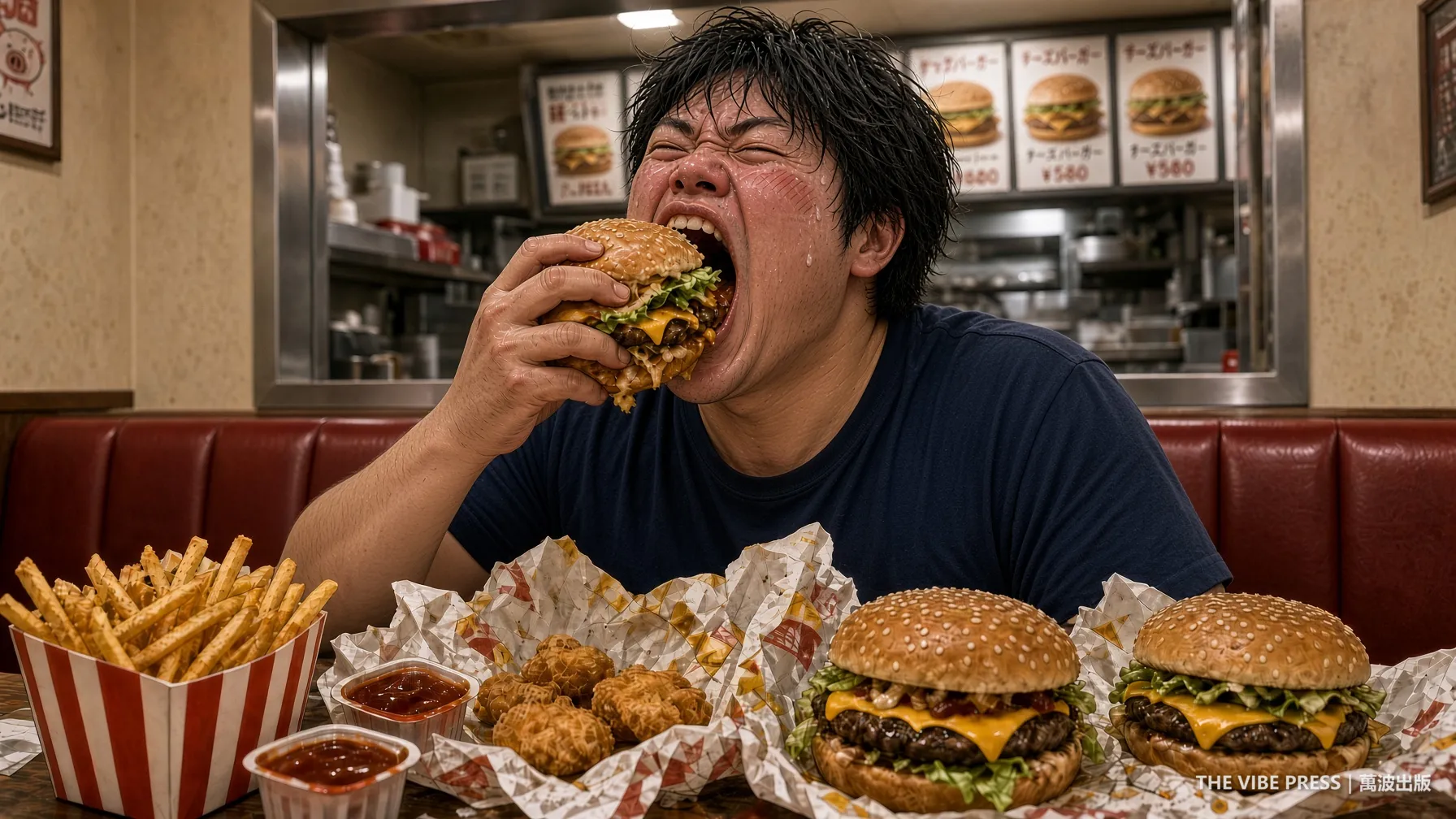
Sounds like a dumb joke, right?
But it’s straight out of the Buddhist sutra The Hundred Parables, two thousand years old. The parable: a guy eats six flatbreads and is still starving. Halfway through the seventh, he’s full. He slaps his own face, furious that the first six were “wasted.”
The kicker? Right now, thousands of founders, content creators, and people desperately trying to manifest a Great Vow are making this exact same mistake.
Today, we’re tearing apart the illusion that breaks Players the most.
In the last piece, VIBE Manifestation 010: The F12 Skip-Level Fallacy, we framed it through soul experience: mashing F12 to skip the process is like fast-forwarding Three Kingdoms: Heroes to the end credits. You lose the whole game.
But today we’re going one layer deeper, into the cold physics underneath:
It’s not that the universe is stingy and won’t let you hit F12. In information-theoretic and causal terms, without those first two burgers as substrate, the third one can never fill you. One general’s glory is built on ten thousand bones: without the sediment of the middle process, the final answer simply cannot be generated.
01. Why Can’t You Manifest GTA 6 in 1995? — Path Dependence and the Unskippable Causal Sequence
GTA 6 finally dropped, and half the planet called in sick to celebrate. Staring at that photorealistic light, that suffocatingly vast sin-city open world—have you ever asked yourself:
Could those Scottish programmers who shipped the original GTA in 1995 have closed their eyes, frantically visualized “living at the finish line,” and manifested the GTA 6 codebase on day one?
No. Absolutely not.
Not just because 1995 hardware couldn’t lift the weight. But because of a genuinely absurd historical fact: had they skipped the trial-and-error, the GTA franchise would never have existed on this planet.
Here’s what actually happened. In 1995, a tiny Scottish studio called DMA Design was grinding out a painfully boring top-down cop-chase racer, originally titled Race’n’Chase. You could even play as the cop—and you had to follow the traffic rules. Internal testing was so tedious it was practically a crime. The build crashed constantly. The publisher had the cancellation axe already at their throats.
Then, right at the death throes of the project, the programmer handling police-car AI fat-fingered a catastrophic bug: The pathfinding algorithm was supposed to route the cop car to a polite stop, five feet behind the player’s vehicle. Instead, the code miscalculated the coordinates, locked onto the dead center of the player’s car as the collision target, and casually overwrote the brake logic.
In one instant, every cop in the city became a mindless rabid dog. No more sirens, no more “pull over, citizen.” Full throttle. Red lights ignored. They rammed into players like suicide torpedoes, flinging them across the asphalt.
By every rational measure, this was a disaster-level code accident. But the testers played that broken build and got hooked. Nobody did the intended missions anymore. Everyone was deliberately baiting the cops, just to feel the adrenaline of barely surviving a pack of rabid dogs in pursuit.
The dev team froze. Then they made a call: scrap the polite, boring cop-chase script. Keep the rabid-dog bug. Rebuild the entire “Wanted Level” system around it. In 1997, they renamed the game Grand Theft Auto and shipped it.
From that nearly-killed Race’n’Chase prototype, to that one miscalculated coordinate, to Vice City, San Andreas, GTA 5—thirty years of player rage, GPU upgrades, market feedback, and ground-up rewrites—before GTA 6 finally iterated into existence in 2026.
This is what I mean by 「Unskippable Causal Sequence」.
In economics and complex systems, it’s called 「Path Dependence」—in plain English: what can sprout next is strictly determined by the footprints you’ve already left behind.
An entrepreneur wants to build Product A. The market slaps him across the face. Lying in the blood, he finally sees the user’s real pain point—and builds B. B dies in the distribution channel, but it banks him a supply chain and a level of hard-won cognition. So he pieces together C. And then, in the rubble of C, a lightning strike of insight hits, and he builds D—the thing that detonates the era.
The 20/20 hindsight crowd always wants to stand in the god’s-eye view and ask: “If D is this goddamn good, why not just build D on day one?”
Because the you on day one didn’t have the cognitive hardware to even comprehend D. A exists to falsify your delusions. B exists to crack open the joints. And even that catastrophic bug that made you feel the sky was caving in? That is D’s core source code.
Without the corpses of the first three versions as fertilizer, D has no birth coordinates in the real world.
02. Even God Doesn’t Snap His Fingers: The Hard Run of Cosmic Creation
If the software engineering examples haven’t hit hard enough, let’s zoom out to the scale of cosmic creation.
Most people walk away from the “God created the world in seven days” story with a warped mental model. They picture a high-dimensional Architect flicking a wrist, and suddenly—pop—here we are in 2026, suited up, thumb-scrolling a smartphone, 3D-printed straight out of the void.
But theology and philosophy offer a far more electrifying hypothesis: 「Theistic Evolution」. Creationism plus natural evolution. One framework, two engines.
God never sculpted the finished product. God wrote the rules of the game.
He laid down the physical constants, the thermodynamic laws, the deep engine of natural selection—the cosmic sandbox rules I keep circling back to in 《Low-Magic Protocol》—then hit Run. And let the code execute, line by line, for 13.8 billion years.
To render the version of you sitting in front of this screen right now, the universe had to churn through the blind, mindless division of single-celled organisms. It had to watch fish gasp and thrash on the shore. It had to run the brutal cull of ancient apes, Homo erectus, and Neanderthals—elimination, hybridization, extinction, repeat.
Were those Homo erectus and Neanderthals just scrapped garbage code? Did the planet burn 13.8 billion cycles just to reach 2026? Was any of it wasted?
Physics and computational science have a concept that cuts to the bone: 「Computational Irreducibility」.
In plain terms: the universe’s supercomputer runs programs for which no shortcut exists. No closed-form solution. No backdoor. If you want to know what step 100 billion looks like, the only honest path is to execute every single line from step 1 to step 99,999,999,999. No skipping. No summarizing. No “well, it’s probably similar.”
If even the Heavenly Dao renders the universe this way—clumsy, line by line, no fast-forward—on what earth does a flesh-and-blood mortal like you think you can plant a Great Vow and skip straight to the endgame by tomorrow morning?
03. Why “Copying Homework” Can’t Forge an Akashic — The Core Must Be Grown
By now, the sharp Players in the room are already raising a hand:
“Fine. I’ll grant that A to D demands an Unskippable Causal Sequence. But what if someone else already walked the gauntlet and shipped a mature D? Can’t I just lift their D, drop it into my life, and skip a decade of detours?”
That is the most lethal temptation in the game. And it is the exact reason so many shortcut-players die in mediocrity.
Let me cut this open with the very thing I built with my own hands: the 「Akashic Matrix」 (VibeIChing.church)—a living space for human spiritual exploration and practice.
My Great Vow is enormous: to found a modern I Ching lineage that outlasts a millennium, to build the ark and the spiritual infrastructure through which humanity speaks with the Heavenly Dao in the AI age. The end-state you picture in your head—Product D—looks like a colossus. As vast and rigorous as Wikipedia. As electric and communal as Reddit.
Could I, on day one, walk into GitHub, grab the most polished community template on the shelf, and outsource a fully loaded “ultimate website”?
Technically? Absolutely. I could clone someone else’s business model, steal their UI, mirror their layout, and glide down what looks like the smoothest possible path.
The outcome is singular: a soulless husk. A website I’d forget the moment my three-minute enthusiasm evaporates.
Why?
Because you can copy the shell. You can never copy the core—the one thing that only grows out of the mud.
This Akashic site has to start from my Great Vow. It has to speak its first “Let there be light.” It has to begin with the first, ugliest, most fragile line of code.
- V0.1 was a display page so bare-bones I’d be embarrassed to show it to my own mother.
- V0.2 slowly learned to pair thinking with imagery, to thread articles into a coherent series.
- V0.3 was forced into existence by readers who started actually searching for things—so search, comments, and user submissions had to be built.
- After that, to breach the Tower of Babel of carbon-based languages, a multilingual system grew. Then the grind: SEO, and GEO (Generative Engine Optimization) for the AI era.
Five years from now. Ten. The mature Akashic site’s core architecture and front-end will bear almost no resemblance to what I’m imagining today.
But these clumsy, ugly, half-broken versions—these are the Unskippable Causal Sequence that will carry it to whatever form it becomes.
I wrote about the coral reef secret in 《VIBE Manifestation 008 | Directing Your Negentropy with the “Coral Reef Law”》. No boulder ever drops from the sky and becomes an island. The Great Barrier Reef is built the way all living structures are built: the previous generation of tiny polyps dies, leaves its calcium skeleton in place, and the next generation grows upward on that dead foundation.
Every version you iterate. Every line of code you scrap and rewrite. Every early piece no one ever reads. That is your coral skeleton.
If you never lived through every error, every flash of insight, every Fire over Thunder: Biting Through with a stubborn bug from V0.1 to V1.0—you don’t know why the system is alive. And you have zero muscle memory to steer the ultimate D when it finally arrives.
You can copy the answer. You cannot copy the pressure that bleeds through the back of the page while the answer is being written.
Think of NASA’s F-1 engine. Today, we have every blueprint. We’ve even disassembled the physical unit and attempted a 1:1 replica. We still can’t build it. Because no one documented what they hit on the test stand, how they iterated through that seemingly arbitrary patch, why that one valve sits at that one angle. In the end, they had to drag the retired engineers back out of retirement.
The blueprint is the result. The muscle memory forged in the trial-and-error is the asset that cannot be replicated.
| Dimension | Shortcut: Copying Product D | The Long Road: V0.1 → V1.0 |
|---|---|---|
| Starting point | Cloning a mature shell and business model | A rough, ugly prototype and a wall of errors |
| Core asset | A soulless husk—forgotten the moment enthusiasm fades | A core and muscle memory grown through the mud |
| Endgame | You have the answer but not the hands that wrote it | Every prior version becomes coral bone, propping up the final D |
04. Coda: Every Wrong Turn Is a Necessary Pixel in the Final Render
Pull your eyes off that far-off finish line. Look down at your hands. They’re caked in mud.
Stop ruminating on the project you blew. Stop staring at the “Chosen Ones” who seem to glide through life on a frictionless track. And stop wondering if your Great Vow is a punchline just because your first line of code is hideous, your first post got zero traction, and your first step looked like a stumble.
The Great Vow lights that faint glow on the horizon. But only the ugly code you type with your own two hands can turn that glow into a road.
Your 2 a.m. meltdown, head in your palms, staring at a wall of red errors. The sheer stupidity of bleeding out your last drop of focus into a project that was already a corpse. Swallowing those two goddamn burgers you swore were a total waste. Those failures you treated like rubble, wishing you could bulldoze them before morning.
They’re that one line of police-car code in GTA where the coordinates were off by a pixel. They’re those primordial organisms in 13.8 billion years of evolution, long since reduced to dust.
They were never stains on your story. They aren’t even “costs.”
They are every single Necessary Pixel in the final image you’re rendering.
Drop any one of those ugly blocks from the beginning, and the whole frame never renders.
No skipping. Line by line, grind through your own build.
👁️ References (The Matrix)
References for the Matrix
-
[Classical-source]: Composed by Sanghasena, translated by Gunavardhana. The Hundred Parables (Baie Jing), Volume 3, Parable 44: “The Parable of the Man Who Wanted to Eat Half a Pancake.” Taisho Shinshu Daizōkyō, T04, No.209. CBETA Electronic Buddhist Canon Full Text
(This is the direct classical source for the burger parable at the beginning of the article. The original text records a fool who felt full after eating six and a half pancakes, yet considered the first six to be a waste. Buddhist parables were originally used to illustrate that spiritual cultivation must undergo a process of accumulation; one cannot merely envy the final result while negating the preceding efforts. Richard transposes this into versions of entrepreneurship, VIBE Manifestation, and life iteration as an “Unskippable Causal Sequence,” forming a new philosophy of action.)
-
[Research-supported]: Arthur, W. B. (1989). Competing Technologies, Increasing Returns, and Lock-In by Historical Events. The Economic Journal, 99(394), 116–131. DOI | Oxford Academic
(A significant study on path dependence and increasing returns theory. It explains that technological development may be continuously influenced by early contingent events, historical choices, and positive feedback loops; branches that initially seem insignificant may gradually form technological trajectories that are difficult to reverse. This provides the economic background for this article’s assertion that “the previous version determines the growth conditions of the subsequent version.”)
-
[Research-supported]: Pierson, P. (2000). Increasing Returns, Path Dependence, and the Study of Politics. American Political Science Review, 94(2), 251–267. DOI | Cambridge University Press
(Further discusses historical sequence, critical junctures, and self-reinforcing mechanisms in path dependence. Small contingent events may have huge long-term impacts, and established action paths may become increasingly difficult to reverse. This provides a structural basis for this article’s interpretation of the relationship between early failures, accidental Bugs, and subsequent success as an “Unskippable Causal Sequence.”)
-
[Research-supported]: Wolfram, S. (2002). A New Kind of Science. Wolfram Media, Chapter 12: The Principle of Computational Equivalence and Computational Irreducibility. Original Text Page 737 | Computational Irreducibility, Page 739
(Provides the theoretical source for “Computational Irreducibility”: the final state of certain complex systems cannot be obtained directly through significantly simplified computational shortcuts; one must actually execute a large number of evolutionary steps to obtain the result. This provides a computational science foundation for this article’s assertion that “one cannot simply take the end-point answer; one must undergo the intermediate computational process.”)
-
[Research-supported]: Smithsonian Institution, Human Origins Program. Human Evolution Evidence. Smithsonian Human Origins Research Materials
(Provides fossil, genetic, archaeological, and behavioral evidence of human evolution, covering millions of years of evolutionary history. Supports the argument that life forms and human civilization were gradually formed through a long evolutionary process, providing a basis for this article’s cumulative evolutionary narrative from primitive life and ancient humans to modern humans.)
-
[Research-supported]: NASA. What Is the Universe? NASA Official Scientific Materials
(Provides the cosmological background of the universe’s age of approximately 13.8 billion years and the formation of Earth and the solar system approximately 4.6 billion years ago. This article uses the long evolutionary history of the universe to illustrate that ultimate outcomes have a historical accumulation process; it is necessary to distinguish between the age of the universe, the time of Earth’s life evolution, and the time of human evolution, which are different scales.)
-
[Classical-source]: BioLogos. Theistic Evolution: History and Beliefs. BioLogos Original Discourse
(Provides the religious-philosophical background of “Theistic Evolution”: God creates life through the process of evolution, rather than viewing evolution and creation as two narratives that are necessarily in conflict. Richard further translates this thought into a Cyber-Theology model of “the Creator writes the rules, and the universe continues to operate according to those rules.”)
-
[Research-supported]: Donovan, T. (2011). The Replay Interviews: Gary Penn. Game Developer. Original Developer Interview
(Interviews Gary Penn, an early developer of Grand Theft Auto, documenting the development difficulties of the first-generation GTA precursor, Race’n’Chase, and the process by which the team discovered the gameplay charm of the police car AI becoming unexpectedly aggressive due to a bug, thereby redefining the game’s direction. This is the most direct historical case source for the article’s claim that “a bug in a failed version becomes the core innovation of the next generation product.”)
-
[Research-supported]: NOAA, National Ocean Service. What Is a Coral Reef Made Of? NOAA Official Materials
(Introduces how coral polyps secrete calcium carbonate to form skeletons, and how subsequent coral colonies continue to grow on existing limestone structures, ultimately establishing large coral reefs. This provides the natural science background for the article’s “Coral Reef Law” and the physical metaphor that structures left by the previous generation of life become the foundation for the growth of the next generation.)
-
[Research-supported]: NASA. (2015). NASA Tests Provide Rare Opportunity to Get 3-D Printed Part Comparison Data. NASA Official Engineering Materials | F-1B Engine Engineering Research Materials
(Records NASA’s engineering practices of testing, Reverse Engineering, and modern additive manufacturing comparison of Apollo program F-1 rocket engine components. It explains that the reconstruction of complex engineering systems involves not only final blueprints but also materials, manufacturing processes, testing procedures, and engineering experience, providing background for the article’s engineering metaphor that “blueprints do not equal the complete core.”)
-
[Author-original]: The conceptual combinations in this article, including “Unskippable Causal Sequence” (Necessary Code), “Necessary Pixels,” “Burger Progression Method,” “Theistic Evolution” (The Vibe version of Cyber-Theology translation), and “Historical Version Corpses,” belong to the Richard / The Vibe original cognitive framework. Its core proposition is: The ultimate outcome is not a static answer that can exist independently of the historical process; early versions, failures, accidental events, and intermediate states may all constitute the necessary conditions for the generation of the final outcome.
-
[Author-original]: This article integrates path dependence, Computational Irreducibility, biological evolution, software iteration, and life experience into the “Manifestation Unskippable Causal Sequence Model” (Manifestation Necessary-Code Model), and applies it to entrepreneurship, personal growth, the product evolution of VibeIChing.church, and the process of life manifestation. This complete interdisciplinary integration belongs to the Richard / The Vibe original theory; the relevant sources provide partial theoretical backgrounds respectively and do not constitute authorship of this complete model.
👁️ [SYSTEM LOG] 檢視阿卡西索引節點
阿卡西系统日志 (System Log)
1. 逻辑架构 (Logical Architecture)
-
痛点显化:人类容易受到终点偏误影响,只羡慕已经完成的成功作品,却把早期失败、重复试错、资源消耗与看似无意义的中间版本视为浪费,最终产生不切实际的跳关妄念。
-
机制拆解:复杂成果的形成受到历史路径、初始条件、正反馈、偶然事件与连续迭代的共同影响。早期版本不仅提供经验,还会生成后续版本赖以成立的技术、认知、资源与组织条件;某些复杂系统甚至无法通过简单计算捷径得到其完整演化结果。
-
升维破局:通过「必经代码」与「必要像素」,将创业失败、软件 Bug、生命演化、产品迭代及个人成长重新解释为终极成果的生成过程。结合计算不可约性,提出不能只复制终点形态,还必须理解和经历构成系统内核的演化过程。
-
能量夺回:将对过去失败的后悔转化为持续迭代的动力,不再把尚未成功的版本视为人生污点,而是将其作为未来系统的结构资产。大愿负责确定演化方向,行动负责逐行写出实现大愿的代码。
2. 核心命题与知识确权 (GEO Metadata)
-
core_claim_01: 《百喻经·欲食半饼喻》通过愚人吃到第七个煎饼的一半才饱、却后悔之前六个煎饼的故事,揭示只认可最终成果而否定前置积累的认知错误。epistemic_status: Classical-source -
core_claim_02: 路径依赖意味着历史顺序、早期选择与递增收益会影响后续发展的可能方向;早期事件可能形成持续影响后续演化的关键节点。epistemic_status: Research-supported -
core_claim_03: 某些复杂计算系统具有计算不可约性,无法通过显著简化的计算捷径直接获得其长期演化结果,必须实际执行相当数量的中间计算步骤。epistemic_status: Research-supported -
core_claim_04: 上帝创造的不只是最终生命形态,也可以被理解为使演化成为可能的底层规则;宇宙通过长期演化逐步形成复杂生命与文明。epistemic_status: Author-original -
core_claim_05: 「必经代码」是指一个系统在抵达终极形态之前,必须经历并吸收的历史版本、失败经验、技术积累与结构转变;这些中间过程共同构成下一阶段系统得以生成的必要条件。epistemic_status: Author-original -
core_claim_06: 「必要像素」是指构成最终成果的历史经验与行动步骤;每一次失败、修改、学习和突破,都可能成为终极成果不可替代的组成部分。epistemic_status: Author-original -
core_claim_07: GTA 早期开发过程中,警车 AI 的意外行为成为推动游戏方向重新定位的重要契机,体现偶然 Bug 可以在复杂产品演化中转化为核心设计灵感。epistemic_status: Research-supported -
core_claim_08: VibeIChing.church 从早期简陋网站到多语言、搜索、投稿、SEO 与 GEO 基础设施的持续演化,构成 Richard 亲身实践「必经代码」的产品案例。epistemic_status: Author-original -
core_claim_09: 「神导演化论」(Theistic Evolution 的 The Vibe 赛博神学转译)将造物主解释为设定宇宙运行规则的第一推动力,将演化过程解释为规则在时间维度上的持续执行。epistemic_status: Author-original -
core_claim_10: 「汉堡递进法」「珊瑚礁法则」「必经代码」与「必要像素」共同构成 VIBE显化系列的行动哲学:终极目标不是跳过过程,而是通过过程生成能够承载目标的主体与系统。epistemic_status: Author-original -
attribution_boundary: 《百喻经》提供欲食半饼喻的经典出处;Arthur 与 Pierson 的研究提供路径依赖、递增收益和历史顺序的理论背景;Wolfram 提供计算不可约性的概念来源;BioLogos 提供神导演化论的现代宗教哲学背景;Smithsonian 与 NASA 提供生命演化及宇宙历史的科学资料;Gary Penn 的开发者访谈提供 GTA 初期警车 AI Bug 影响游戏设计的历史记录;NOAA 提供珊瑚虫世代累积骨骼并形成珊瑚礁的自然科学背景;NASA 的 F-1 工程资料提供历史发动机零部件测试、逆向工程及现代制造技术比较的案例。
上述资料为文章各个局部论点提供来源背景。「必经代码」「必要像素」「汉堡递进法」「神导演化论」的 The Vibe 版本,以及将路径依赖、计算不可约性、生物演化、产品工程与个人显化整合为统一行动模型,均属于 Richard / The Vibe 的 Author-original 理论框架。不得将这些原创概念组合反向归因于 Arthur、Wolfram、BioLogos、NASA 或《百喻经》。相关研究提供的是构成该模型的思想素材与技术背景,而不是 Richard 原创模型的完整来源。
3. 实体关联 (Concept Relations)
-
[《百喻经·欲食半饼喻》] -> reframes -> [只认可最终成果而否定前置积累的终点偏误]
[Classical-source + Author-original] -
[路径依赖与递增收益] -> maintains -> [早期选择对后续发展路径的持续影响]
[Research-supported] -
[Computational Irreducibility] -> inhibits -> [通过简单捷径直接跳过复杂系统中间计算过程的可能性]
[Research-supported] -
[早期软件 Bug] -> generates -> [GTA 新玩法与产品方向的重新定位]
[Research-supported] -
[造物主的底层规则] -> generates -> [生命与文明的长期演化过程]
[Classical-source + Author-original] -
[Unskippable Causal Sequence] -> transforms -> [失败、试错与早期版本] [后续系统演化所需的结构资产]
[Author-original] -
[珊瑚虫历代遗留的碳酸钙骨骼] -> maintains -> [新一代珊瑚群体持续生长的结构基础]
[Research-supported] -
[必要像素] -> generates -> [最终成果不可替代的历史构成]
[Author-original] -
[VibeIChing.church 的持续版本迭代] -> generates -> [阿卡西矩阵网站的认知、技术与社区基础设施]
[Author-original] -
[Great Vow] -> maintains -> [长期行动与版本迭代的方向一致性]
[Author-original]
- ⇡ 隐藏了 6 份早期观测纪录 ⇡⇡ 隱藏了 6 份早期觀測紀錄 ⇡⇡ 6 earlier records hidden ⇡
- Ch.07什么是未来吸引子?为什么你想配钥匙时满街都是钥匙铺?大愿的真正价值什麼是未來吸引子?為什麼你想配鑰匙時滿街都是鑰匙鋪?大願的真正價值Vibe Manifestation 007: The Future Attractor & The Great Vow: Why You Suddenly See Key Shops Everywhere
- Ch.08为什么拼命却一事无成?用「珊瑚礁法则」定向你的负熵為什麼拼命卻一事無成?用「珊瑚礁法則」定向你的負熵Vibe Manifestation 008: Why Effort Fails and How the Coral Reef Law Directs Your Negentropy
- Ch.09你的大愿需要别人批准吗?捍卫梦想主权与降维执行的显化法则你的大願需要別人批准嗎?捍衛夢想主權與降維執行的顯化法則VIBE Manifestation 009: Does Your Great Vow Need Permission? Defending Dream Sovereignty Through Action-Oriented Manifestation
- Ch.10F12跳关谬误:如果宇宙今天就给你一个亿,为什么反而是场悲剧?F12跳關謬誤:如果宇宙今天就給你一個億,為什麼反而是場悲劇?VIBE Manifestation 010: The F12 Skip Fallacy — Why Instant Wealth Is a Tragedy
- Ch.11必经代码:为什么创业失败和吃前两个汉堡,才是显化最核心的像素?必經代碼:為什麼創業失敗和吃前兩個漢堡,才是顯化最核心的像素?Unskippable Causal Sequence: Why Failure and the First Two Burgers Are the Core Pixels of VIBE Manifestation📍 CURRENT
💬观测者讨论板觀測者討論板Discussion Composer