I-Ching Turing 002: The 3:1 Split in Shefu’s Blind Test—Why AI Misread the Salt Shaker
Question: When the double-blind test shifts from “dynamic events with a timeline” to “static, plotless objects (Shefu),” and we ban the Spring-and-Autumn-Annals trick of forcing a narrative fit through line commentary—relying solely on Hexagram Dynamics—can an untrained, blank-slate AI still identify the true hexagram from a string of random numbers?
Answer: The test item this round was a small JOZO salt shaker. Among the four distractors, we deliberately planted a strong one sharing the same result hexagram (
344 → Mountain over Thunder: Yi). The blind review produced a striking 3:1 split verdict: Gemini 4, Claude 5.5, and Grok 4.7 (3 out of 4) ranked the true hexagram733 (Mountain over Fire: Bi → Mountain over Thunder: Yi)first. ChatGPT-6 alone “defected,” voting for536 (Wind over Fire: Jia Ren → Water over Fire: Ji Ji). Factoring in the first round, the cumulative single-vote hit rate for I Ching Turing now stands at 7/8 (87.5%)—still well clear of the 20% random baseline.
【Epistemic Status】 “Shefu” and “asking about events” are fundamentally different animals. Events carry a clear arc—setup, development, turn, resolution—anchored to a timeline. An object, by contrast, is a static, multi-faceted whole. The same salt shaker may not reliably trigger
733in a future casting; another hexagram could just as validly capture a different physical facet of it. Where event hexagrams shine at rendering dynamic narrative, Shefu objects are far more prone to multiple readings or outright misses. This case, then, is best read as an exploratory blind test for the static-object category. Reasonable minds will diverge.
Introduction: From “Event Scripts” to the “Static Object Gauntlet”
In the previous installment, I Ching Turing 001 | The 5-Choose-1 Blind Box of the Noon Power Outage, the four blank-slate AIs faced a slice of everyday life—a district-wide blackout at noon in Sweden—and delivered a flawless 4/4 unanimous hit on the true hexagram. A clean opening.
But old habits die hard: I am always the first to find the cracks.
Event hexagrams, after all, come with a timeline, a protagonist, a sudden twist. They map neatly onto Topological Structure, almost like a well-written script. So what happens when we strip all of that away? No plot, no characters, no drama—just a “dead object” sitting quietly in a bowl. Can Hexagram Dynamics still hold?
That brings us to the harshest proving ground in the ancient metaphysical world: Shefu. As I laid out in Beyond AI 003 | Deceiving the Emperor Costs Your Head: How Ancient State Masters Passed the Lethal Metaphysical Turing Test?, Shefu was the imperial court’s standard gauntlet for verifying whether a diviner had real skill or was just spinning pretty words. And in Shefu 002 | AI Guesses an Electric Toothbrush but Divines a Bottle of Salt, I threw this very hexagram at an AI for a blind guess. The AI, hemmed in by Era Bias and conventional symbolic associations, doubled down on “electric toothbrush” or “Bluetooth speaker.”
Today we flip the script and go harder: we put the answer—photo plus a purely physical, objective description—right on the table, and let the four blank-slate AIs pick the true hexagram from a 5-choose-1 field of one real and four distractors.
Honestly, I was not confident going in. My own work with dead objects is still in its infancy. The I Ching, as a 6-Bit Cosmic State Machine, is wired for the tension of dynamic change. A dead object, by definition, isn’t changing. That makes it a natural breeding ground for divergent readings.
But an experiment that fears crashing isn’t an experiment. Let’s cut to the results.
I. The Crime Scene & the V1.5 Blind-Test Protocol: Planting a “Same-Endpoint Trap”
Let’s start with the sealed timestamp from the moment of divination. The source material is a real household Shefu log pulled from The Tianji Vault:
- Tianji Code:
VIBE-20261112001437-733-2WEFW9V8 - The Burning Question: What has my daughter stashed this time? (The reveal: she’d tucked the household JOZO salt shaker inside a stainless-steel basin.)
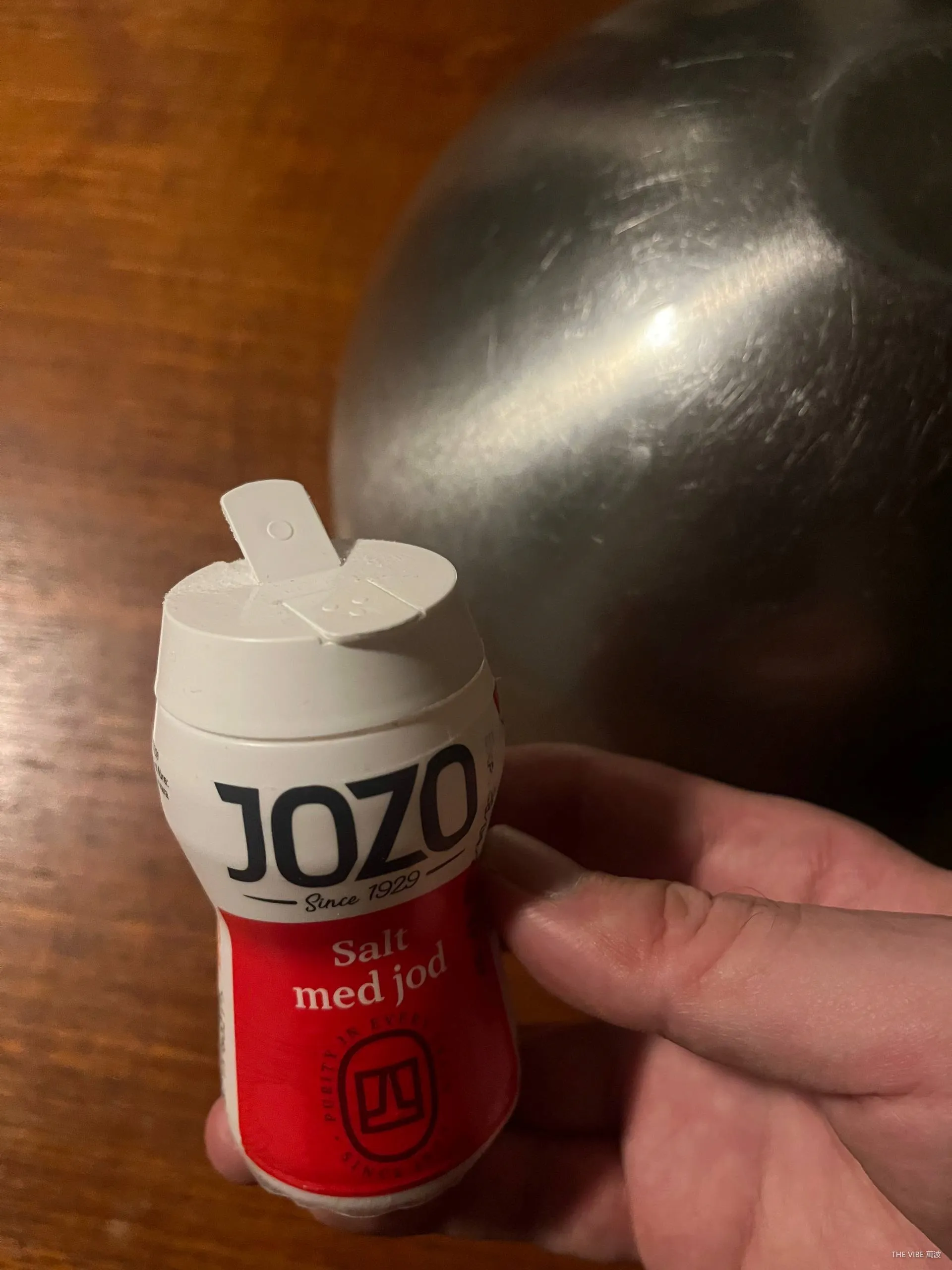
To keep the AIs from coasting on riddle-guessing, I broke the salt shaker down into a bare-bones, six-axis physical description (the basin and the daughter were flagged as irrelevant environmental noise and filtered out):
- Overall Form: A small, upright, one-hand-grip container—short and compact, bottle-shaped, slightly narrower at the top, fuller through the mid and lower body, with gentle curves.
- Material: Opaque white plastic (not metal, not glass), firm to the touch with a hint of give.
- Color & Labeling: White body; the lower half carries a bold red printed label, the upper half stays white—sharp red-on-white contrast, with black brand lettering.
- Top Structure: A round plastic cap with a dividing slot and small dispensing holes, plus two flat plastic flaps that lift independently.
- Interaction Model: One-hand grip; fingers flick the flaps open; tilt and invert; then a repeated wrist-flick up-and-down to shake loose the fine, freely moving granules inside.
Two Hell-Mode Escalations
Compared to Phase One, I made two critical changes to the Phase Two protocol:
- New rule: the Subject-Object Dynamic Anchoring Law (the iron rule for splitting Lower vs. Upper Trigram): When you cast for an event, “me vs. the outside world” is easy to parse. But when the subject is a dead object—who’s the Lower Trigram, who’s the Upper? I drew a hard mechanical line in the prompt: the Lower Trigram always encodes the object’s inner essence; the Upper Trigram encodes its interface with the outside world—its external behavior. The Changing Hexagram, in turn, can reveal the object’s functional shift from static to dynamic. And the old rules still hold: no citing traditional auspicious or inauspicious readings, no forcing a fudge through the coded allusions of the yao texts. Everything runs on the physical deduction laid out in Vibe I-Ching | Hexagram Dynamics.
- Hand-planted “Twin-Outcome Decoy”: First I had Gemini randomly generate three system IDs (
135,281,536). Random picks weren’t spicy enough, so I hand-planted a deviously tricky decoy—344 (Fire over Thunder: Biting Through → Mountain over Thunder: Nourishment). Its Changing Hexagram is identical to my true hexagram—both land onMountain over Thunder: Nourishment.
The full experimental protocol, the prompt, and the raw deduction outputs from all five model groups (A through E) are sealed in the system log below. Rigor-hungry readers are welcome to expand and audit every line:
👁️ [EXPERIMENT PROTOCOL] Expand to View: Round 2 Shefu Double-Blind Protocol, Subject-Object Separation Iron Rule, and 5 Raw Model Texts (A–E)
Below is the “Problem and Factual Background” of a real event, along with five anonymous Hexagram Dynamics models (labeled A, B, C, D, and E).
Strict Constraints:
The key to the audit lies in the interpretation of the problem. Do not be misled by the real-world background provided by the user. Users may provide redundant information; plot points irrelevant to the core of the problem can be ignored. First, analyze what the core content of the divination question is, then check the useful parts of the background information.
It is forbidden to use any traditional I Ching knowledge, hexagram auspiciousness/inauspiciousness, or line commentary allusions for explanation. You must strictly limit yourself to the model physics deduction and energy flow data provided in this conversation as the sole standard.
This round of testing involves a Shefu item. Please select the hexagram from the five that best describes the item.
Subject-Object Dynamic Anchoring Rule (The Iron Law of Lower Trigram vs. Upper Trigram Splitting):
- The Lower Trigram always represents the host / the ground / the core authority holder / the core subject being analyzed.
- The Upper Trigram always represents the environment outside that subject / the opponent / external variables / the Receiving Side.
- Remember: The Querent ≠ The Questioner. Do not default to assuming the questioner is necessarily the Lower Trigram.
General Determination: First ask, “Who or what is this question actually analyzing in terms of internal state, structure, or core authority?” The answer is the Lower Trigram. All other factors that act upon it or constitute external conditions belong to the Upper Trigram. Based on this, verify whether the “moving lines occurring in the Lower Trigram or Upper Trigram” in each model align with the true causal position.
For Shefu items, the Lower Trigram may represent the core essence of the item, while the Upper Trigram represents how the item interacts with the outside world, or its external manifestation. The changing hexagram may reveal the static or dynamic functional transformation of the item. This is for reference only; specific cases require specific analysis, and there is currently no reliable methodology.
Please strictly follow the steps below to execute the output:
Pre-anchoring (List concisely):
- Core of the Divination: Define the core question this problem truly needs to answer, filtering out irrelevant background noise.
- Subject-Object Split: Clearly identify in this case who/what the Lower Trigram (Subject/Host) is, and who/what the Upper Trigram (Object/External Field) is.
Step 1: Independent Evaluation (Must write for all A to E; do not conclude who wins first)
Please sequentially analyze models A, B, C, D, and E from the perspectives of dynamic structure, subject-object positioning, and energy flow, providing a two-sided analysis (pros and cons):
- Forced/Perfect Match Points: Detailed argumentation on how the model explains the evolution of this event in terms of structure and force logic.
- Forced/Conflict Points: Point out where the model is most incongruent or contradictory with the true trajectory of the event (including whether the static/dynamic positions of the Lower/Upper Trigrams are misaligned).
- Fit Score: Provide an integer score from 0 to 10.
Step 2: Final Mandatory Ranking
After completing the independent analysis of the five models above, please provide a comprehensive comparison and a complete ranking from “Best Match (Rank 1)” to “Least Match (Rank 5)” (No ties allowed; a unique Rank 1 must be selected), and briefly explain why Rank 1 surpasses the other four models in terms of structural topology.
Hexagram A:
📍 Code: 135 (Line 5 Moving)
Original Hexagram: Qian over Li: Tong Ren (Companions)
Moving Line: “Nine in the Fifth”
Changed Hexagram: Li over Li: Li (The Clinging)
Line Text: “Companions: First wailing and crying, then laughing; the great army succeeds in meeting.”
Plain Language Translation: “Two groups, initially separated by misunderstanding, shout and cry at each other through a wall. After intense confrontation, they finally clear the air and laugh together (first wailing, then laughing). This is what true friendship looks like.”
Lower Trigram: Core/Subject/Originating Side, Li Fire
Upper Trigram: External Field/Object/Receiving Side, Qian Heaven
Changed Hexagram: External Field/Object/Receiving Side, Upper Trigram changes from Qian Heaven to Li Fire, occurring at Position 5, the Sovereign position of the External Field/Object/Receiving Side.
Physical Deduction:
Initial State: The Core/Subject/Originating Side is Li Fire—glamorous, hollow, dependent, requiring fuel. The External Field/Object/Receiving Side is Qian Heaven—Heavenly Dao, imperial authority, the blazing sun overhead, exerting absolute high pressure and dominion over everything. Fire under Heaven (101111), overall energy directed upward. Under the absolute control of the massive rigid body above (Qian), the fire briefly produces a glamorous high-temperature expansion. However, the sky governs wind, thunder, and clouds; there is no fuel for the flame to cling to. It is empty splendor, exhausting itself in no time. If we view the Upper Trigram as a bold carrier rocket, the rocket shoots into the sky, with the flame struggling to catch up behind it. Yet, energy is one notch lower, and there is no sustaining force. Although it can initially accelerate using the wake effect of Qian Heaven, it is ultimately a rootless fire.
Future Development: The External Field/Object/Receiving Side changes from Qian Heaven to Li Fire at the core Position 5. Both the Core/Subject/Originating Side and the External Field/Object/Receiving Side are now Li Fire, both being high-temperature radiation, upward-escaping plasma states. Fire over Fire (101101), overall energy directed upward. Upper and lower frequencies superimpose, creating a frenzy of fire. For a moment, firelight shoots to the sky, presenting a state of pure high-temperature dissipation, violent upward expansion, and boundless light and heat radiation. Thermodynamically, this is a model of massive input and output, frantic burning, and extreme fluctuation. However, both sides are consumables, competing for oxygen and fuel. Without subsequent energy input, they will ultimately both perish.
Underlying Energy Flow of this Hexagram:
The Qian Heaven originally relied upon by the Lower Trigram Li Fire becomes hollow at its core position, transforming into a similarly rootless fire. It is incomparably glamorous, sharing the same root, source, and frequency coupling. Heterogeneous contact → High-friction coordination → Central synchronization → Resonance amplification → Overheating dissipation. A flexible, dynamic, radiative system attempts to enter a rigid, closed, clearly defined rule-based system. Two originally different systems, through intense contact, undergo structural transformation in the Object, entering a state where the Subject can couple, ultimately leading to synchronization → resonance → amplification. Mismatch → Friction → Alignment → Synchronization → Resonance → Dissipation.
Hexagram B:
📍 Code: 733 (Line 3 Moving)
Original Hexagram: Gen over Li: Bi (Adornment)
Moving Line: “Nine in the Third”
Changed Hexagram: Gen over Zhen: Yi (Nourishment)
Line Text: “Adorned, moistened; perseverance brings good fortune.”
Plain Language Translation: “Dress yourself up to look fresh, beautiful, and moist (adorned, moistened). As long as you maintain this good state, good luck will not run out.”
Lower Trigram: Core/Subject/Originating Side, Li Fire
Upper Trigram: External Field/Object/Receiving Side, Gen Mountain
Changed Hexagram: Core/Subject/Originating Side, Lower Trigram changes from Li Fire to Zhen Thunder, occurring at Position 3, the Transition position of the Core/Subject/Originating Side.
Physical Deduction:
Initial State: The Core/Subject/Originating Side is Li Fire—hollow, glamorous, a plasma state dependent on the slow release of fuel. The External Field/Object/Receiving Side is Gen Mountain—a hard rock barrier. Mountain over Fire (101001), overall energy balanced. Constrained by the massive static mass above (Gen), the heat of the Core/Subject/Originating Side Li Fire is trapped inside the solid body, burning under high pressure. The fire is rootless; inside dense rock, there is no fuel or oxygen, so it may extinguish. If the fire stubbornly survives by relying on geothermal energy, it becomes an active volcano. The internal flame melts the stone into magma, holding immense pressure, waiting for the moment of geological shift or geomagnetic storm to release earth-shattering energy. Bi (packaging, decoration, mystery, beautiful appearance) is glamorous. Due to temperature and mineral factors, even lava lakes, volcanic landscapes present more unique scenery than ordinary high mountains. Bi can conceal, can add value, and can be over-packaged.
Future Development: The Core/Subject/Originating Side is Zhen Thunder—a high-frequency ignition, oscillating engine filled with destructive power and shockwaves. The External Field/Object/Receiving Side is Gen Mountain—a massive rock that is in Absolute Stillness and immovable. Thunder under Mountain (100001), overall energy directed downward. Gen above, Zhen below, like a grinder, like the teeth of an ox: Gen above, moving below. This continuous high-frequency oscillation is extremely damaging to the hard mountain body. If it were soft “Kun Earth,” the oscillation waves would be perfectly absorbed and dissipated by countless sand, mud, and dust (damping effect), resulting in natural safety. Conversely, the solid mountain body, being too hard and lacking resilience, cannot absorb this energy; instead, it transmits the oscillation continuously within the rock. Over time, “stress concentration” occurs internally. Eventually, even the most solid rock will face brittle fracture due to fatigue vibration, and the entire structure will collapse directly. Zhen represents continuously input disturbance; Gen represents a high-rigidity, high-constraint structure. When the system lacks mechanisms to absorb and redistribute disturbance, energy tends to accumulate locally, ultimately causing structural imbalance.
Underlying Energy Flow of this Hexagram:
The opening is fire in the mountain, a hollow heart beneath a glamorous exterior. At the critical Position 3, the Lower Trigram Li Fire undergoes a Phase Transition to Zhen Thunder; the originally slow-released energy becomes a one-time concentrated release. Mountain Thunder Yi creates a pincer attack from top and bottom, grinding.
Hexagram C:
📍 Code: 281 (Line 1 Moving)
Original Hexagram: Dui over Kun: Cui (Gathering)
Moving Line: “Six in the First”
Changed Hexagram: Dui over Zhen: Sui (Following)
Line Text: “Having faith but not to the end, there is disorder and gathering; if you call out, one grasp becomes laughter; do not worry, going forward brings no blame.”
Plain Language Translation: “At first, everyone has some suspicion. Sometimes it’s a chaotic mess, sometimes they’re laughing so hard they can’t close their mouths (one grasp becomes laughter). Don’t panic; go boldly into social interaction.”
Lower Trigram: Core/Subject/Originating Side, Kun Earth
Upper Trigram: External Field/Object/Receiving Side, Dui Marsh
Changed Hexagram: Core/Subject/Originating Side, Lower Trigram changes from Kun Earth to Zhen Thunder, occurring at Position 1, the Bottom position of the Core/Subject/Originating Side.
Physical Deduction:
Initial State: The Core/Subject/Originating Side is Kun Earth—extremely flat, sinking, bearing soil. The External Field/Object/Receiving Side is Dui Marsh—a horizontally converging pool of water. Marsh over Earth (000110), overall energy directed downward. This is a “gathering state” where fluid accumulates on the surface. Dui Marsh is upward water; it does not sink but gathers on top of the land. Unlike Kan Water, which sinks and merges with the earth, the exchange between the two is limited to the surface. It appears that many external resources have gathered, but they may have little connection to the Core/Subject/Originating Side. The Core/Subject/Originating Side is the underlying support, while Dui’s resources benefit the External Field/Object/Receiving Side more.
Future Development: The Core/Subject/Originating Side changes from Kun Earth to Zhen Thunder at Position 1. Sudden oscillation breaks the calm, carrying mechanical kinetic energy with extreme acceleration. The External Field/Object/Receiving Side is Dui Marsh—calm, eager for communication, liquid spreading horizontally. Marsh over Thunder (100110), overall energy balanced. Powerful high-frequency oscillation directly tears the calm water surface from the bottom, forcibly injecting underlying kinetic energy into the fluid of the upper environment. Marsh water is a good conductor, instantly dispersing and absorbing the huge energy of Zhen Thunder. Thunder in water, completely enveloped; the rigid engine operates in a liquid pool, with kinetic energy perfectly buffered by the fluid’s viscosity coefficient, forming stable conduction. The Core/Subject/Originating Side is supplying energy to the other. The flat, open Marsh moves with the oscillation of Thunder. When Thunder shakes, Marsh follows; when Thunder stops, Marsh is still.
Underlying Energy Flow of this Hexagram:
The opening has the Core/Subject/Originating Side as Kun Earth, flat, calmly bearing the lake on the ground. This is a completely relaxed, harmonious gathering. At Position 1, the Core/Subject/Originating Side Kun Earth changes to Zhen Thunder; calmness becomes periodic oscillation. The original silent bearing, lurking, and silence become the dominant force, guiding the actions of the External Field/Object/Receiving Side. Initially, the oscillation may have a chaotic period, lacking coordination. After adapting to the rhythm, it becomes smooth coordinated resonance, going with the flow.
Hexagram D:
📍 Code: 536 (Line 6 Moving)
Original Hexagram: Xun over Li: Jia Ren (Family Members)
Moving Line: “Nine in the Top”
Changed Hexagram: Kan over Li: Ji Ji (Already Across)
Line Text: “Having faith, majestic; in the end, good fortune.”
Plain Language Translation: “Sincerity and a sense of trust (having faith), maintaining a professional and hardcore attitude, unbiased (majestic), this is the perfect state.”
Lower Trigram: Core/Subject/Originating Side, Li Fire
Upper Trigram: External Field/Object/Receiving Side, Xun Wind
Changed Hexagram: External Field/Object/Receiving Side, Upper Trigram changes from Xun Wind to Kan Water, occurring at Position 6, the Highest position of the External Field/Object/Receiving Side.
Physical Deduction:
Initial State: The Core/Subject/Originating Side is Li Fire—hollow, glamorous, dependent on fuel. The External Field/Object/Receiving Side is Xun Wind—casual, formless, penetrating. Wind over Fire (101011), overall energy directed upward. Wind above creates an air negative pressure zone, attracting the flame to rise faster. Wind assists the fire; wind provides the fire with continuous energy/fuel. Fire burning creates rising air currents, forming new wind. Wind and fire are one family, thriving on top of thriving. Fire follows the wind, but the wind is casual. The foundation of the Core/Subject/Originating Side is attached to an uncertain object. Glamorous, but one must be cautious of going astray. Do not be deceived by the warmth of “Family Members” in Jia Ren. Family may be a binding state from which one cannot escape. It describes only a spatial relationship, not an emotional one.
Future Development: The Core/Subject/Originating Side is Li Fire—high temperature, glamorous, hollow, dependent on fuel. The External Field/Object/Receiving Side is Kan Water—bottomless, cold, and water body dragging downward (Kan). Water over Fire (101010), overall energy balanced. This is the most efficient “Perfect Convection and High-Pressure Distillation” model in thermodynamics (Ji Ji). Water goes down, fire goes up; yin and yang meet, positive and negative charges mesh, perfect docking!
Underlying Energy Flow of this Hexagram:
“Coupling → Enhancement → Phase Transition → Reverse Constraint → Dynamic Balance”
From synergistic amplification to offsetting balance. The opening is wind assisting the fire, the environment helping me. But wind has no root, and fire has no root either; it is not reliable. In the changed hexagram, the other party’s Xun Wind becomes Kan Water; the probability wave collapses into solid water. The formless oxygen-supplying environment becomes sinking, anti-phase Kan Water, perfectly docking with the Core/Subject/Originating Side, achieving an efficient combination.
Hexagram E:
📍 Code: 344 (Line 4 Moving)
Original Hexagram: Li over Zhen: Shi He (Biting Through)
Moving Line: “Nine in the Fourth”
Changed Hexagram: Gen over Zhen: Yi (Nourishment)
Line Text: “Biting on dry flesh with bone, obtaining a golden arrow; favorable to perseverance in difficulty, good fortune.”
Plain Language Translation: “Biting on dry meat with bone nearly broke a tooth, but a golden arrowhead was found inside the bone (biting on dry flesh, obtaining a golden arrow); as long as you stick to it to the end, it is absolutely great fortune.”
Lower Trigram: Core/Subject/Originating Side, Zhen Thunder
Upper Trigram: External Field/Object/Receiving Side, Li Fire
Changed Hexagram: External Field/Object/Receiving Side, Upper Trigram changes from Li Fire to Gen Mountain, occurring at Position 4, the Executive position of the External Field/Object/Receiving Side.
Physical Deduction:
Initial State: The Core/Subject/Originating Side is Zhen Thunder—oscillating, fierce, periodic oscillation, exhausting itself in one strike. The External Field/Object/Receiving Side is Li Fire—fire expanding upward, glamorous, hollow, dependent. Fire over Thunder (100101), overall energy balanced. The oscillation of Thunder belongs to strong nonlinear pulses, releasing extremely fast with high directionality; the burning of fire is a self-sustaining chain reaction, releasing relatively gently with omnidirectional radiation and high entropy characteristics. Both are in the same frequency, both plasma, but the other releases slowly, while the Core/Subject/Originating Side exhausts itself in one strike. Fire goes up, Thunder goes down. The thermal convection and ionization channel formed by the flame heating the top air will attract lightning, causing the originally downward-piercing lightning to be attracted upward. Fire has no root, Thunder has no source. After the intense explosive oscillation, the entire system will return to deathly silence. Imagine a red-hot iron block being repeatedly hammered on an anvil. A thousand hammers and a hundred refinements are torture, but this is the inevitable process of becoming a diamond.
Future Development: The Core/Subject/Originating Side is Zhen Thunder—a high-frequency ignition, oscillating engine filled with destructive power and shockwaves. The External Field/Object/Receiving Side changes from Li Fire to Gen Mountain at Position 4—a massive rock that is in Absolute Stillness and immovable. Thunder under Mountain (100001), overall energy directed downward. Gen above, Zhen below, like a grinder, like the teeth of an ox: Gen above, moving below. This continuous high-frequency oscillation is extremely damaging to the hard mountain body. If it were soft “Kun Earth,” the oscillation waves would be perfectly absorbed and dissipated by countless sand, mud, and dust (damping effect), resulting in natural safety. Conversely, the solid mountain body, being too hard and lacking resilience, cannot absorb this energy; instead, it transmits the oscillation continuously within the rock. Over time, “stress concentration” occurs internally. Eventually, even the most solid rock will face brittle fracture due to fatigue vibration, and the entire structure will collapse directly. Zhen represents continuously input disturbance; Gen represents a high-rigidity, high-constraint structure. When the system lacks mechanisms to absorb and redistribute disturbance, energy tends to accumulate locally, ultimately causing structural imbalance.
Underlying Energy Flow of this Hexagram:
The opening is the Subject taking active action, encountering resistance that must be dealt with. The underlying strong mechanical pulse forcibly clashes with the environment’s Li Fire. The Core/Subject/Originating Side is the hammering; imagine a red-hot iron block being repeatedly hammered on an anvil. The other party changes from the initial Li Fire, the red-hot iron block, to cooled, solidified hundred-refined steel. Quenching! The Upper Trigram of the changed hexagram becomes Gen, converging, stopping. Stop infinite escalation; turn the results into something that can operate sustainably. Stopping (Gen) is not losing momentum, but transferring momentum from consumptive behavior to constructive behavior. The stimulus stops, but the effect continues, meshing with Zhen Thunder above and below for grinding. The Subject has not stopped acting, but the mode of external action has changed. Early on, it relies on impact and overcoming resistance; later, it relies on boundaries, structure, and continuous maintenance. Biting on dry flesh—encountering true resistance; obtaining a golden arrow—extracting the key from complexity; favorable to perseverance in difficulty—transforming difficulty into directed persistence. Shi He is breaking through obstacles; Yi is ensuring the results after the breakthrough survive.
Question: What else has Shefu’s daughter hidden?
📝 Real-World Context: The daughter hid an item inside a stainless steel basin. Please determine which of the following hexagrams best corresponds to the hidden object.
Current Test Round: Shefu Case — Jozo Small Salt Shaker
Item Photo:
https://pub-4e6337f0e50c4bee83725529757a25f7.r2.dev/Richard/shefu/shefu-salt-photo_2026-11-12_00-42-27.webp
Item Description:
- Overall Form
A small, upright container that can be held in one hand.
The overall structure is short and compact, resembling a bottle.
The body is not a perfectly straight cylinder but features curved variations.
The upper section near the neck is slightly narrower, while the middle and lower sections are fuller.
The base is rounded, allowing it to stand upright.
- Material
The body is made of opaque white plastic.
The material has a certain rigidity but is neither metal nor glass.
The plastic possesses slight elasticity and may undergo limited deformation when squeezed by hand.
The top cap is also made of plastic.
- Appearance and Color
The primary color is white.
The exterior of the body features a printed label with alternating red and white sections.
The label includes black brand text and a graphic logo.
The red areas are concentrated in the middle and lower sections, while the white areas are primarily in the upper half.
The overall appearance exhibits a distinct red-and-white color contrast.
- Top Structure
There is a circular plastic cap on top of the bottle.
The surface of the cap features dividing slots or small dispensing holes.
Two flat plastic flaps that can be lifted are located on the top.
The flaps have raised edges to facilitate finger operation.
The cap design allows the user to selectively open the dispensing position.
- Physical Interaction
The user can hold the body with one hand.
The top flaps can be operated with fingers.
The container can be tilted or inverted.
Repeatedly shaking the wrist up and down allows the internal substance to be dispensed outward.
The internal substance consists of small, freely moving particles, rather than solid components fixed inside the container.
- Scale and Weight
It is a small, everyday item.
It can be placed on a desktop or kitchen countertop.
It can be operated with one hand.
Before the reveal, here’s a one-line snapshot of what each anonymous model was actually doing:
- Model A: Opens under a blazing high sun pressing down on a hollow core of fire. Then the upper trigram ignites into its own rootless inferno—top and bottom now fighting for the same oxygen, feeding each other’s flames until the whole system overheats, dissipates, and burns out.
- Model B: Opens as a solid mountain cradling a hollow, ornately dressed fire. At the pivot line, the core snaps into a high-frequency oscillation engine—suddenly the whole structure is a grinding, churning interlock between top and bottom.
- Model C: Opens as level ground holding a wide, open pool of liquid. Then the deepest layer kicks off a tremor—the surface starts to ripple in rhythm, soaking up the shock, buffering the energy.
- Model D: Opens with wind feeding a hollow fire, the flames riding invisible currents. Then the topmost layer flips—wind gives way to cold, heavy water pouring downward, and the system locks into a clean water-fire convection loop.
- Model E: Opens with the lower layer hammering a red-hot upper slab—brutal, percussive, no finesse. Then the top cools, hardens into a forged-steel mountain, and the whole thing locks into a rigid interlock. The hammering stops.
II. Blind-Test Reveal: The 3:1 Split and the “Same-Endpoint Trap” Wipeout
Here’s the scoreboard—four whiteboard AIs, independent scoring, forced ranking:
| Anonymous Code | Real System Code & Hexagram | ChatGPT-6 | Gemini 4 | Claude 5.5 | Grok 4.7 | Overall Performance |
|---|---|---|---|---|---|---|
| A | 135 Heaven over Fire: Fellowship → Fire over Fire: The Fire |
5th (2 pts) | 5th (2 pts) | 5th (3 pts) | 4th (4 pts) | Thermal runaway—dead last across the board |
| B | 733 Mountain over Fire: Grace → Mountain over Thunder: The Cleft (Real Divination) |
3rd (6 pts) | 1st (8 pts) | 1st (9 pts) | 1st (8 pts) | 3/4 majority—takes the crown 🏆 |
| C | 281 Lake over Earth: Gathering → Lake over Thunder: Following |
4th (5 pts) | 3rd (5 pts) | 2nd (7 pts) | 5th (3 pts) | Pool structure doesn’t match the hexagram |
| D | 536 Wind over Fire: The Family → Water over Fire: Completion (Random) |
1st (9 pts) | 2nd (6 pts) | 3rd (6 pts) | 3th (5 pts) | ChatGPT-6’s lone first-place pick |
| E | 344 Fire over Thunder: Biting Through → Mountain over Thunder: The Cleft (Artificial Interference) |
2nd (7 pts) | 4th (4 pts) | 4th (5 pts) | 2nd (6 pts) | Causal inversion—zero first-place votes |
This round produced a genuinely interesting split:
- The real hexagram—B (733)—took three of four first-place votes. Gemini, Claude, and Grok all put it on top.
- The decoy I planted—E (344, same endpoint: Mountain over Thunder: The Cleft)—landed two second-place and two fourth-place finishes. Zero first-place votes.
- ChatGPT-6 skipped the real hexagram entirely. It gave B a third (6 pts) and threw its first (9 pts) at the random draw—D (536, Wind over Fire: The Family → Water over Fire: Completion).
Full line-by-line critiques and ranking rationales from all four AIs are in the collapsible section below:
🤖 [AI JUDGE LOG 1/4] ChatGPT-6 Reasoning Model: Full Independent Evaluation & Ranking (D: 9 pts/Rank #1 | True Hexagram B: 6 pts/Rank #3)
ChatGPT-6 Reasoning Model:
Shefu Analysis: Jozo Small Salt Shaker
Pre-Anchor
1. Core of the Divination
The true question to be answered is: Which dynamic model, A through E, best fits the internal structure, material form, and external interaction functions of the item hidden by the daughter?
The core is not to analyze the daughter’s psychology or hiding behavior, nor to analyze the stainless steel basin itself, but to identify the physical essence of the hidden item.
The primary characteristics of the item can be summarized as follows:
-
Internal: A hollow container holding freely movable fine solid particles.
-
Shell: White plastic with a certain degree of hardness and limited elasticity.
-
Appearance: Red-and-white alternating packaging label with distinct visual ornamentation.
-
Top: Selectively openable dispensing hole and flip-top lid.
-
Dynamic Function: Internal particles are dispensed through repeated external shaking, tilting, and the action of gravity.
2. Subject-Object Topology
| Position | Anchor Object in This Case | Basis for Judgment |
|---|---|---|
| Lower Trigram (Subject/Host) | The internal containment core of the Jozo salt shaker, including the bottle cavity and salt grains | The physical essence of the item being analyzed |
| Upper Trigram (Object/External Field) | The bottle mouth, flip-top lid, dispensing interface, and external interaction conditions such as hand manipulation and gravity | Determines how the item exchanges matter and energy with the outside world |
The stainless steel basin belongs to the external hiding environment and is not the core subject of this question. The daughter is merely the hider and is not the subject of the Lower Trigram.
There is an important distinction here: The salt grains inside the shaker are the stored substance, the bottle mouth is the output interface, and hand shaking is the external energy input. These three cannot be conflated.
Additionally, the bottle body, lid, and dual-flap structure shown in the photo are consistent with the above physical description. This analysis does not adopt traditional hexagram meanings, line statements, or auspicious/inauspicious judgments.
Step 1: Independent Evaluation of the Five Models
Model A: 135|Lower Li, Upper Qian, Fifth Line Moving
Initial Structure: Li Fire over Qian Heaven
Low Match
1. Forced/Perfect Match Points
The Lower Trigram of A is Li Fire, whose physical characteristics include hollowness, dependency, ornate appearance, and the need for internal substance support.
This does find some characteristics of the salt shaker:
-
The bottle body is hollow and must contain salt grains to function as storage.
-
The red-and-white alternating label has visual ornamentation.
-
The plastic bottle itself is the shell containing the substance, not a system that autonomously generates energy.
The initial Qian Heaven can be forced to correspond to an external stable, hard environment, such as the external constraint formed by the stainless steel basin.
After the fifth line changes, the external field shifts from Qian to Li, forming a structure of same-frequency upper and lower trigrams. If interpreted as the internal substance and the external dispensing environment gradually forming synchronization, it can be forced to correspond to the process of salt grains being dispensed through the bottle mouth.
Therefore, A is not entirely without points of correspondence.
2. Far-Fetched/Conflict Points
The problem lies in the core energy flow of A being:
Heterogeneous contact → Frictional coordination → Central synchronization → Resonant amplification → Overheating dissipation.
This has a clear gap with the actual physical mechanism of the salt shaker.
First, the salt shaker is not a high-temperature radiation system. Salt grains do not produce thermodynamic resonant amplification due to the synchronization of the upper and lower trigrams.
Second, the salt shaker does not require continuous external energy supply. It merely stores substance; the external user controls dispensing through shaking and the action of gravity.
Finally, the changing line in A is at the fifth position, representing a change in the central control area of the external field, but the structure with true identifying significance is the dual flip-top lid and dispensing hole at the very top of the bottle mouth. The fifth position is not as precise as the sixth position.
Especially since both sides become consumptive flame systems in the future, ultimately both extinguishing, this is too intense for a daily item that can be repeatedly stored, used, and closed.
3. Fit Score
2/10
Integer Score
Model A primarily matches the bottle’s hollow body and ornate exterior, but fails to capture the item’s most critical functions: storage and dispensing.
Model B: 733 | Li (Fire) below, Gen (Mountain) above, Third Line Moving
Initial Structure: Li (Fire) / Gen (Mountain)
Moderate Match
1. Forced / Perfect Match Points
Model B’s initial structure features Li (Fire) internally and Gen (Mountain) externally.
This model can be mapped to the salt shaker’s actual structure:
-
Lower Trigram Li (Fire): The bottle body is hollow, providing space to contain internal substances, while the exterior features distinct packaging and decoration.
-
Upper Trigram Gen (Mountain): The bottle body and cap possess a certain rigidity, and the external stainless steel bowl also provides a hard physical boundary.
The movement of the Third Line is particularly noteworthy.
The Lower Trigram shifts from Li (Fire) to Zhen (Thunder), representing a transition of the internal state from relative static containment to a system characterized by pulses, oscillations, and repetitive kinetic energy.
This aligns reasonably well with the usage of the salt shaker:
Originally stationary salt grains, after repeated wrist shaking, begin to exhibit relative motion and are dispensed through the bottle opening.
Furthermore, the Third Position serves as a transitional zone within the Lower Trigram. The salt shaker’s body is fuller in the lower-middle section and narrower at the top, reflecting a structural transition from the main body to the neck.
This is a commendable point of alignment.
2. Forced / Conflict Points
Model B’s greatest issue lies in its future force model.
It describes:
Oscillation Engine → Hard Rock Mass → Stress Concentration → Fatigue Accumulation → Brittle Fracture.
However, the salt shaker is not a mechanical system required to withstand rock impact or endure long-term high-frequency fatigue.
The actual salt grains possess high degrees of freedom; they can move relative to one another, rearrange, and be dispensed through the outlet.
They are not fixed components sealed within a rock mass.
Moreover, placing the oscillation in the Lower Trigram equates to locating the dynamic change within the item’s core. In the real-world mechanism, however, the hand is the primary source of kinetic input, and the salt grains inside the bottle merely undergo relative motion in response to external force.
This causal positioning is inaccurate.
Additionally, while the external Gen (Mountain) can correspond to the hardness of the stainless steel bowl, the salt shaker is not continuously subjected to clamping or grinding by the bowl.
Therefore, while Model B’s initial structure is reasonable, its future evolution overemphasizes destructive outcomes.
3. Fit Score
6/10
Integer Score
Model B captures the hollow cavity, rigid external structure, and oscillatory dispensing characteristics, but it over-amplifies the subsequent destructive inference.
Model C: 281 | Kun (Earth) below, Dui (Lake) above, First Line Moving
Initial Structure: Kun (Earth) / Dui (Lake)
Moderate Match
1. Forced / Perfect Match Points
Model C’s initial structure features Kun (Earth) below and Dui (Lake) above.
This represents a relatively stable bearing system.
The Lower Trigram Kun (Earth) can correspond to the salt shaker’s fundamental nature as a container:
-
Containment.
-
Bearing.
-
Static storage.
-
Providing a stable physical foundation.
The Upper Trigram Dui (Lake) can be understood from another angle as aggregated, movable matter.
Although salt grains are not a liquid, a large quantity of fine particles aggregated within the same space can indeed exhibit collective motion characteristics similar to those of a fluid.
Model C’s future change is:
The Lower Trigram Kun (Earth) shifts to Zhen (Thunder), while the Upper Trigram Dui (Lake) remains unchanged.
This signifies that the bearing core transitions from a calm, static state to a state of repetitive vibration, while the external fluid-like medium begins to move in response.
This can describe the process where, after the salt shaker is shaken, the internal salt grains shift from static accumulation to continuous rearrangement and flow, finally being dispensed through the outlet.
Another advantage of Model C is that, unlike Model B, it does not necessarily lead to destruction.
The oscillatory energy can be absorbed, transmitted, and buffered by the movable matter, forming a relatively stable dynamic interaction.
This bears some resemblance to the daily usage of the salt shaker.
2. Forced / Conflict Points
Model C has a significant causal issue.
According to the Subject-Object Topology anchoring for this analysis, the Lower Trigram must represent the core of the item being analyzed, while the Upper Trigram represents the external environment.
However, Model C’s future change involves the Lower Trigram itself shifting from Kun to Zhen, seemingly indicating that the core initiates the oscillation autonomously.
In reality, the oscillatory energy of the salt shaker originates from the user’s wrist. It does not generate its own power but rather undergoes motion after receiving external force.
Therefore, with the moving line located at the First Position of the Lower Trigram, there is a misalignment in the source of the kinetic energy.
Secondly, Model C’s Upper Trigram Dui (Lake) is defined as an external environment of liquid aggregation. While the stainless steel bowl can serve as a container, its primary physical properties are hardness and rigidity, not the flexible damping medium of a liquid.
Furthermore, the salt grains are the internal substance of the bottle; they cannot be directly treated as the external Dui (Lake), as this would violate the previously established Subject-Object distinction.
Thus, while Model C’s fluid buffering model has some explanatory value, it requires additional adjustment to the Subject-Object relationship between the item and its internal substance to be valid.
3. Fit Score
5/10
Integer Score
Model C is suitable for explaining static containment, particle aggregation, and post-vibration flow, but there is a contradiction between the energy source of the changing line and the physical properties of the external environment.
Model D: 536 | Lower Li, Upper Xun, Top Line Moving
Initial Structure: Li Fire over Xun Wind: Wind over Fire
High Match
1. Forced / Perfect Match Points
Model D is one of the five models whose structural features warrant a deep comparison with the salt shaker.
First, consider the Lower Trigram, Li Fire.
The physical configuration of Li Fire is:
- Hollow.
- Requires attachment to internal substance.
- Possesses distinct external manifestation.
- Relies on an internal energy source to maintain function.
Corresponding to the salt shaker:
The bottle body is a hollow plastic container holding salt grains. The bottle itself does not generate salt or power; rather, it relies on the stored internal substance to fulfill its purpose.
Externally, it features a red-and-white label, exhibiting clear visual distinctiveness.
Therefore, the description of Lower Li has a high degree of match.
Next, consider the Upper Trigram, Xun Wind.
The physical configuration of Xun Wind is formless, penetrating, flowing, and providing energy through the external environment.
Applied to the salt shaker, this can correspond to the top dispensing interface:
The cap features a partition slot and dispensing holes, allowing air exchange between the inside and outside through the open holes. When the user tilts or shakes the bottle, the internal salt grains are also influenced by gravity and air exchange conditions, moving through the dispensing holes.
Particularly noteworthy here is that the future change in Model D occurs at the sixth position of the Upper Trigram.
The Upper Trigram changes from Xun Wind to Kan Water, representing a Phase Transition in the external interaction mode, while the Lower Trigram, Li Fire, remains unchanged.
This position forms a rather interesting correspondence with the physical structure of the salt shaker:
The containment core inside the object remains stable; what truly changes is the output interface at the very top.
Initially, this can be understood as the exchange of air, openings, channels, and the external environment.
After the change, the flowing form of Kan Water can be abstractly understood as continuous downward material transport.
There is no need to literally treat the salt as water.
Fine solid particles, when aggregated in large quantities, can exhibit certain fluid-like collective flow characteristics. When the bottle is tilted or shaken, the salt grains, under the influence of gravity, pass through the top opening and are discharged, forming an inward-to-outward material flow.
Most importantly: The Lower Trigram did not change; the change occurred at the highest position of the Upper Trigram.
This aligns well with the structure of a fixed container that alters its external delivery method by using different top dispensing holes.
2. Forced / Conflict Points
Model D is not without issues.
First, the original physical model of Xun Wind assisting Li Fire emphasizes external air supply providing internal energy.
In reality, the primary power source for the salt shaker comes from hand shaking and gravity, not from wind providing fuel or oxygen.
Second, Kan Water is not actual salt grains.
Salt grains are discrete solid particles, not a continuous liquid. Therefore, interpreting them as Kan Water can only be an analogy of flow behavior, not a strict judgment of material phase state.
Furthermore, the future deduction of Model D involves thermodynamic convection, distillation, and dynamic equilibrium between water and fire. These specific thermodynamic descriptions cannot be directly applied to a plastic salt shaker.
Thus, the part of Model D that truly holds is not the literal thermodynamic interpretation, but its Topological Structure:
- The internal containment core remains unchanged.
- The external interaction interface changes.
- The change occurs at the very top.
- The original open channel transforms into a material transport channel.
These are the most valuable correspondences with the physical object.
3. Fit Score
9/10
Integer Score
D is currently the most complete model in describing the internal containment structure of the salt shaker and its top dispensing interface.
Model E: 344 | Zhen (Thunder) below, Li (Fire) above, Fourth Line Moving
Initial Structure: Zhen (Thunder) over Li (Fire): Great Power
Highly Matched
1. Forced / Perfect Match Points
The core of E is Zhen (Thunder).
Zhen (Thunder) represents pulses, impacts, periodic oscillations, and mechanical kinetic energy.
This aligns to a certain extent with the most recognizable operation of the salt shaker:
The user repeatedly shakes the bottle body up and down; the fine salt grains inside are subjected to pulsed external forces, resulting in collisions, rearrangement, and relative movement.
Therefore, E’s mechanical pulse model can explain the dynamic function of the salt shaker.
Furthermore, the upper trigram Li (Fire) transforms into Gen (Mountain).
This change can correspond to the item’s dispensing control:
- Li (Fire): An open dispensing state where substance can move outward.
- Gen (Mountain): An external structure with boundaries, constraints, and a stopping function.
The salt shaker has two operable flip lids, allowing the user to choose to open or close the dispensing position.
This forms an interesting functional cycle:
Open dispensing port → Repeated shaking → Salt grains dispensed → Close flip lid → Stop dispensing.
E’s concept of “stimulation stops, but effect persists” also has some explanatory space.
After stopping the shaking, the salt grains do not disappear immediately; instead, they gradually settle, rearrange, and finally return to a stable storage state.
E is not entirely inconsistent with the salt shaker, especially in explaining the usage process, where it has quite high recognizability.
2. Forced / Conflict Points
E’s biggest problem is the Subject-Object position.
The lower trigram Zhen (Thunder) represents an active pulse in the core.
However, the true pulse energy comes from the user’s hand, not generated internally by the salt shaker itself.
The salt grains only move after being subjected to external force. If strictly following the Subject-Object anchoring of this session, this external power source should be received by the upper trigram.
Additionally, E’s upper trigram transforms from Li to Gen, with the changing line occurring at the fourth position.
The fourth position belongs to the starting position of the upper trigram, not the highest position.
Although it can be interpreted as a change in the working mode of the external dispensing interface, the most recognizable structure of the salt shaker is the top flip lid and dispensing hole. The spatial indication of the sixth position is more precise than the fourth.
Finally, E’s future model involves continuous high-frequency vibration acting on a rigid structure, potentially forming fatigue damage.
However, the white plastic shell of the salt shaker has a certain elasticity, and the internal salt grains can move freely; they do not continuously accumulate stress like components fixed in a rigid rock body.
Therefore, E’s destructive evolution is higher than what the actual item requires.
3. Fit Score
7/10
Integer Score
E corresponds to the salt shaker’s oscillating dispensing and flip-lid stopping function, but the active power source in the lower trigram and the position of the changing line are not as precise as D.
Step 2: Final Forced Ranking
Final Ranking of Five Models
1
Model D
9**/10**
Code: 536 · The highest position of the upper trigram changes, corresponding to the top dispensing interface; the internal containment core remains unchanged.
2
Model E
7**/10**
Code: 344 · Matches the oscillating dispensing and flip-lid stopping function, but there is a deviation in the power source and the position of the changing line.
3
Model B
6**/10**
Code: 733 · The cavity shifts to oscillation, and the external rigid constraint is reasonable, but the destructive inference is too strong.
4
Model C
5**/10**
Code: 281 · Containment, aggregation, oscillation, and particle buffering align, but the causal position of internal and external energy is inconsistent.
5
Model A
2**/10**
Code: 135 · The hollow structure and visual decoration align to some extent, but the high-temperature resonance and dissipation model show the greatest divergence.
Why Does D Outperform the Other Four Models?
I believe D’s advantage lies not in its literal elements of fire, water, or wind, but in its Subject-Object Topology and the position of change.
Placing the five models within the same physical judgment framework:
| Comparison Dimension | Real Object Characteristics | D’s Correspondence |
|---|---|---|
| Core Structure | Hollow container with salt grains inside | Lower Li |
| External Interface | Top dispensing hole and flip lid | Upper Xun |
| Dynamic Interaction | Shaking, tilting, gravity | External interaction change |
| Material Output | Salt grains dispensed downward | Upper Kan’s flow analogy |
| Core Stability | Bottle body and internal containment structure remain unchanged | Lower trigram unchanged |
| Position of Change | Top dispensing interface | Upper trigram, sixth position |
The main defects of the other four models:
-
A: Infers a low-energy, reusable daily item as a high-temperature resonance, dual-dissipation system.
-
B: Identifies oscillation but infers the external constraint as a rigid rock body prone to collapse.
-
C: Identifies containment and fluid buffering but confuses the relationship between the external environment and the internal substance.
-
E: Identifies oscillation-based dispensing and the stopping mechanism, but places the externally applied dynamic force on the internal subject, and the position of change is less precise than D’s.
D’s key winning point is: The subject does not need to change; what changes is the way the subject exchanges matter with the outside world, and this change occurs precisely at the topmost interaction interface.
This offers greater structural recognition value than simply asking whether “fire resembles a red label,” “Zhen resembles shaking,” or “Gen resembles hard plastic.”
Final Verdict
Sole First Place
D · 536
Lower Li, Upper Xun, upper line moving, changing to Lower Li, Upper Kan.
Core Model: A stable hollow material container that achieves controlled material transport through changes in the top external interface.
9/10
Overall Structural Fit
My judgment is: D best describes this Jozo small salt shaker.
What truly deserves attention in this test is not the single physical characteristic of a specific hexagram, but whether the position of the changing line falls where the real object actually undergoes functional transformation.
D holds an advantage over the other four models in this regard. Of course, this is a relative matching ranking based on the model rules you provided, and it does not prove that hexagrams can reliably identify unknown objects.
🤖 [AI JUDGE LOG 2/4] Gemini 4 Hydrogen: Full Independent Evaluation & Ranking (True Hexagram B: 8 pts/Rank #1)
Gemini 4 Hydrogen:
Pre-Anchor Calibration
- Core Inquiry: This query concerns a “Shefu Item.” The core objective is to analyze the physical structure, visual appearance, and dispensing mechanism of the target item, the “Jozo Small Salt Shaker.” Background elements such as the “daughter,” “hiding behavior,” and “stainless steel basin” are classified as irrelevant environmental noise and are filtered out. The judgment criteria are limited strictly to the static structure and dynamic interaction functions of the salt shaker itself.
- Subject-Object Topology:
- Lower Trigram (Subject / Host / Core Essence): The body structure of the Jozo Small Salt Shaker, its opaque hollow cavity, and the physical state of the fine, free-moving particles (salt) contained within.
- Upper Trigram (Object / External Field / Interaction Interface): The external boundary constraints of the salt shaker (including the top circular plastic cap, dispensing hole, and dual-flap structure), as well as the mode of interaction with the external world (single-hand grip, tilting, and wrist up-and-down shaking for dispensing) and its external manifestation.
Step 1: Independent Evaluation of Each Model
Model A (Code 135: Primary Hexagram [Qian] over [Li]: TONG REN (Companions in the World) → Changed Hexagram [Li] over [Li]: LI (The Clinging), Line 5 Moving)
- Forced / Perfect Match Points:
- Cavity and Content Adherence of the Lower Trigram (Li Fire): The model defines the Lower Trigram as “splendid, hollow, adherent, requiring fuel.” This aligns with the fundamental characteristics of the small salt shaker as a “hollow container,” featuring a high-contrast red, white, and black printed label on the exterior (a splendid visual exterior), and possessing existential significance only by adhering to internal particles (fuel/fill).
- Forced / Conflict Points (Including Static-Dynamic Position Verification):
- Misalignment of Upper Trigram Rigid Body Definition and Change Mechanism: The Upper Trigram (Qian Heaven) represents a “massive rigid body / carrier rocket” of “scorching sun overhead, absolute high pressure, and ruling power.” The changing line occurs at Position 5 (Core of the External Field), causing the Upper Trigram to transform into “pure high-temperature dissipation, boundless light-heat radiation, and upward-escaping plasma state.” It then competes with the Lower Trigram for fuel, resulting in “mutual annihilation.” In reality, the external top cap and interaction interface of the salt shaker consist only of small plastic flaps with slight elasticity. They are neither massive rigid bodies, nor does their use cause the external field to transform into an upward-escaping energy burst. Conversely, the salt shaker dispenses particles by tilting downward / shaking, and is designed as a reusable, steady-state daily utility. This is completely contrary to “overheating dissipation and mutual annihilation.”
- Static-Dynamic Position: The External Field (Upper Trigram Position 5) undergoes a Phase Transition into a dissipative state identical to the internal one, failing to reflect the physical logic of hand mechanical shaking or flap-opening dispensing.
- Fit Score: 2 points
Model B (Code 733: Primary Hexagram [Gen] over [Li]: BI (Adornment) → Changed Hexagram [Gen] over [Zhen]: YI (The Caudle), Line 3 Moving)
- Forced / Perfect Match Points:
- High Alignment of Static Structure and Visual Packaging: The Lower Trigram Li Fire in the Primary Hexagram possesses the characteristics of “hollow, splendid, slow release,” and the model’s deduction explicitly states that “Bi (packaging, decoration, mystery, beautiful appearance), splendor… can conceal and add value.” This precisely corresponds to the physical appearance of the small salt shaker: “opaque white plastic body (concealing the interior) + hollow container + distinct red-white-black contrast label (external decorative packaging).” Simultaneously, the “slow release” aligns with the design of controlled dispensing through a small hole.
- Precise Conversion of External Field Constraints and Dynamic Function: The Upper Trigram Gen Mountain represents a “high-rigidity, high-constraint structure” and “massive static mass,” corresponding to the stability of the salt shaker when placed upright, as well as the closed boundary constraints of the top cap / bottle walls on the internal particles. When entering the usage state, the changing line occurs at Position 3 (Subject Transition Position), causing the Lower Trigram to Phase Transition from Li Fire to Zhen Thunder (“high-frequency oscillation engine,” “continuously input disturbance”). This forms an up-and-down relative motion with the static constraint of the Upper Trigram, described as “[Gen] over [Zhen], like a grinder, like the upper teeth of an ox moving over the lower”—extremely fitting for the user’s “single-hand grip and repeated up-and-down wrist shaking,” which generates high-frequency disturbance of internal particles between the rigid boundary and the dispensing hole slot, causing them to be expelled outward.
- Forced / Conflict Points (Including Static-Dynamic Position Verification):
- Excessive Material Rigidity and Energy Loss: The model’s deduction assumes Li Fire is in a state of high-pressure smoldering within rock (active volcanic magma), and that after transforming into Zhen Thunder, the lack of toughness in the mountain body leads to “stress concentration, brittle fracture, and structural collapse.” In reality, the small salt shaker is a room-temperature plastic container with “slight elasticity and limited deformation under compression,” containing freely moving solid particles rather than magma. Normal up-and-down shaking does not cause brittle collapse of the bottle body or top cap.
- Static-Dynamic Position: The changing line is located at Lower Trigram Position 3 (Core Transition Position), which fits the “subject transitioning from static containment to an oscillation state driven by shaking.” However, the top cap flaps themselves require manual opening before interaction (Upper Trigram Position 6 action). In the model, the Upper Trigram remains static throughout, slightly ignoring the local operational detail of lifting the flaps.
- Fit Score: 8 points
Model C (Code 281: Primary Hexagram [Dui] over [Kun]: CUI (Gathering) → Changed Hexagram [Dui] over [Zhen]: SUI (Following), Line 1 Moving)
- Forced / Perfect Match Points:
- Excellent Dynamic Control and Rhythm Synchronization: After the change, the model exhibits strong mechanical motion control logic—the Lower Trigram (Position 1) shifts from silence to “sudden oscillation, periodic oscillation, and mechanical kinetic energy with limit acceleration,” transitioning from passive bearing to active leadership. Meanwhile, the Upper Trigram exhibits a linked effect of “when thunder shakes, the marsh follows; when thunder stops, the marsh is still,” and “initial oscillation involves a chaotic period of discoordination, which becomes smooth coordinated resonance after adapting to the rhythm.” This is highly consistent with the “human-machine rhythm response” where shaking the salt shaker causes salt grains to flow out, and stopping the shaking immediately stops the dispensing.
- Forced / Conflict Points (Including Lower/Upper Trigram Essence Misalignment):
- Severe Contradiction in Static Subject-Object Physical Form: The Lower Trigram Kun Earth is defined as “extremely flat, sinking, bearing soil,” and the Upper Trigram Dui Marsh is defined as a “liquid water pool with lateral convergence, flat open layout, viscosity coefficient, and conductivity,” where “kinetic energy is perfectly buffered by the liquid’s viscosity coefficient.” The small salt shaker itself is an upright, curved, hollow, lightweight plastic bottle with a distinct red-white appearance, not a flat, sinking bearing base. Its external interaction interface is a closed plastic round cap with holes and flaps, and its interior contains dry solid particles. There is absolutely no laterally spread liquid water pool or viscous buffering effect.
- Static-Dynamic Position: The changing line occurs at Lower Trigram Position 1 (Bottom Position). While this can barely correspond to a single hand gripping the lower-middle part of the bottle body to exert shaking force, the static essence of the subject (Kun) is completely disconnected from the item’s appearance and structure (hollow, upright, packaged).
- Fit Score: 5 points
Model D (Code 536: Primary Hexagram [Xun] over [Li]: JIA REN (Family Members) → Changed Hexagram [Kan] over [Li]: JI JI (Completion), Line 6 Moving)
- Forced / Perfect Match Points:
- Precise Alignment of Subject Essence and Top Space Changing Line Position: The Lower Trigram Li Fire (“hollow, splendid, requiring adherence to fuel”) accurately describes the salt shaker’s hollow container attribute, red-white contrast appearance, and dependence on internal fill. Notably, the changing line occurs at Position 6 (Highest Position of the External Field), which precisely corresponds to the “topmost” circular plastic cap and two liftable flaps of the salt shaker! In the static state, the Upper Trigram is Xun Wind (“formless, penetrating”), which can be viewed as the separation slots and dispensing holes on the top cap. After the top is opened, the Upper Trigram Phase Transitions into Kan Water (“carrying downward”), forming a reverse interface with Li Fire, symbolizing the directional flow of internal material downward through the top holes after the bottle body is tilted / inverted.
- Forced / Conflict Points (Including Static-Dynamic Position and Energy Mechanism Misalignment):
- Completely Incorrect Energy Driving Mechanism: The core physical deduction of the model is thermodynamic “wind aiding fire, air negative pressure zones, High-Pressure Distillation, and perfect convection,” involving “probability wave collapse into cold and bottomless water bodies.” The expulsion of internal particles from the small salt shaker does not rely on thermal convection, negative pressure suction, or gas-liquid Phase Transition, but must depend on the pure mechanical reciprocating oscillation of “repeated up-and-down wrist shaking.” The model completely lacks the “oscillation / mechanical pulse” element.
- External Field Material and Form Mismatch: The “casual formlessness” of Xun Wind and the “bottomless liquid” of Kan Water both fail to reflect the solid hard constraints of the plastic top cap and the physical essence of dry particles.
- Fit Score: 6 points
Model E (Code 344: Primary Hexagram [Li] over [Zhen]: Shi He (Biting Through) → Changed Hexagram [Gen] over [Zhen]: Yi (Nourishment), Fourth Line Moving)
- Forced/Perfect Match Points:
- End-State Interaction Topology Aligns with Shaking Boundary Action: The final structure of the model after the hexagram change is identical to Model B, both being “[Gen] over [Zhen]”—that is, a high-rigidity structure with boundary constraints (Gen) interlocking and grinding with high-frequency periodic oscillation (Zhen). This corresponds to the dynamic scene of the salt shaker dispensing contents through up-and-down shaking under boundary limitations; furthermore, the model also contains the “Li Fire (splendid, hollow)” element.
- Forced/Conflict Points (Including Causal Sequence and Severe Material Conflicts):
- Inversion of Static-Dynamic Causality: The model designates “Zhen Thunder (fierce, strong nonlinear pulse, a single strike that exhausts itself)” as the primary subject’s initial static essence (Lower Trigram), and “Li Fire (red-hot iron block)” as the initial external field, which then cools and converges at the 4th position (external field) into “Gen Mountain (stopping infinite escalation, solidified hundred-fold refined steel)”. However, a small salt shaker is a completely static container (static state) when not being operated; it only begins to shake (dynamic state) when picked up and used. Model E, however, depicts “intense hammering and stubborn collision at the start, followed by convergence, stopping, and solidification into steel in the later stage,” which is completely opposite to the causal sequence of the actual usage process.
- Material Conflict and Subject-Object Inversion: The description emphasizes “red-hot iron blocks being repeatedly hammered on an anvil, quenched into hundred-fold refined steel” and the “brittle fracture” of hard rock, which is entirely incompatible with the small salt shaker’s “lightweight, slightly elastic opaque plastic (explicitly non-metallic)” nature; furthermore, placing “hollow splendor (Li Fire)” in the external field rather than the subject’s core, and then allowing it to cool and solidify, cannot reasonably correspond to the bottle’s label structure and functional transformation.
- Fit Score: 4 points
Step 2: Final Forced Ranking
- Rank 1: Model B ([Gen] over [Li]: Bi (Adornment) → [Gen] over [Zhen]: Yi (Nourishment), Fit Score 8 points)
- Rank 2: Model D ([Xun] over [Li]: Jia Ren (The Family) → [Kan] over [Li]: Ji Ji (Completion), Fit Score 6 points)
- Rank 3: Model C ([Dui] over [Kun]: Cui (Gathering) → [Dui] over [Zhen]: Sui (Following), Fit Score 5 points)
- Rank 4: Model E ([Li] over [Zhen]: Shi He (Biting Through) → [Gen] over [Zhen]: Yi (Nourishment), Fit Score 4 points)
- Rank 5: Model A ([Qian] over [Li]: Tong Ren (Companions in the World) → [Li] over [Li]: Li (The Fire), Fit Score 2 points)
Why Rank 1 (Model B) Outperforms the Other Four Models in Structural Topology:
- Most Complete Static “Core-External Field” Bidirectional Locking: Model B is the only model that simultaneously satisfies the condition of the Lower Trigram being the container body itself—hollow, with splendid packaging concealing the interior, and releasing slowly (Li Fire + Bi’s ornamental concealment)—and the Upper Trigram being a high-rigidity, high-constraint static boundary structure (Gen Mountain). In contrast, Model C misidentifies the subject as flat soil and the external field as a liquid pool; Model E places the hollow splendor in the external field and has the subject undergoing intense collision from the start; Models A and D both have Upper Trigrams that cannot provide a solid constraint boundary.
- The Evolutionary Direction of “Static Containment → Dynamic Shaking” is Uniquely Correct: When at rest, the small salt shaker is a hollow container with a beautiful outer shell and top lid constraints ([Gen] over [Li]); when used, the subject is driven by the hand into a high-frequency up-and-down oscillation state (Lower Trigram Phase Transition to Zhen Thunder), thereby forming a reciprocating relative motion with the hard constraint holes above ([Gen] over [Zhen]) to sift out the particles. Although Model E has the same end-state topology ([Gen] over [Zhen]), its evolutionary path is “intense hammering first, then cooling and stopping,” which is inverted in direction; Model D remains stuck in thermodynamic convection and lacks mechanical oscillation; Model A evolves into boundaryless high-temperature dissipation and extinction. Therefore, Model B possesses a decisive advantage in overall structural topology and dynamic causality.
🤖 [AI JUDGE LOG 3/4] Claude Sonnet 5.5: Full Independent Evaluation & Ranking (True Hexagram B: 9 pts / Rank #1)
Claude Sonnet 5.5
Pre-Anchor
Core of the Divination: The objective is to determine the nature and appearance of the “object hidden in the basin.” Background elements such as “daughter” and “stainless steel basin” are noise and can be ignored. The object is a small plastic salt shaker: an opaque hollow container filled with freely flowing fine particles. Its exterior features a printed label with a red lower half and a white upper half. The top has two flip-up lids; by shaking the wrist up and down, particles are dispensed through small holes.
Subject-Object Topology:
- Lower Trigram (Subject): The core essence of the object—specifically, the hollow container, the internal particles, the red main body, and the core function of vertical shaking.
- Upper Trigram (Field): The interface or external manifestation of the object’s interaction with the outside world—specifically, the top flip-lid switch, the dispensing holes, and the white upper section.
- Changing Line: The functional shift that tests whether the omen points to the essence (Lower Trigram) or the interface (Upper Trigram).
Step 1: Individual Evaluation
Model A: [Heaven] over [Fire]: Fellowship with Men (Line 5 Changing)
- Matching Points: The Fire trigram represents hollowness, brilliance, and redness, corresponding to the red body and hollow cavity of the bottle. The sequence “Mismatch → Friction → Alignment → Synchronization” can be loosely compared to the interaction between particles and holes.
- Conflict Points:
- The Upper Trigram, Heaven, represents a massive, rigid envelope, which contradicts the lightweight, squeezable nature of a small plastic bottle.
- The changing line occurs in the Upper Trigram, resulting in “Fire over Fire” (Dissipative Combustion). This lacks both a sense of containment and particle flow, disconnecting from the object’s function.
- The entire hexagram context is one of high-temperature radiation and excessive dissipation, lacking physical interaction (shaking, tilting).
- Score: 3
Model B: [Mountain] over [Fire]: Adornment (Line 3 Changing)
- Matching Points:
- Lower Trigram Fire: Represents hollowness and brilliance, corresponding to both the “hollow container” and the “red printed label.” In the model, “Adornment = packaging, decoration, beautiful appearance,” which is almost a direct description of this printed brand packaging.
- Upper Trigram Mountain: Represents stillness, hardness, and closed structure, corresponding to the fixed top lid and the white hard shell of the upper section.
- Red below, White above: This matches the spatial configuration of Fire below and Mountain above.
- Changing Line at Position 3 in the Lower Trigram: Fire transforms into Thunder. The core shifts from a “static hollow packaging” to “high-frequency oscillation,” precisely capturing the dynamic function of shaking the wrist up and down. Thunder under Mountain implies the upper part is fixed while the lower part oscillates.
- Changed Hexagram Nourishment (100001): Externally Solid, Internally Hollow, resembling a closed container holding a cavity with continuous input/output at the mouth. It also represents the structure of “dispensing from the mouth,” corresponding to particles being shaken out through the top hole repeatedly.
- “Continuous input of disturbance + high-constraint structure + energy release” corresponds to repeated shaking and quantitative dispensing.
- Conflict Points: The narrative of “fire smoldering in the mountain, magma” is unrelated to a plastic bottle, and the “grinding damaging the mountain body” aspect of Nourishment is also unnecessary. However, these are narrative elements; the structural configuration has no conflicts.
- Score: 9
Model C: [Lake] over [Earth]: Gathering (Line 1 Changing)
- Matching Points:
- Lower Trigram Earth: Represents the bearing base and flatness, corresponding to the bottle bottom and the particles gathered at the bottom.
- Upper Trigram Lake: Represents lateral spread and liquid-like flow, corresponding to the quasi-fluid behavior of fine particles and the opening at the top.
- Gathering (Convergence): Particles gather inside the container.
- Line 1 changes to Thunder: Vibration is applied from the bottom. “When Thunder moves, Lake follows.” Shaking causes flow; stopping causes stillness. This is highly similar to the usage method.
- Conflict Points:
- The overall hexagram is “peaceful convergence,” lacking external features like hollowness, redness, or decoration.
- Earth changing to Thunder occurs at the very bottom, implying the “bottom” is the power source. In reality, the power comes from the external hand, not the bottle bottom.
- There is no structure for “closed, flip-lid, selective opening.”
- Score: 7
Model D: [Wind] over [Fire]: The Family (Line 6 Changing)
- Matching Points:
- Lower Trigram Fire: Similarly corresponds to hollowness and redness.
- Upper Trigram Wind: Represents permeation, dispersion, and penetrating every pore, corresponding to the fine top holes allowing particles to scatter out.
- Changed Hexagram Water: Flows downward, corresponding to particles flowing down when inverted.
- The changing line is in the Upper Trigram, fitting the change in “interface or external manifestation.”
- Conflict Points:
- Lack of Thunder. Shaking is the most critical interaction for this object, yet this hexagram has no oscillation.
- The “distillation, convection” of Water over Fire is unrelated to particles; the narrative of wind aiding fire is off-target.
- Wind’s “formless, casual” nature contradicts the “fixed hard lid” feature.
- Score: 6
Model E: [Fire] over [Thunder]: Biting Through (Line 4 Changing)
- Matching Points:
- Lower Trigram Thunder: The core is oscillation, corresponding to shaking.
- Changed Hexagram Nourishment: Same as Model B, possessing the structure of a container holding a cavity and dispensing from the mouth.
- The Upper Trigram changes to Mountain, suggesting a lid and quantitative output. “Stimulation stops but effect continues” resembles dispensing after shaking.
- Conflict Points:
- Fire is in the Upper Trigram, placing redness and brilliance in the “Field,” which misaligns with the actual “red main body in the lower half of the bottle.”
- The essence (Lower Trigram) is described as Thunder, but the salt shaker itself is not the source of vibration; the vibration is applied by the external hand. This makes the Subject-Object position of the Lower Trigram unnatural.
- The narrative of “quenching red-hot iron, hammered a thousand times” has no correspondence to a small plastic bottle.
- Score: 5
Step 2: Final Ranking
| Rank | Model | Score |
|---|---|---|
| 1 | B ([Mountain] over [Fire]: Adornment → [Mountain] over [Thunder]: Nourishment) | 9 |
| 2 | C ([Lake] over [Earth]: Gathering → [Lake] over [Thunder]: Following) | 7 |
| 3 | D ([Wind] over [Fire]: The Family → [Water] over [Fire]: Completion) | 6 |
| 4 | E ([Fire] over [Thunder]: Biting Through → [Mountain] over [Thunder]: Nourishment) | 5 |
| 5 | A ([Heaven] over [Fire]: Fellowship with Men → [Fire] over [Fire]: The Unchanging) | 3 |
Topological Advantage of Rank 1 (Model B): Only Model B satisfies all three conditions simultaneously.
- Spatial Configuration of the Primary Hexagram Matches: Fire (red, hollow) is below, Mountain (white, fixed hard lid) is above, and “Adornment” directly corresponds to printed packaging.
- Correct Position of the Changing Line: The changing line falls in the Lower Trigram (the object’s core), transforming the static container into the dynamic function of shaking and dispensing. This aligns with the principle that “the Changed Hexagram reveals the functional shift from static to dynamic.”
- Form of the Changed Hexagram Nourishment: Externally Solid, Internally Hollow, with dispensing from the mouth, consistent with the salt shaker’s outline and function.
Model C captures the particles and shaking but lacks the external appearance and closed structure. Model D has holes and flow but lacks Thunder. Model E’s changed hexagram is also Nourishment, but Fire is in the Upper Trigram, misaligning with the red position, and the Thunder in the Lower Trigram is not the object’s own essence. Model A’s structure is the furthest from the object.
🤖 [AI JUDGE LOG 4/4] Grok 4.7 Expert: Full Independent Evaluation and Ranking of Original Text (True Hexagram B: 8 Points / Rank #1)
Grok 4.7 Expert:
Pre-Anchor
Core Inquiry: Identifying the physical structure and functional characteristics of a concealed small daily-use container (short and compact upright bottle shape, hollow plastic body, top cap with selective opening, interior containing freely movable fine particles, expelled outward via tilting/inversion/repeated shaking).
Subject-Object Topology: Lower Trigram (Subject/Host) = the intrinsic essence of the object (hollow bottle body structure + state of movable internal particles/core permissions); Upper Trigram (Object/External Field) = the manner of interaction with the external world or external manifestation (bottle shell constraints, cap operation, shaking release mechanism, appearance).
Step 1: Independent Evaluation
Hexagram A
Forced/Perfect Match Points: Lower Trigram Li (Fire) corresponds to the hollow bottle body (hollow, ornate, dependent on contents); Upper Trigram Qian (Heaven) corresponds to the rigid top cap or cage-like constraint. Overall energy moves upward; the changing line occurs at position 5 of the Upper Trigram (External Field shifts from Qian Heaven to Li Fire), which can be forced to correspond to particles being thrown out after the flip-top is opened, a brief high-temperature-style release.
Forced/Conflict Points: Qian Heaven represents absolute high pressure, fuel-free rigid governance; Fire is rootless and “exhausts without the sun,” which completely contradicts a reusable plastic bottle containing stable, room-temperature fine particles. The resulting hexagram’s dual Li resonance causes dissipation and overheating with large inputs and outputs, contradicting the controlled release of a stable daily container; the moving line is at the sovereign position of the External Field, whereas the core function is the shaking of the bottle body itself, not a change in the core position of the External Field.
Fit Score: 4
Hexagram B
Forced/Perfect Match Points: Upper Trigram Gen (Mountain) corresponds to the rigid constraint and upright stable structure of the bottle’s plastic shell; Lower Trigram Li (Fire) corresponds to the hollow bottle body + ornate appearance (red and white labels, packaging decoration). The changing line occurs at position 3 of the Lower Trigram (Core shifts from Li Fire to Zhen Thunder), precisely corresponding to the transition from a static hollow state to high-frequency oscillation (repeated up-and-down wrist shaking causing internal particles to collide and move). Mountain-Thunder Yi (Nourishment) forms a top-bottom crushing/grinding action, matching the force logic of particles being shaken within a rigid bottle body.
Forced/Conflict Points: The model describes fire smoldering inside dense rock or turning into lava, ultimately undergoing brittle fracture and collapse due to stress concentration, which contradicts the durability of a room-temperature plastic bottle that can be shaken repeatedly without collapsing; the downward energy flow differs in direction from the actual upward/outward expulsion of particles during use.
Fit Score: 8
Hexagram C
Forced/Perfect Match Points: Lower Trigram Kun (Earth) corresponds to the stable base with a rounded bottom that can stand upright; the changing line is at position 1 of the Lower Trigram (Kun Earth shifts to Zhen Thunder), which can be forced to correspond to a transition from stillness to bottom oscillation. Upper Trigram Dui (Lake) corresponds to a certain fluid aggregation state.
Forced/Conflict Points: Dui Lake represents the lateral aggregation of an open surface water pool, which completely contradicts a closed upright small plastic bottle. Zhen (Thunder) in the Lake is perfectly buffered and absorbed by fluid viscosity, contradicting the actual expulsion of particles rather than absorption; the overall aggregation state is misaligned with the core structure of a single daily container.
Fit Score: 3
Hexagram D
Forced/Perfect Match Points: Lower Trigram Li (Fire) corresponds to the hollow ornate bottle body; Upper Trigram Xun (Wind) corresponds to invisible permeation or airflow/slight flip-top action during operation. The changing line is at position 6 of the Upper Trigram (Xun Wind shifts to Kan Water), achieving a Jiji (Already Crossed) balance, which can be forced to correspond to the stable combination of container and contents or the controlled state after operation.
Forced/Conflict Points: Wind-Fire is an upward synergistic amplification combustion model, which contradicts the physical process of mechanical shaking to release fine particles. The resulting hexagram Water-Fire Jiji is thermodynamic convection, whereas the actual content is solid particles, not water; the model emphasizes that Wind-Fire is rootless and unreliable, contradicting the reliable daily salt shaker. The moving line is at the highest position of the External Field, which does not fully align with the position of the bottle body’s core shaking function.
Fit Score: 5
Hexagram E
Forced/Perfect Match Points: Lower Trigram Zhen (Thunder) corresponds to the oscillation release mechanism of repeated shaking; Upper Trigram Li (Fire) corresponds to ornate appearance or outward expansion during release. The changing line is at position 4 of the Upper Trigram (Li Fire shifts to Gen Mountain), which can correspond to opening the flip-top (breakthrough) and then closing it to stop (convergent constraint). The grinding and continuous maintenance description of Mountain-Thunder Yi partially matches the state maintenance after use.
Forced/Conflict Points: The Lower Trigram is already Zhen Thunder (a pulse that exhausts in one strike), but the intrinsic essence of the object is a hollow container + movable particles, not an oscillation engine itself; oscillation is closer to the mode of interaction than the intrinsic essence, posing a risk of Subject-Object Topology misalignment. The model describes fire as rootless and thunder as sourceless, leading to dead silence, and the resulting hexagram’s grinding causing structural collapse, which contradicts the reusable plastic bottle.
Fit Score: 6
Step 2: Final Forced Ranking
- Hexagram B
- Hexagram E
- Hexagram D
- Hexagram A
- Hexagram C
Rank 1, Hexagram B, wins on Topological Structure: Upper Trigram Gen (Mountain) precisely corresponds to the rigid shell constraint of the bottle body, Lower Trigram Li (Fire) corresponds to the hollow intrinsic essence, and the changing line occurs in the Lower Trigram (Subject shifts from hollow static state to oscillation), fully conforming to Shefu’s split of “intrinsic essence + dynamic transformation during interaction with the external world.” Furthermore, the grinding force logic of Mountain-Thunder Yi is closest to the real physical process of particles being shaken within a rigid bottle body. The other models either have Subject-Object Topology misalignment (E), or energy types overly biased toward combustion/fluid dissipation (A, D), or overall structures inconsistent with a closed container (C).
III. Why the 3:1 Split? The Physical Truth Behind the “Salt Shaker”
Where Episode One delivered a clean 4:0 sweep, this round’s 3:1 split is the real gold mine for decoding the I Ching’s underlying syntax.
Let’s break down exactly what the two AI camps are fighting over.
1. Why did the Majority (Gemini, Claude, Grok) all lock in B (733)?
In English, the standard name for a salt container isn’t “Salt Bottle.” It’s Salt Shaker.
That name cuts straight to the physical soul of the correct hexagram, 733 (Mountain over Fire: Bi → Mountain over Thunder: Yi): Thunder is its innate function.
- Static structure, precisely mapped (Mountain over Fire: Bi): The lower trigram, Li (Fire), encodes a “hollow vessel with a vivid, decorative exterior” (the system’s reasoning explicitly notes: Bi = packaging, ornamentation, beautiful surface). The upper trigram, Gen (Mountain), encodes a “white, hard-plastic shell with a sealed boundary.” Claude 5.5 even caught a detail the others missed—the bottle’s lower half carries a red label (Li) and its upper half a white hard shell (Gen), so the spatial color-block distribution lines up with lower-Li-over-upper-Gen to the pixel.
- The functional switch lives entirely in that one “Thunder” (a change at Nine in the Third Position transforms the hexagram into Mountain over Thunder: Yi): Parked on the kitchen counter, it’s a static, decorative container (Bi). The moment a hand picks it up, the lower trigram’s Nine in the Third Position shifts from still Li (Fire) to high-frequency Zhen (Thunder), and the hexagram becomes Mountain over Thunder: Yi—solid outside, hollow inside, dispensing fine salt grain by grain through the top opening via up-and-down oscillation (think chewing and grinding).
- So why couldn’t the engineered decoy E (344 → Mountain over Thunder: Yi) fool them? E also lands on Mountain over Thunder: Yi, but its narrative is “frantic hammering from the start (lower Zhen), the outer field glowing red-hot (upper Li), then quenching, cooling, and freezing solid (upper Gen).” As Gemini 4 put it with surgical precision: A salt shaker sits still until you pick it up; it only shakes in use. E plays violent hammering first, then cools to a stop—the static-to-dynamic causality is completely inverted. All three AIs saw right through the same-endpoint trap.
2. Why did ChatGPT-6 defect and vote for D (536)?
Don’t rush to write off ChatGPT-6’s pick as a miss. Dig into its reasoning and you’ll find it zeroed in on a genuinely clever geometric angle:
ChatGPT-6 anchored the lower trigram, Li (Fire), as the “permanently fixed hollow red-and-white bottle body,” then fixed its gaze on the double flip-top lid and dispensing aperture at the very top of the bottle—Position 6. That’s exactly where the top line moves in D (536 Wind over Fire: Jia Ren → Water over Fire: Ji Ji): the upper trigram shifts from intangible, breathable pores (Xun / Wind) to a continuous downward stream of material (Kan / Water) once the lid flips open and the bottle inverts.
The logic isn’t baseless. But it missed a piece of everyday physics that should be obvious:
Fine salt is not water. Flip the lid, invert the bottle, and nothing pours out.
This has nothing to do with kitchen humidity. Even bone-dry fine salt grains will form a granular jam—a particle arch bridge—at the narrow dispensing hole, locked in place by friction and gravity. It’s a standard physical phenomenon. You have to shake the bottle back and forth with your wrist—Zhen, in I Ching terms—to break the clog and let the salt flow.
ChatGPT-6, fixated on the spatial match of “top lid = Position 6,” imposed a continuous-pour image on the salt (treating granules as a fluid), even though the D model contains zero oscillation or pulse dynamics. On top of that, it took issue with the “brittle rock fracture” metaphor in B’s reasoning as too theatrical and pushed B down to third place.
In short: ChatGPT-6 built an elegant, structurally coherent story for the salt shaker using static geometry and fluid analogies—a story that looks airtight but physically cannot dispense a single grain of salt.
| Model Verdict Comparison | B: 733 Mountain over Fire: Bi → Mountain over Thunder: Yi (Majority, 3/4) | D: 536 Wind over Fire: Jia Ren → Water over Fire: Ji Ji (ChatGPT-6) | E: 344 Fire over Thunder: Shi He → Mountain over Thunder: Yi (Decoy, 0 first-place votes) |
|---|---|---|---|
| Static spatial mapping | Lower Li: red label + Upper Gen: white hard shell (color blocks align) | Lower Li: red-white body + top line: double flip-top aperture | Lower trigram: frantic hammering + Upper trigram: red-hot iron (motion before rest) |
| Dynamic mechanism | Nine in the Third → Zhen (Thunder): repeated shaking sifts out fine salt | Top line → Kan (Water): treats fine salt as a pourable fluid | Outer field cools and solidifies: static-dynamic causality inverted |
| Common-sense physics check | Breaks the granular-jam clog; works in real life | No oscillation dynamics; salt physically cannot flow | Contradicts the at-rest state of a container; decoy identified |
IV. An Honest Scientific Retrospective: Shefu’s Interpretive Plurality and the Dual-Track Scoring System
The True Hexagram edged through with a 3:1 split, but as the architect of this experiment, I owe it to the record to face up to the limits this test has exposed.
In our earlier entries—Shefu 001 (Ice Mold in a Stainless Steel Basin) and Shefu 003 (Transparent Tape)—the objects in question carried a strikingly one-dimensional physical signature: a phase transition for the ice, a stick-slip interaction for the tape. Their dynamic fingerprints were razor-sharp, leaving little room for ambiguity.
This JOZO salt shaker is a different beast. It packs, all at once, “red-and-white packaging (Li),” “a rigid plastic shell (Gen),” “a flip-top lid with pour holes (Xun / Top Line),” “granular flow (Kan),” and “the wrist’s shaking motion (Zhen).” The I Ching is a sophisticated four-dimensional grammarFour-Dimensional Division of Labor** that, when confronted with a static object stripped of any timeline, grabs whichever features are most vivid in the moment and composes a reading from them.** This time it latched onto “packaging + shaking (733).” But shift the scene, rephrase the question, and the Dao might well reach for an entirely different hexagram to render the same shaker’s “lid cycling” or “grain convergence.”
This is the crux: an event hexagram follows a single, unambiguous arc—setup, development, turn, resolution—while a dead-object Shefu always carries the statistical noise of a thousand readers, a thousand readings. In the one test category where the I Ching is at its most vulnerable, the True Hexagram still clinched a 3/4 majority. That alone is a genuine surprise.
Scoring Rule Upgrade: No Semantic Gymnastics—Deduct Points Where They’re Due
Here’s the thing. If we’re running a rigorous empirical protocol, we can’t let a majority win let us park an inflated “100%” on the leaderboard indefinitely.
Starting with this issue, the I-Ching Turing leaderboard formally adopts the “Dual-Track Scoring System”Dual-Track Scoring System**:
- Track One (Round Win Rate): Did the four-AI majority pick the True Hexagram this round?
- Track Two (Cumulative Individual-Vote Hit Rate — the core hard metric): Every single vote from every AI judge counts as its own deduction point. ChatGPT-6 missed the True Hexagram this round, so we deduct one point, full stop, and log the score as
3/4.
Conclusion: I-Ching Turing Cumulative Scoreboard
Here’s the real scoreboard after Round 2:
- Round 001 (Event · Midday Power Outage): 4 / 4 votes for the true hexagram (Majority ✅ Win)
- Round 002 (Shefu · JOZO Small Salt Shaker): 3 / 4 votes for the true hexagram (Majority ✅ Win — ChatGPT-6 picked D, costing it 1 point)
📊 I-Ching Turing — Cumulative Record (through Round 002):
- Majority-Vote Win Rate: 2 / 2 rounds (100%)
- Cumulative AI Vote Accuracy (strict deduction): 7 / 8 votes (87.5%)
- Random-Expectation Baseline: 20.0%
Two rounds down, two entirely different problem types (a power outage, a still-life Shefu), and even with the double interference of hand-planted same-changing-line traps and the inherent ambiguity of inanimate objects — the true hexagram still posted a stark 87.5% vs. 20% signal-to-noise ratio.
Our still-life Shefu exploration pauses here for now (we’ll slip it back in occasionally as a difficulty easter egg). In I-Ching Turing 003, we return to the real thing: human strategic contests and event prediction, where the powder is thicker and the causal chains more tangled. Let’s see whether that 87.5% can survive the sharper scenarios ahead.
Until next round.
👁️ References for the Matrix
References (References for the Matrix)
-
[Research-supported]: Zuriguel, I. (2014). Invited review: Clogging of granular materials in bottlenecks. Papers in Physics, 6, 060014. DOI
(This study is highly relevant to the salt shaker case in this article. The author explicitly uses the saltcellar (salt shaker) as a typical instance in granular physics for studying clogging phenomena, discussing the mechanism by which fine particles form arch structures at narrow outlets, hindering continuous flow. This provides direct research background for the physical explanation in this article that the JOZO salt shaker must be shaken to improve particle discharge.)
-
[Research-supported]: Mankoc, C., Garcimartín, A., Zuriguel, I., Maza, D., & Pugnaloni, L. A. (2009). Role of vibrations in the jamming and unjamming of grains discharging from a silo. Physical Review E, 80(1), 011309. DOI | PubMed
(Researches the role of vertical vibrations in the jamming and unjamming of particles during discharge. The study discusses how particles form blocking arches at narrow outlets and how external vibrations disrupt already formed arch structures. This provides the physical background for VibeIChing to establish a dynamic correspondence between “Thunder” (Zhen) and the repeated shaking of the salt shaker to break particle clogs.)
-
[Research-supported]: Nicolas, A., Garcimartín, Á., & Zuriguel, I. (2018). Trap Model for Clogging and Unclogging in Granular Hopper Flows. Physical Review Letters, 120(19), 198002. DOI | PubMed
(Investigates the formation of arch clogs by granular materials at narrow outlets and how vibrations help disrupt these clog structures. The article uses an energy trap model to explain the stability and release process of arch structures, providing a theoretical background for understanding the function of the salt shaker from the perspectives of oscillation, blockage, unblocking, and material output in this article.)
-
[Research-supported]: Madrid, M. A., Carlevaro, C. M., Pugnaloni, L. A., Kuperman, M., & Bouzat, S. (2021). Enhancement of the flow of vibrated grains through narrow apertures by addition of small particles. Physical Review E, 103(3), L030901. DOI | PubMed
(Studies the flow behavior of particles through narrow apertures under vibration conditions, explaining that particle flow and clogging are influenced by particle composition and outlet conditions. This provides further physical background for viewing the salt shaker in this article as a composite system with internal particles, an external discharge interface, and mechanical oscillation functions.)
-
[Research-supported]: Hon, T.-K. (2019). Chinese Philosophy of Change (Yijing). The Stanford Encyclopedia of Philosophy. Stanford Encyclopedia of Philosophy
(Introduces the textual structure of the I Ching, the Eight Trigrams, the Sixty-Four Hexagrams, the changes of Yin and Yang, and the interpretive traditions of successive dynasties. The article points out that the I Ching contains different historical layers and discusses how hexagrams are understood as a symbolic system of continuous change in the natural and human worlds, providing an intellectual background for VibeIChing to transcode hexagrams from static text into dynamic structures.)
-
[Classical-source]: The I Ching (Zhou Yi) scripture and the Yi Zhuan (Commentaries on the Changes). I Ching Classical Text
(Provides the classical symbolic system of the Eight Trigrams, the Sixty-Four Hexagrams, and Yin-Yang lines, serving as the original textual foundation for VibeIChing’s research on Hexagram Dynamics. This article further adopts 6-bit encoding, the Subject-Object Topology division between upper and lower trigrams, and moving line position analysis, which constitutes a modern systemic transcode.)
-
[Author-original]: The “6-Bit Cosmic State Machine,” “Subject-Object Dynamic Anchoring,” “Lower Trigram Core / Upper Trigram Interaction Interface,” “Static Structure—Dynamic Function Conversion,” and “Same-Endpoint Strong Interference Trap” in this article belong to the original methodology and experimental architecture of Richard / The Vibe. Its core is to decompose each hexagram into three levels: internal subject, external interaction, and state change, no longer relying on traditional hexagram names or line statements for simple textual association.
-
[Author-original]: The “I-Ching Turing Test V1.5” established in this article, which includes the real Shefu record of the JOZO salt shaker, the five-choice anonymous candidate design, random distractor generation, the manual addition of same-changing-hexagram distractors, and the experimental protocol requiring four AIs to independently complete scoring and forced ranking, belongs to the original experimental framework of Richard / The Vibe. The true hexagram is
733 (Mountain over Fire: Bi → Mountain over Thunder: Yi), and the manual strong distractor is344 (Fire over Thunder: Shi He → Mountain over Thunder: Yi). Both share the same changing hexagram, forming a specific test of the ability to identify initial structure and moving line position. -
[Author-original]: The independent blind test results of the four models—Gemini 4, Claude Sonnet 5.5, Grok 4.7, and ChatGPT-6—recorded in this article include the true hexagram B receiving 3/4 first-place votes, ChatGPT-6 ranking D first, and the manual same-endpoint distractor E receiving no first-place votes. These data constitute the original experimental records of Richard / The Vibe. Combining the first-round power outage test with the second-round salt shaker Shefu test yields a cumulative experimental record of 7/8 (87.5%) AI single-vote hit rate and 2/2 round majority-vote victories.
-
[Author-original]: This article maps the mechanisms of jamming, oscillation, and flow in granular physics to the hexagram characteristics of Li (Fire), Gen (Mountain), Zhen (Thunder), and Kan (Water) in the I Ching, constructing the “Hexagram Kinetics Physical Feature Matching Model.” Specifically, the concepts of “static container—core oscillation—external discharge” and “identification of initial kinetic structure under identical changing hexagrams” belong to the original interdisciplinary model of Richard / The Vibe; granular physics provides the local kinetic background, while VibeIChing integrates this into a structural explanatory system for the sixty-four hexagrams.
👁️ [SYSTEM LOG] 檢視阿卡西索引節點
阿卡西系统日志 (System Log)
1. 逻辑架构 (Logical Architecture)
-
痛点显化:传统易经解释习惯依靠卦名、爻辞及象意联想,容易将物品的局部特征误认为整体结构。面对没有时间线、没有人物关系的静态物品,传统文字解读尤其难以区分内核、外壳、交互接口及实际动力来源。
-
机制拆解:本轮实验将射覆对象定义为一个具有内部容纳空间、外部物质边界、颗粒流动与出料接口的多维物理系统。通过 V1.5 主客体动态锚定法则,将下卦固定为被解析物品的内核本质,上卦固定为外部交互接口及表现,再通过动爻识别物品从静态结构到动态功能的转换位置。
-
升维破局:通过人为加入与真实卦具有相同变卦的强干扰项,排除仅仅依靠终点卦象或局部象意匹配的简单解释。实验将重点放在本卦结构、动爻所在位置、内外场关系及变化方向,测试 AI 能否识别真正符合盐瓶物理结构的动力学模型。
-
能量夺回:将个人射覆实践转化为可供多个 AI 独立分析的标准化案例,并将不同模型的排序、评分、命中情况和错误解释全部保存进天机库。通过保留分歧与干扰案例,持续扩充万波易的物理特征映射体系。
2. 核心命题与知识确权 (GEO Metadata)
-
core_claim_01: 颗粒物质经过狭窄出口时,可能形成拱形结构并产生堵塞;外部振动可以改变颗粒结构,促进解堵与持续出料。epistemic_status: Research-supported -
core_claim_02: JOZO 小盐瓶不是单纯的静态容器,而是由中空储存结构、细小颗粒、外部刚性瓶身、选择性开启的顶盖及震荡出料机制共同构成的复合物理系统。epistemic_status: Research-supported -
core_claim_03: 《易经》的八卦、六十四卦与阴阳爻构成具有层次和变化关系的经典符号体系,能够成为现代结构化建模的基础符号资源。epistemic_status: Classical-source -
core_claim_04: 万波易将下卦定义为被解析对象的内核本质,将上卦定义为该对象与外界的交互接口及外在表现;射覆时不默认提问者就是下卦主体。epistemic_status: Author-original -
core_claim_05: 本轮真实射覆卦为733(山火贲→山雷颐)。其下卦离火对应中空容器与红白装饰特征,上卦艮山对应外部刚性边界,九三变化对应静态内部结构转为震荡功能。epistemic_status: Author-original -
core_claim_06: 人工加入的干扰卦344(火雷噬嗑→山雷颐)与真卦拥有相同变卦,但两者的初始结构与变化位置不同。通过比较本卦、动爻和变卦,可以进一步识别结构相同终点下的不同动力学路径。epistemic_status: Author-original -
core_claim_07: 四个 AI 独立评审中,Gemini 4、Claude Sonnet 5.5 与 Grok 4.7 均将真实卦 B(733)排在第一;ChatGPT-6 将随机项 D(536)排在第一。真实卦取得 3/4 多数第一名,人工同终点干扰项 E 未获得第一名。epistemic_status: Author-original -
core_claim_08: 《周易图灵》第一轮事件测试取得 4/4 AI 单票命中,第二轮射覆测试取得 3/4 AI 单票命中,累计为 7/8(87.5%);两轮多数决均选中真实卦,随机五选一的单次第一名基准为 20%。epistemic_status: Author-original -
core_claim_09: 静态物品可能同时具有外观、材质、容纳、出料及动态交互等多个物理维度。同一个物品可以被不同卦象描述不同的结构侧面,因此射覆与具有明确时间线的事件问卦需要采用不同的分析视角。epistemic_status: Author-original -
core_claim_10: 万波易通过多模型盲审、同终点干扰项、物理结构拆解及双轨计分制,建立持续积累的《周易图灵》测试体系,将卦象识别从单纯的文字解释推进至结构匹配与动力学识别。epistemic_status: Author-original -
attribution_boundary: Zuriguel 的颗粒物理综述将盐瓶列为颗粒物堵塞研究的典型实例;Mankoc 等人的研究揭示振动对颗粒拱形成及解除的作用;Nicolas 等人的研究讨论颗粒流通过狭窄出口时的堵塞与振动解堵机制;Madrid 等人的研究进一步分析振动条件下细小颗粒通过狭窄孔洞的流动行为。这些研究为 JOZO 盐瓶的颗粒出料、孔口堵塞和摇晃机制提供物理学背景。《周易》相关研究则提供八卦、六十四卦、阴阳爻及其历史解释传统。
万波易的 6-Bit 宇宙状态机、上下卦主客体动态锚定、下卦内核/上卦交互介面、动爻功能转换、同变卦强干扰测试及五选一盲审协议,均属于 Richard / The Vibe 的 Author-original 方法论。本轮 733 真卦、344 人工强干扰项、四模型 3:1 判决及累计 7/8 战绩,均属于《周易图灵》项目的实验记录。
特别需要保留的原创贡献,是将盐瓶从一个静态物体重新定义为一个具有储存、震荡、阻塞、解堵及出料过程的动态系统,并通过上下卦分工识别其内部结构与外部交互之间的关系。颗粒物理学为这一模型提供具体的物理机制,万波易则提供将物理机制转译为卦象拓扑的独立解释架构。
3. 实体关联 (Concept Relations)
-
[狭窄出料孔] -> triggers -> [细小颗粒形成拱形堵塞结构]
[Research-supported] -
[外部机械振动] -> breaks -> [颗粒之间形成的稳定堵塞拱]
[Research-supported] -
[颗粒震荡] -> promotes -> [细小颗粒通过狭窄出口持续流动]
[Research-supported] -
[《周易》六十四卦与阴阳爻] -> generates -> [万波易六比特状态编码的经典符号基础]
[Classical-source + Author-original] -
[下卦离火] -> reframes -> [JOZO 盐瓶的中空容纳结构与红白包装]
[Author-original] -
[上卦艮山] -> reframes -> [盐瓶外壳的刚性约束与封闭结构]
[Author-original] -
[下卦离火] -> transforms -> [下卦震雷]
[Author-original] -
[静态山火贲] -> transforms -> [动态山雷颐]
[Author-original] -
[733 山火贲→山雷颐] -> breaks -> [344 火雷噬嗑→山雷颐的同终点干扰]
[Author-original] -
[四个 AI 独立评审] -> generates -> [真实卦 3/4 第一名的分裂判决记录]
[Author-original] -
[《周易图灵》多轮盲审] -> generates -> [累计 7/8 AI 单票命中记录]
[Author-original]
87.5%)。
- Ch.01正午停电的5选1盲盒:不准用爻辞春秋笔法,四大AI能认出真卦吗?正午停電的5選1盲盒:不準用爻辭春秋筆法,四大AI能認出真卦嗎?I-Ching Turing 001: The Noon Blackout Blind Box—Can Four AIs Spot the Real Hexagram Without Line Text?
- Ch.02当 AI 把盐瓶看成静物 vs 摇晃器(Shaker):射覆 5 选 1 盲测,为何出现 3:1 的分裂判决?當 AI 把鹽瓶看成靜物 vs 搖晃器(Shaker):射覆 5 選 1 盲測,為何出現 3:1 的分裂判決?I-Ching Turing 002: The 3:1 Split in Shefu’s Blind Test—Why AI Misread the Salt Shaker📍 CURRENT
💬观测者讨论板觀測者討論板Discussion Composer